
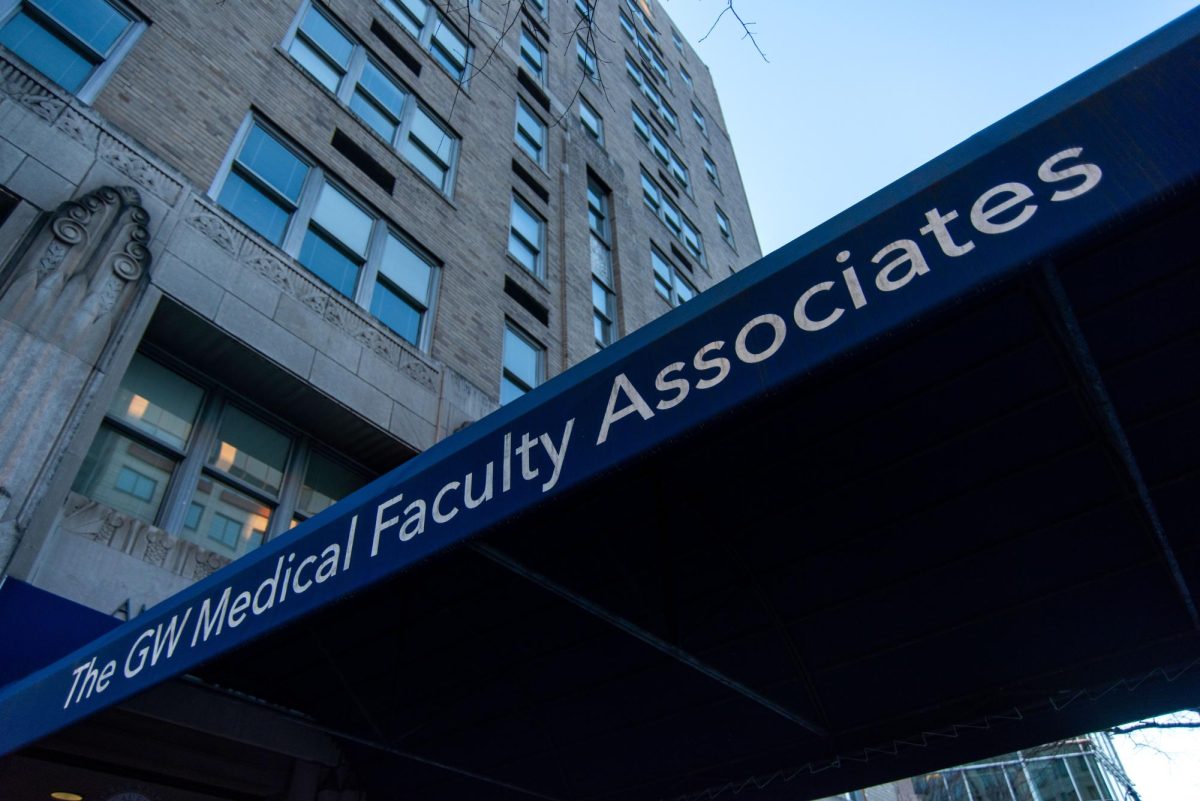
GW announced they reached an agreement with Universal Health Services to transition the Medical Faculty Associates’ clinical operations to a new nonprofit physician group and to cap the University’s financial support for the practice after years of continued losses.
Officials said in a release GW will provide up to $230 million over the next five years to support the MFA’s transition to nonprofit physician practice group Capital Medical Group – which will directly hire the “majority” of MFA employees – and absorb prior loans made to the MFA, which amounted $444 million to GW and other lenders at the end of fiscal year 2025. The deal, which came after months of negotiations between the parties to combat the practice’s continued losses, stipulates that UHS will take over full financial responsibility for clinical practice operations for GW Hospital, Cedar Hill Regional Medical Center and affiliated outpatient sites after a transition period of five years, with most MFA physicians transitioning to the new Capital Medical Group and retaining their faculty appointments at the School of Medicine and Health Sciences.
“Today’s agreement is an important step forward for GW and the communities we serve,” University President Ellen Granberg said in a release. “It successfully safeguards the School of Medicine and Health Sciences’ missions of high-quality education and research, while providing for the funding and delivery of physician services at GW Hospital.”
The deal, which came after former SMHS Dean Barbara Bass projected in November an April 1 transition date for the MFA, provides a framework to eventually end GW’s financial support to the practice after years of what Granberg referred to as “unsustainable” financial losses. The MFA lost more than $100 million in FY2025, marking six consecutive years of losses — $107 million in FY2024, $78 million in FY2023, $78 million in FY2022, $48 million in FY2021 and $43 million in FY2020.
The deal also reverses then-University President Thomas LeBlanc’s 2018 move to bring the MFA — which previously operated as an independent entity — under its governance, giving the University control over its budget and leadership. LeBlanc touted the move as an effort to strengthen SMHS’ national ranking.
Under the deal, Capital Medical Group will provide clinical services to GW Hospital, Cedar Hill and affiliated outpatient sites and occupy many of the locations, including in Foggy Bottom, that the MFA currently operates out of.
GW reached a preliminary agreement with UHS in October 2025 to co-fund the MFA – reducing the University’s financial support by 50 percent – as the medical enterprise marked its sixth consecutive year of losses in FY2025, losing more than a total $450 million over the past six years – according to the University’s annual financial reports. Granberg said in her release officials decided to cut financial support for the MFA after they concluded the current framework for the practice was no longer sustainable for the University.
“The underlying math simply wasn’t working,” Granberg said. “Despite efficiencies MFA put in place, there was a significant and persistent shortfall between what it cost to provide physician services and the revenue MFA received for those services under the existing structure.”
A University spokesperson said the MFA will begin the “wind down process” after the deal closes this summer, but did not specify if that means the practice will be dissolved. The spokesperson did not clarify what the deal’s five-year renewable terms of the agreement includes and declined to comment on whether GW and UHS will have to return to the negotiating table in five years. The release states after five years, UHS will become fully financially responsible for all clinical practice operations, while MFA physicians hired by Capital Medical Group will retain their SMHS faculty positions.
“Moving forward, GW will no longer be faced with uncapped costs associated with clinical care delivery” Granberg said in a separate release.
The release said the University will continue to sponsor and accredit graduate medical education programs for residents and fellows at SMHS, with GW Hospital continuing to serve as the primary clinical site for GW residents and fellows. GW will also financially support MFA team members and patients not moving to Capital Medical Group in their transition to other services.
The spokesperson said while they expect Capital Medical Group to employ the majority of MFA physicians and staff, some parts of the MFA will not transition into the new group. For those individuals, the affected MFA employees will receive notice, severance pay, benefits continuation and outplacement support, the spokesperson said. The spokesperson and the release also did not specify how many MFA physicians and staff the Capital Medical Group plans to hire.
The spokesperson said prior to closing a deal GW, UHS, MFA and other parties will work on a transition plan for the transfer of patients from the MFA to Capital Medical Group.
“For nearly three decades, MFA physicians and staff have delivered exceptional care to patients across the Washington, D.C. region while training the next generation of physicians and advancing clinical research at one of the nation’s leading academic medical centers,” MFA CEO Bill Elliott said in a UHS release. “This agreement was designed with patients and the continuity of high-quality care at the forefront.”
The spokesperson said GW will incur additional costs in addition to officials’ guarantee of up to $230 million over the next five years to financially support the transition. They said the funds are related to the “orderly transition of functions” that will not move to Capital Medical Group, however the final amount will depend on staffing numbers and other factors.
“This is GW’s investment in the medical education and research at SMHS, the future of healthcare for the District of Columbia, and the support of physicians, advanced medical providers, and staff transitioning to Capital Medical Group,” the spokesperson said in an email.
Officials said in the release GW is committed to promote health equity and improved health outcomes in Wards 7 and 8 through continued care at Cedar Hill. Residents of Wards 7 and 8 have reported persistent long wait times, diverted care and subpar experience at Cedar Hill hospital – a $434 million facility in Ward 8 staffed by MFA physicians and operated by UHS – which D.C. leaders linked to uncertainty surrounding GW’s negotiations with UHS over the MFA. Deputy Mayor for Health and Human Services Wayne Turnage said in February that GW-UHS negotiations slowed workforce buildout on the hospital’s outpatient side, resulting in staffing shortages.
“We also believe this transaction will help speed the growth of medical inpatient and outpatient services at Cedar Hill Regional Medical Center, including the addition of community doctors,” GW Hospital Chief Executive Officer Jason Barrett said in a UHS release. “We remain wholly committed to providing high-quality care across a broad range of service lines to best serve patients.”
Officials said in the release the University and UHS are currently developing policies, procedures and access needed for SMHS faculty and students to continue conducting research at GW Hospital and affiliated outpatient sites. They said GW and UHS will continue to work together until the transaction closes this summer to ensure a smooth transition.
The spokesperson said MFA clinicians moving to Capital Medical Group will retain their faculty appointments at SMHS and will continue to provide instruction and training to students and engage in research at the school.
The spokesperson said GW will continue to fund education activities and will continue to conduct medical research sponsored by the federal government, industry and other non-UHS sites. They said officials are working with UHS to develop new policies, procedures and access needed to continue conducting research at GW Hospital and affiliated outpatient sites.
The MFA’s professional education arm has been the only arm of the MFA to turn a profit between fiscal years 2022 and 2024, bringing in $7.3 million in FY2024.
“This agreement establishes a sustainable structure for clinical and academic operations—securing stable training sites, strengthening the learning environment and reinforcing our commitment to excellence in academic medicine,” the spokesperson said.
Granberg said in a separate release officials achieved all three of their goals for the negotiations, which included limiting disruptions to patient care, maintaining SMHS’s academic and research enterprise and providing the University with greater financial certainty. She said the agreement with UHS had trade-offs, although she did not specify what they were.
“What mattered to me is that we reached an outcome that protects the people and the missions we are responsible for and that positions GW well for the future,” Granberg said in her release.
Officials outlined the creation of a new physician group in April. Officials said in their April update they will terminate current agreements between UHS and GW regarding licensing, clinical operations and research at Cedar Hill and compensate UHS-affiliated faculty practice groups for teaching, with both GW and UHS collaborating with department and clinical chairs to allocate clinical and academic responsibilities.
The final agreement follows a series of negotiation delays after Chief Financial Bruno Fernandes told the Staff Council in December that the process was not going as quickly as officials anticipated because of “concerns in terms of physicians.”
The spokesperson said GW and MFA consulted a “variety of internal stakeholders,” however did not specify who those stakeholders were. They said GW and MFA also independently considered multiple scenarios for meeting their objectives and that this agreement reflects the path all parties could agree on.