
Elliott School of International Affairs graduation speakers encouraged students to look for solutions to the “disruption” in the world today and emphasized the importance of international cooperation at the school’s ceremony in the Smith Center Friday.
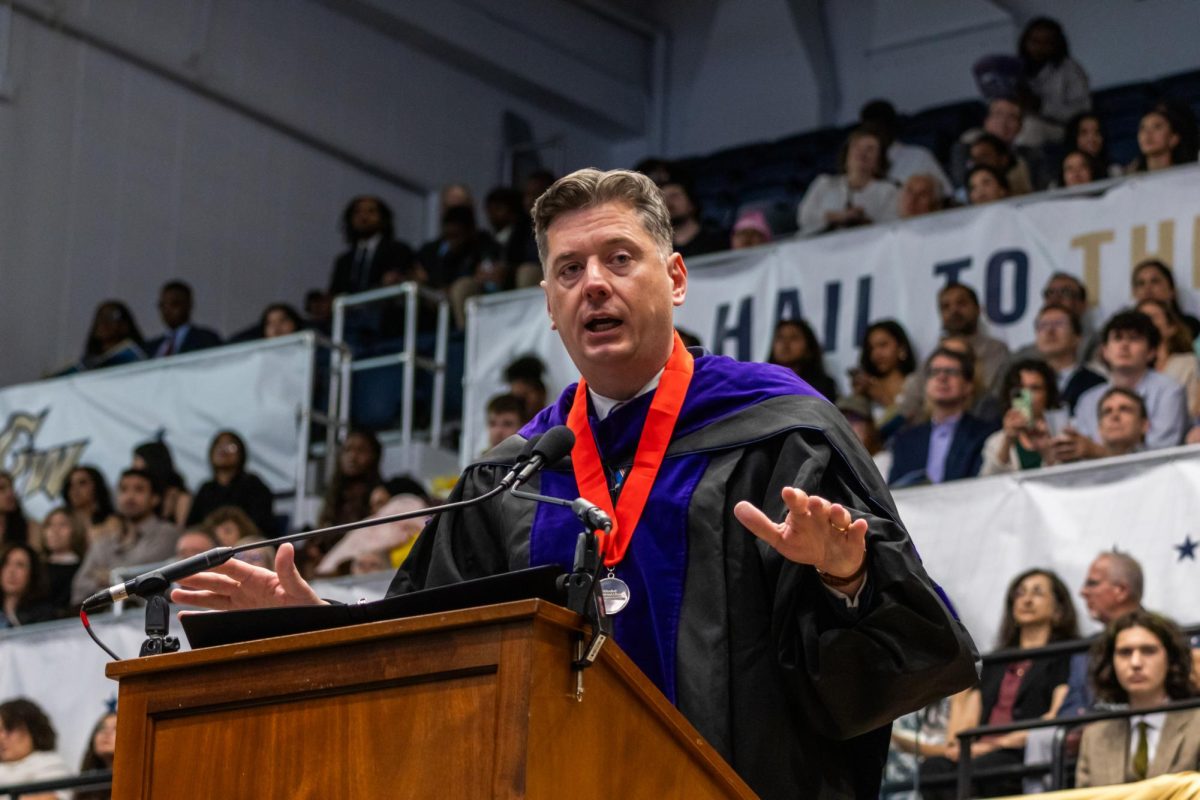
Oklahoma City Mayor David Holt, the ceremony’s keynote speaker, told graduates to uphold their beliefs by being their own ambassadors, even when their government’s policies don’t reflect them. Holt, a 2001 graduate of the Columbian College of Arts & Sciences, told students that “all paths” are open to them, and while the graduates’ futures will look different from his own, they will be limitless in potential.
Holt played a clip of a song from the jazz musical “The Real Ambassadors” by Dave and Iola Brubeck, which was written during the U.S. civil rights movement, saying the song’s lyrics encourage graduates to represent themselves and their identities, even when governmental policy doesn’t always align with their beliefs.
“We are building our own relationships, our own economic partnerships and invest in our own view, independent of our governments,” Holt said.
Holt told students that George Washington’s words about isolationism from his farewell address are often misconstrued to support a specific issue, and that his warnings against permanent international alliances are not so broad as to call for completely eliminating international cooperation.
“The depth and breadth of our modern interconnectedness is distinct beyond comprehension,” Holt said.
Student speaker Bella Burtin, who earned a bachelor of science in international affairs, told graduates that there is a shared sense of responsibility to address the struggles seen around the world, like political division, injustice and abuse of power, with them all sharing responsibility for effecting that change.
“We share a belief that the world can be better, and that we bear responsibility to help,” Burtin said.
Burtin said success is often seen as chasing a prestigious job or debating what looks best on a resume, but that is not the kind of success their idols pursued, with their legacies measured not in titles but in the lives they were able to touch. She said true change requires a daily effort and for those who feel their sacrifices have gone unnoticed, this is their moment of recognition.
“We cannot control anything outside of ourselves, our voice, our vote and our service to others,” Burtin said. “It is from these small steps that the world has been changed before, and that the world will change again.”
Elliott School Dean Alyssa Ayres said graduates are entering a world of “disruption and uncertainty” with many assumptions of the global world order undergoing revision. She said the world is witnessing a “transformation” with new questions about how the United States engages with nations around the globe.
She said graduates are prepared for whatever comes next because they have already faced disruption from the COVID-19 pandemic and adapted to a changing world.
“Each of you has reached this stage having already overcome the profound disruption of the pandemic, and you are already navigating a world of tumultuous disruption as an inherent part of the global environment,” Ayres said.
Ayres presented the Harry Harding Teaching Prize, given to a faculty member who has displayed sustained excellence in teaching, to Scott Pace, a professor of the practice of international affairs and director of the Space Policy Institute.