
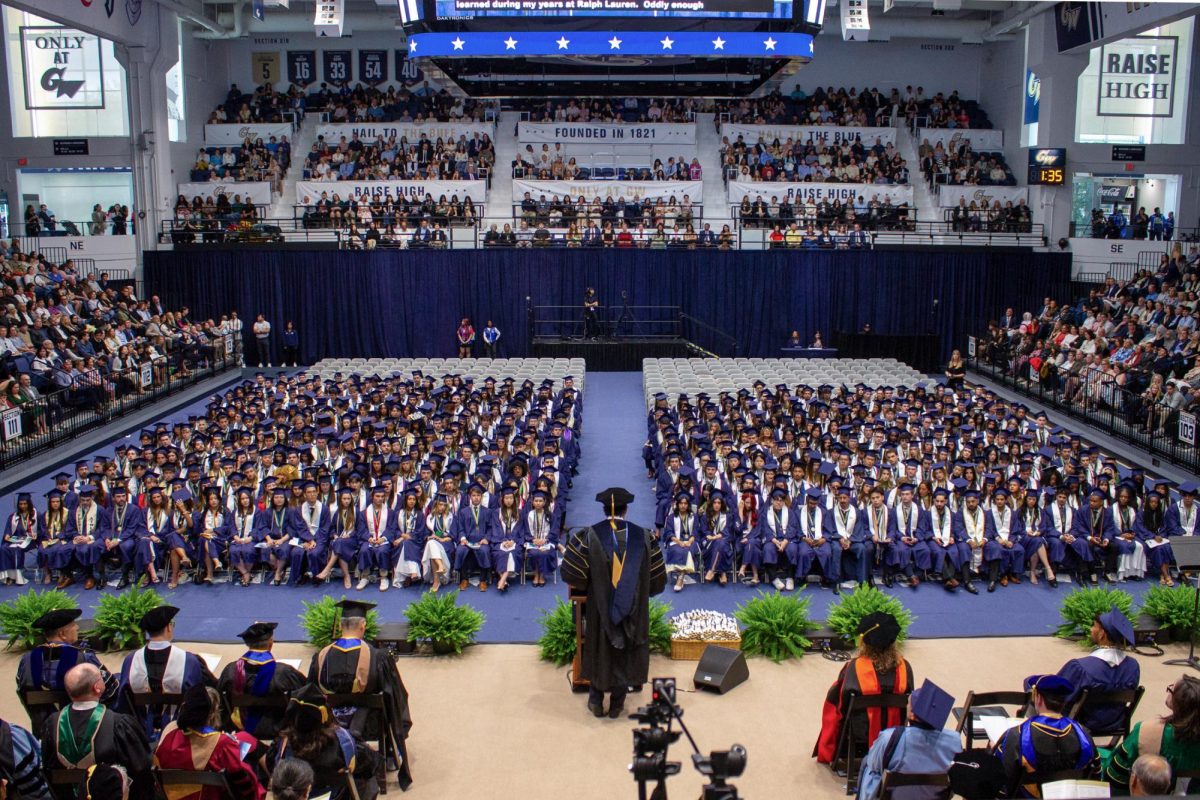
A public health executive urged students to remember to exercise their humanity when serving others at the Milken Institute School of Public Health’s graduation celebration Thursday.
Joneigh S. Khaldun, president and CEO of the Public Health Accreditation Board, the national non-profit accreditation body for public health departments in the U.S., told the 1100 graduates that public health work requires persistence, compassion and a willingness to “be of use” even during periods of uncertainty and political backlash against the field. She reflected on her career in emergency medicine and public health leadership, including helping lead Michigan’s COVID-19 response as chief medical executive, saying public health professionals are trained to confront difficult societal challenges and improve systems that leave certain people behind.
Khaldun told students public health work extends beyond policy and medicine, arguing that improving health outcomes also requires empathy, dignity and community support. She encouraged students to focus on making meaningful differences in their own communities rather than becoming discouraged by large-scale societal challenges.
“If you focus on the opportunities to improve the world within your reach, slowly and steadily, you will make a meaningful difference over time,” she said. “And best of all, usefulness spreads from person to person.”
Kelly Gebo, who is concluding her first academic year as Milken’s dean, told students they were entering a public health field that needs their voice, skills and heart, praising students for their research, advocacy and community work throughout their time at GW. She said graduates’ commitments to issues like health disparities, social justice and global health while at GW reflected the school’s mission and would prepare them to make meaningful impacts in their careers.
“I am absolutely confident that each of you will make a positive impact wherever your journey leads from here,” she said. “The world needs what you have to offer and I want you to leave here knowing that.”
Gebo also thanked the Milken faculty members for mentoring students and contributing to research and policies that improve public health outcomes around the world. She said faculty members played a central role in preparing graduates to enter the workforce and lead in the field.
“Many of you are leaders in public health who have shaped institutions, developed life-saving policies and programs and conducted research that has improved lives across the globe,” she said. “Our graduates are walking into the world tonight because of the foundation you have built for them.”
Lily Cai Kuivila, the student speaker and master’s of public health graduate, compared the current state of public health to solving a Rubik’s Cube, saying progress often comes through various small actions rather than one big solution.
“There is no single, fix-all intervention, she said. “Global health problems can’t be solved with a loan, summit or million dollar grant. No policy can, by itself, repair every broken system; instead, progress is made through small, intentional actions that accumulate over time.”
Matthew Lubman, a master’s of health administration graduate, presented excellence in teaching awards to Gabby Headrick, Wayne Psek and Jane Hyatt Thorpe. Gebo also presented student awards, honoring Christine M. St. Pierre with the Milken Distinguished Scholar Award and Rhea Turner with the Milken Dean’s Award.