

Student Government Association presidential and vice presidential candidates clashed over how to hold University officials accountable over budget cuts, diversity, equity and inclusion rollbacks and rising tuition costs at a debate Wednesday night.
More than 250 students gathered in the University Student Center Grand Ballroom ahead of the SGA’s Thursday and Friday elections to hear candidates outline their plans to boost transparency from University officials about their response to federal policies impacting students, increase students’ say in budget cuts, reform the culture of the SGA and respond to rising tuition costs. Candidates promised to hold officials accountable by presenting a united front of students and other governing bodies to administration and continuously make efforts to center student voices in their policy proposals and advocacy.
Elijah Edwards, The Hatchet’s student government editor, moderated the debate. Here are the highlights:
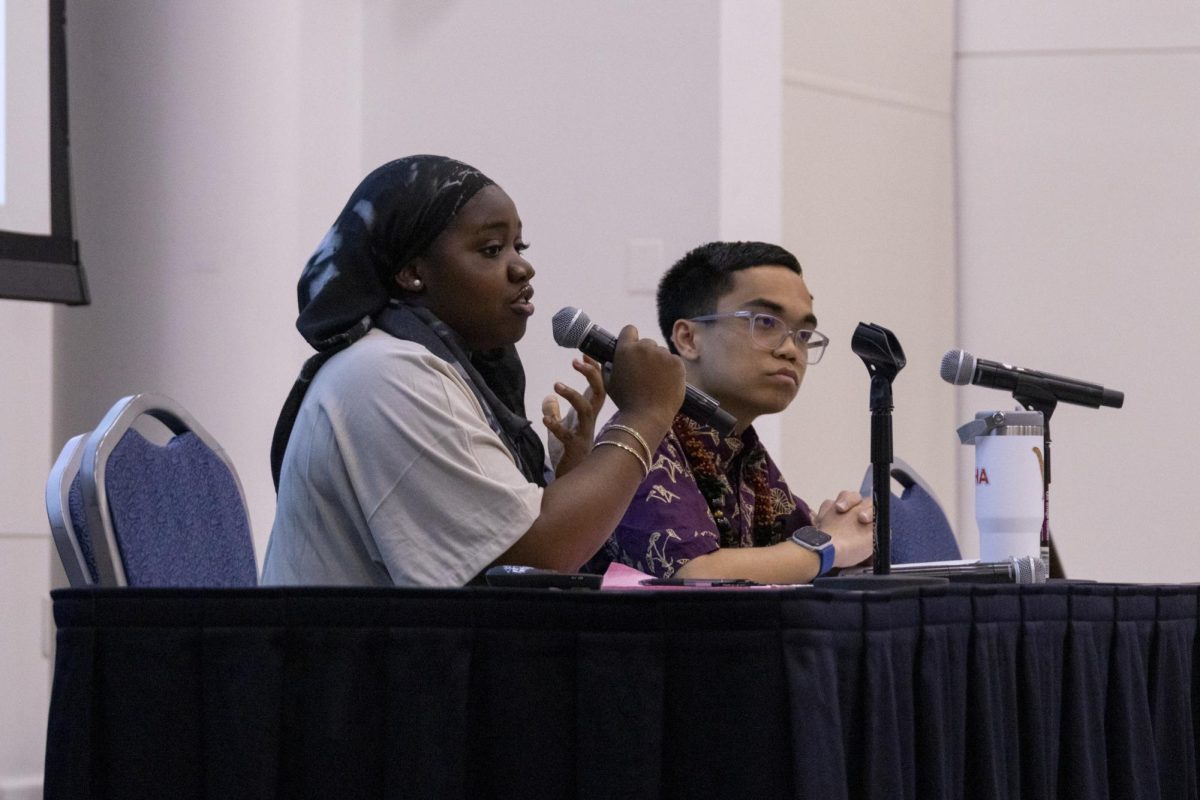
Vice Presidential Debate
The two vice presidential candidates, Cheydon Naleimaile-Evangelista and Aicha Sy, discussed their plans to pressure officials to reverse cuts to student services and increase the SGA’s engagement with students, which they said the body has been disconnected from over the past year.
Both candidates said the lack of widespread student participation in the SGA and disconnect between the SGA’s executive and legislative branches were key concerns they would address by increasing communication between the SGA’s branches, students and administration and the SGA and students.
Aicha Sy, a current Columbian College of Arts & Sciences senator and chair of the SGA Community, Advocacy and Inclusion Committee, said she wanted to include the general student body in the SGA’s decision-making processes by creating a policy-writing office where students could partner with senators to write legislation and communicating frequently to the student body about SGA progress. She also said she would push for more direct communication between administration and students about pressures facing the University from the federal government to internal budget issues.
“I believe transparency isn’t difficult to achieve,” Sy said. “Transparency comes from conversations, it comes from information and it comes from informing the students on this campus.”
Cheydon Naleimaile-Evangelista, a current CCAS senator, chair of the Finance Committee and former chair of the Student Life Committee, said he felt confident he could accomplish his policy goals, which include mandating professors to release syllabi a week before the start of classes and extending dining hours, because he’s seen officials meet student needs before when pressured.
“Nothing’s ever unrealistic,” Naleimaile-Evangelista said. “When it came to last semester, it was very unrealistic to cut down tuition to $0 for students making under $100,000, but just today, that was proven to be wrong. Of course, I would work with admin. Of course, I would pressure admin when it comes to ensuring the policies I want to implement are implemented.”
Naleimaile-Evangelista said he was proud both vice presidential candidates were people of color in a predominantly white institution and said the SGA’s Finance Committee could embrace cultural diversity in student organizations by favoring cultural events when allocating SGA funds.
Sy said as vice president she would continue meeting with student organizations she connected with during the campaign, involving them in SGA decision-making rather than only engaging with them during election season. She said she would also push for all members of the Finance Committee to attend student organizations’ events they fund, to make student organizations feel valued and heard by the SGA.
“I think no changes should be made without the input of the general student body,” Sy said. “You all should not be limited to campaigning period, you should not be over spoken to during campaigning period, and I’m ready to involve these students into those conversations, and that begins with reaching out to them.”
Presidential Debate
The three presidential candidates, juniors Liz Stoddard and Alfred Lewis Jr. and sophomore MJ Childs, largely agreed on problems facing GW students, like cuts to student services amid rising tuition rates and federal pressure stemming from President Donald Trump’s administration, but sparred over how they would address them with University leadership and what experience best qualifies them to lead the SGA.
All three candidates said University leadership too often leaves students out of major decisions, including budget cuts over the last year, which have manifested themselves in nearly every corner of campus, and vowed to work with officials to reverse the cuts, increase student involvement in budgetary decisions and be more transparent with students about their communications with officials.
Stoddard, the SGA’s current vice president, said her record of delivering concrete results for students demonstrates a commitment to closing a gap between administration and students. She said as president she would work to continue advocacy efforts to halt cuts, suggesting places where administrators could cut other underutilized services and publishing detailed reports of advocacy meetings with administrators for the student body to view.
“On this stage with a proven record and a plan, I’m strong, I’m relentless, and I do not back down because we need to make sure that student interest becomes the University’s priority,” Stoddard said.
Childs said the University’s rising tuition has not coincided with improvements to student life, pointing to dining establishments in District House and the USC remaining closed on weekends and the Student Health Center seeing reduced resources. He said as president he would push the Board of Trustees to establish a student life committee where Board members regularly engage with students on campus.
“Here lies the bigger question, where were our voices in those conference rooms when all this was being decided?” Childs said. “Students deserve to go to a university that uplifts all voices in the room.”
Lewis said as a transfer student, he has spent his first semester at GW asking officials direct questions about where tuition money is going and why costs keep rising. He said most students at the University do not pay the “sticker price” and instead receive some type of financial aid, and there seems to be a “line of miscommunication” between students and administrators about the cost of attendance and how they spend tuition dollars.
“So we hear questions like, ‘Where’s my $100k?’” Lewis said. “The question we really need to ask is, ‘Are you paying that $100k?’”
All three candidates said if elected they would push back on the University’s alleged rollback of DEI initiatives this academic year, including its decision to halt the national search for a vice provost to lead the Office of Diversity, Equity and Community Engagement, a position which has sat vacant for more than 20 months.
Stoddard said the University’s decision to strip DEI language from websites, including GW Law and the Elliott School of International Affairs, demonstrated institutional “cowardice” from administrators, who she said made the moves to yield to federal pressure from Trump’s directives to eliminate DEI at universities. She added that as vice president she has pushed officials to restart the search for a permanent leader of ODECE.
“The University has absolutely chosen the Trump administration over students, and it shows because we leave our DEI at the door, that means we leave our values at the door,” Stoddard said.
Childs said he would immediately call on officials to restart the vice provost search and establish a coalition for “student inclusivity” — a working group that would bring together representatives from multicultural organizations, advocacy groups and political groups to discuss how to “foster” DEI on campus. He said he already has relationships with ODECE officials who have expressed support for the initiative.
“I absolutely would push back on officials and their decisions to roll back on DEI,” Childs said.
Lewis said he questioned whether the University’s DEI efforts were actually working or effective prior to their alleged rollbacks. He said he has heard student organizations complain that they do not receive their full requested amounts of funding from the SGA, which indicates to him that equity on campus is still lacking.
“DEI should not be a sticker or a phrase where we use to fit in with the group, but it must mean real social impactful change, and I plan to bring that,” Lewis said.
Stoddard said the SGA cannot fight federal overreach from the Trump administration alone and must “link arms” with other governing bodies at GW, like the Faculty Senate, Staff Council and Student Bar Association to present a unified message to administrators, work she said she has done in her role as vice president by building relationships with faculty senators and collaborating with the SBA to pass a resolution criticizing administrators’ response to Immigration and Customs Enforcement operations near campus.
“I think it’s about time that we stand up and say something, and we link arms with other people who are having the exact same problems, and we have because we’re only stronger when we’re together,” Stoddard said.
Childs said GW has quietly signed letters condemning the Trump administration — including one University President Ellen Granberg signed last April that criticized “undue” government intrusion into higher education — but officials do a poor job of communicating those efforts to students. He said officials should be more open about their efforts by holding public meetings with students and including them in decision-making conversations about how the University is responding to federal pressure.
“We need to call on our university to be more honest and open about what they are doing in relation to the Trump administration,” Childs said.
Lewis said the SGA has expected students to come to it rather than seek out students’ perspectives. He said he has built his campaign around “amplifying” student voices and would attempt to reverse that trend as president, seeking out student organizations and student perspectives on the SGA instead of expecting students to come to the body to affect change.
“SGA cannot be a place where we are expecting people to come to us, but it must be a place we’re bringing community to them,” Lewis said.