

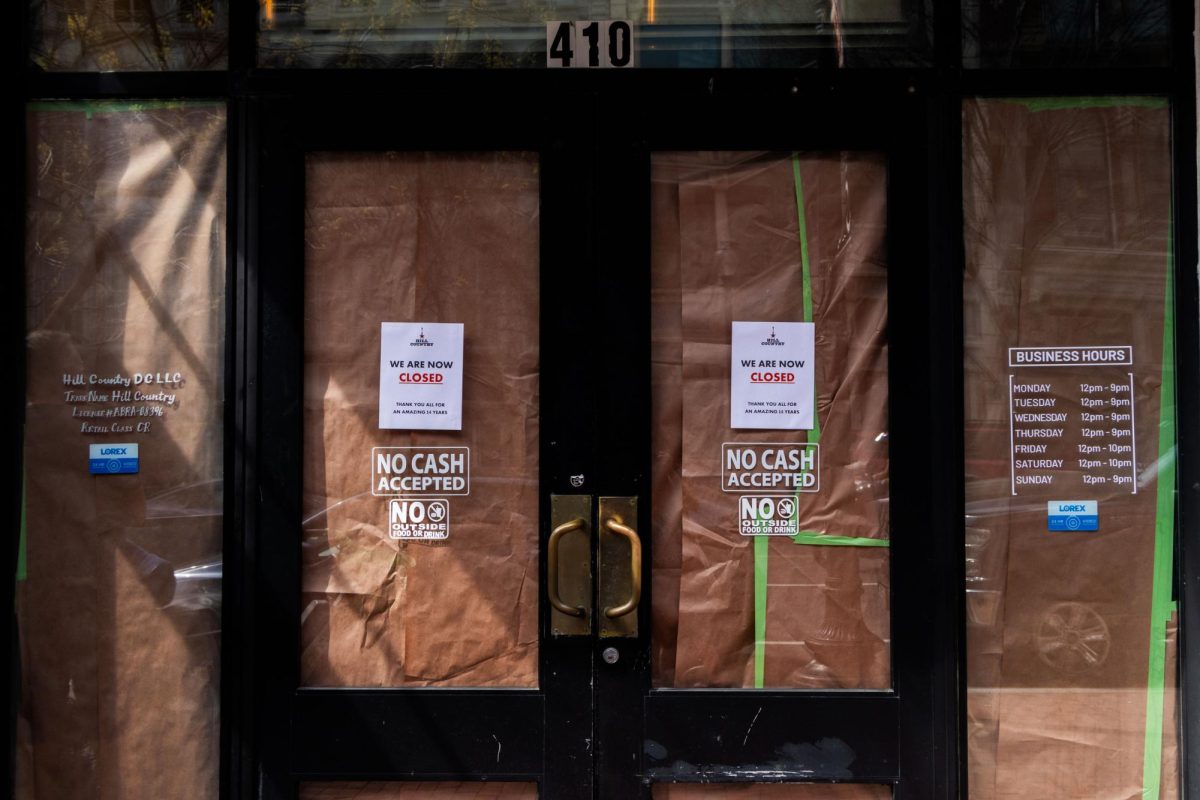
Restaurant closures in D.C. jumped roughly 39 percent in 2025, according to the Restaurant Association of Metropolitan Washington, as Foggy Bottom eateries faced declining sales and rising costs amid federal workforce layoffs and a rising tipped minimum wage.
A RAMW report released this month found 54 percent of the association’s more than 600 member restaurants in D.C. made lower sales compared to 2024, with mid-priced restaurants — establishments costing $21-$40 per person — affected most severely, averaging 21 percent sales decreases compared to 9 percent in upscale restaurants and making up 67 percent of D.C. restaurant closures. Foggy Bottom restaurant owners said the government shutdown, rising service costs and higher tipped wages throughout the District hurt business industrywide last year, which experts in the service industry said hit mid-priced restaurants the hardest because they can’t offer the low prices of fast-casual eateries or the dining experience of more upscale restaurants.
“Policies that drive up costs and reduce consumer spending are falling hardest on mid-priced restaurants,” RAMW CEO and President Shawn Townsend said in the report. “These are the neighborhood restaurants that anchor communities and economies — and they are disappearing.”
Restaurants in Foggy Bottom say they saw lower sales in 2025 as a 43-day government shutdown decreased their patronage from federal workers and the deployment of the National Guard caused many D.C. residents to stay home. Increasing food prices due to President Donald Trump’s tariff policies and rising service costs associated with higher tipped minimum wage also strained restaurants as they tried to appeal to customers gravitating toward more budget-friendly options.
Jeremy Pollok, owner of Foggy Bottom’s Tonic at Quigley’s, said steadily rising costs of goods and labor in D.C. due to inflation have put pressure on already thin profit margins. He said in 2025, Trump’s August tariffs on goods, like beef, raised food prices, while the 43-day government shutdown last October and the layoffs of 317,000 federal workers last year decreased the number of government workers and tourists in the neighborhood eating at local restaurants, creating a combination of pressures on his business.
Pollok said his business saw a 15 percent decrease in revenue in 2025, which he attributed in part to the National Guard deployment in the District starting last August. He said the troops’ presence caused uncertainty in consumers about politics and the economy, with the effects still ongoing.
“Just having so much uncertainty makes things volatile, and when people are uncertain, they start spending less money and the discretionary stuff goes away first — eating out, going to shows — and all that has impact,” Pollok said.
102 D.C. restaurants closed in 2025 — including Foggy Bottom’s Poppabox and Ristorante La Perla — more than double the number in 2022, continuing a trend of heightened closures over the last three years, according to the RAMW report.
As a mid-priced restaurant owner, Pollok said he’s struggled to maintain an affordable menu that attracts customers increasingly conscious of price while continuing to serve quality food. Pollok said he would no longer consider opening a restaurant in D.C. because of the uncertainty surrounding Initiative 82, raising tipped minimum wage in the city and a new initiative introduced by a coalition of labor advocates in December that could raise the minimum wage to $25.
Initiative 82, which the D.C. Council passed in November 2022 and many D.C. restaurants opposed, raises the tipped minimum wage biannually until it reaches the regular minimum wage of $17.95. As a result, Foggy Bottom restaurant owners have had to add service fees and lay off workers due to the initiative stretching their budgets.
The D.C. Council pared back the initiative in July by scrapping the initiative’s original timeline, keeping the tipped wage at $10 through July 2026 and increasing the value every two years until it reaches 75 percent of the minimum wage in 2034. Businesses said this relief was minimal as they still had to cut staff and swap premium ingredients for cheaper ones due to tariffs and inflation.
Kathryn Velazquez, a lecturing instructor of hospitality and service management at The Culinary Institute of America, said modern consumers nationwide are gravitating toward more “wallet-friendly” options and decreasing how much they eat out as inflation drives up the cost of travel and menu items, which hurts restaurants.
“Dining frequency has declined,” Velazquez said. “Consumers are more likely to reserve restaurant visits for weekends or special occasions rather than multiple nights throughout the week.”
Velazquez said diners tend to focus on affordability, which fast-casual restaurants do best, or experience, satisfied by premium dining options, leaving mid-priced casual restaurants to occupy a “disappearing space.”
The share of more upscale and fine dining restaurants opening in D.C. — 33 percent in 2025 — rose 10 percent since 2022, according to RAMW, a trend Velazquez said could be attributed to upscale and fine dining establishments relying on affluent clientele less sensitive to increasing prices.
Fast-casual and limited-service restaurants led all segments in sales performance across the District, with 44 percent reporting growth and 33 percent saying they saw increased foot traffic, according to RAMW.
Velazquez said that to counter declining consumer interest, mid-priced restaurants should focus on attracting neighborhood residents and consider diversifying or marketing their business in ways that weren’t necessary in previous years.
Mounir Bouzuita, the owner of Tazza Cafe, a mid-priced restaurant in Foggy Bottom located directly across from the Kennedy Center, said while the end of 2025 and 2026 so far have been the hardest years of operation because the Kennedy Center’s cancellations and impending two-year closure this summer are causing an overall decline in sales, residents from the Watergate building have been supporting Tazza.
“They try to help us and to support us and come for dinner or for lunch, at least one time a day, so it helps,” Bouzuita said. “Honestly, they try to help us because they want us to stay here.”
Bouzuita said Tazza relied mainly on the center’s employees, guests and dinner rushes before shows, which made around 75 percent of the restaurant’s profits. To compensate, he has started advertising deals and specials on social media, he said, and he’s noticed an increase in Columbia Plaza residents, another nearby apartment complex, coming because of the online marketing.
George Hajjar, a reporter and special projects editor for The Food Institute, said as inflation rates cause the price of eating out to outpace the cost of dining in, lower and middle-income diners are less likely to eat out. Hajjar said restaurant owners need to find ways to make their prices attractive if they want to continue operating.
“Good restaurants must also be good businesses,” Hajjar said. “The ones that succeed will be able to entice consumers and maintain healthy foot traffic while also ensuring a favorable cost per plate ratio after factoring in cost of goods sold.”
122 dining establishments opened last year, 21 percent less than the previous year, according to the report. Juliann Francis, the CEO of Captain Cookie and the Milkman, said D.C. needs to make policy changes, like reducing taxes on small businesses, if the city wants to see restaurant openings increase.
“If D.C. wants to support its city in terms of positive outcomes for people who live here, people who work here, people who study here and go to school here, making a supportive business environment where it makes sense for businesses to be there in the first place has got to be the goal,” Francis said.


