
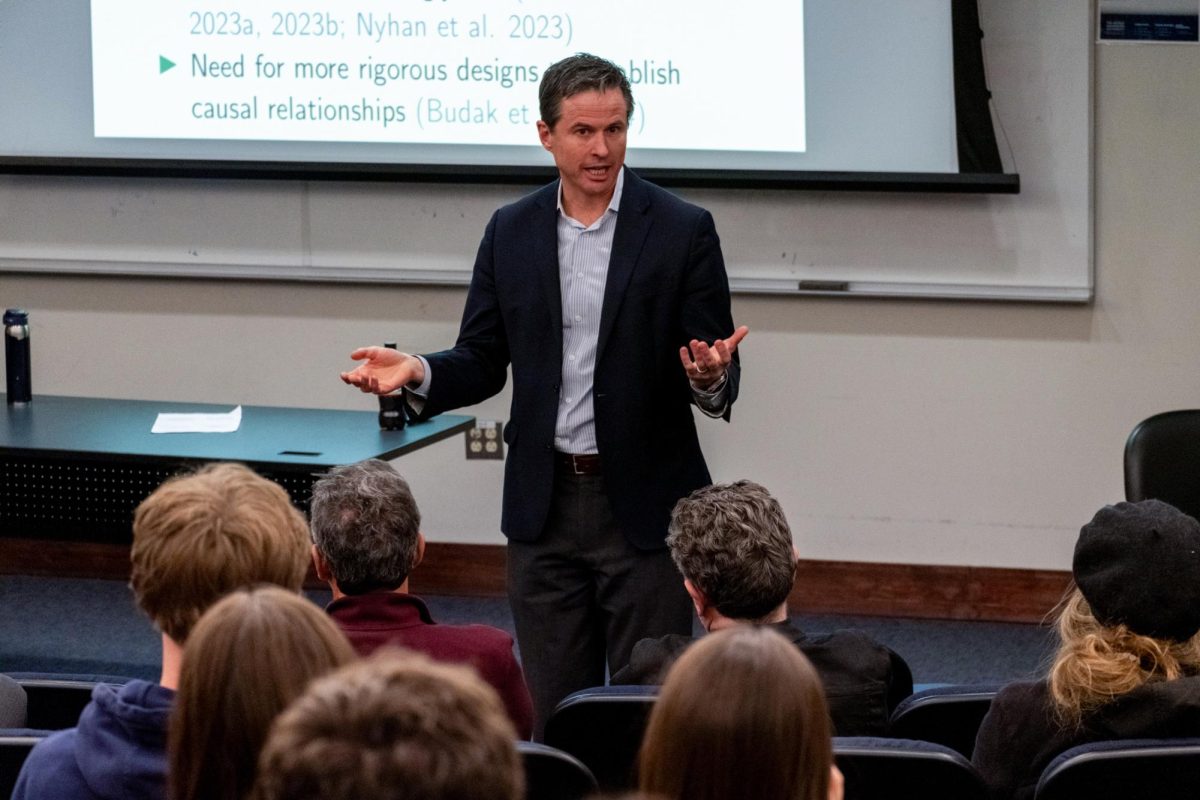
A political scientist debunked four common myths about misinformation and its effects on public opinion at an event at the School of Media and Public Affairs Wednesday.
Brendan Nyhan, a professor of government at Dartmouth College, said misinformation is often overstated in public discourse, and research shows its effects on political behavior are more limited and concentrated than many commonly believe. Nyhan spoke after receiving the 2026 Robert M. Entman Award in Democracy and Political Communication, an honor created by SMPA recognizing scholars who have made contributions to the understanding of political communication and the health of democracy.
Nyhan said many Americans, commentators and policymakers misinterpret the nature of misinformation, often focusing too much on what people don’t know rather than what they believe incorrectly. He said early political research framed the public as either informed or uninformed, but more recent work shows a more complicated problem — that people are misinformed, not uninformed.
“The problem, then, is not that people simply lack information,” Nyhan said. “But they firmly hold the wrong information.”
Nyhan said he broadly defines misinformation as “false or unsupported” claims and that the key issue in evaluating public understanding of politics is whether people believe those claims. He said researchers rely on expert consensus and credible evidence — like government agencies and scientific bodies — to evaluate the “best approximation” of what is true and what counts as misinformation, while acknowledging that knowledge can evolve and experts are not immune to making mistakes.
He said public discussions frequently exaggerate the extent to which Americans are trapped in ideological echo chambers, pointing to data showing that most people consume a mix of information from sources across the political spectrum. He said while strongly partisan media diets do exist, they are concentrated among a relatively small group of highly engaged individuals.
“Actually, highly slanted information diets are quite rare, the kinds of the stylized model of the echo chamber is really an aberration,” Nyhan said. “Most people’s information diets don’t look like that.”
Nyhan said the misconception persists in part because the most politically engaged people — who tend to have the strongest views — also consume the most news and dominate public conversations. He said, as a result, their behavior can make polarization appear more widespread than it is across the broader population.
Nyhan said similar misunderstandings apply to the spread of false and extreme content on the internet and social media, which many people assume is pervasive. He said research using digital behavior data shows that while some Americans do encounter untrustworthy sources, those sources make up only a small share of overall news consumption.
He said he found in a study exmining patterns of extreme video content consumption that 1.7 percent of the users in the study were responsible for 80 percent of the time spent on alternative video channels.
“Very small percentages of folks are responsible for the vast majority of the exposure that we see,” Nyhan said.
Nyhan said claims that social media is a primary driver of political polarization often rely on assumptions rather than strong causal evidence. He said many studies that attempt to isolate the effects of platforms like Facebook show little to no impact on users’ political attitudes when they reduce their exposure to content on the platforms.
“We simply don’t have as much evidence as you might intuit about the harms of social media in terms of political polarization,” Nyhan said.
Nyhan said people frequently attribute broader political dysfunction to social media because that is where they encounter visible examples of conflict and misinformation, leading to overstating the platforms’ role in causing those problems.
“In many cases, social media is where you’re encountering evidence of the problem, and in that way, the blame is being attributed to the platform on which you’re observing the social phenomenon in question,” Nyhan said.
He said early research, including his own, suggested that fact-checking could sometimes backfire, like when groups that might believe a false claim in question endorsed it more when they were exposed to corrective information compared to when they were not. He said subsequent studies have largely failed to replicate that effect, and the evidence now shows that corrective information generally improves people’s accuracy in the short term.
“It turns out that what we find instead is that when we expose people to the correct information, their beliefs tend to become a little more accurate,” he said.
Nyhan said the more significant challenge is that improvements to the accuracy of people’s beliefs through supplying corrective information rarely last, as people tend to revert to their original beliefs slowly over time. He said even repeated or more intensive efforts to provide accurate information have produced only modest and temporary effects.
“The puzzle, the dilemma is, how we make those effects last,” Nyhan said.
Nyhan said misinformation remains a serious concern, but he cautioned that overstating its reach or effects can lead to misguided conclusions. He said researchers need more evidence, particularly outside the United States and Western Europe, to fully understand how misinformation operates in different contexts and how exposure to it affects political beliefs.
“This isn’t the end, this is the starting point,” Nyhan said. “And it will be a real mistake to just think the problem is settled and we can stop paying attention.”
Isaac Harte contributed reporting.