
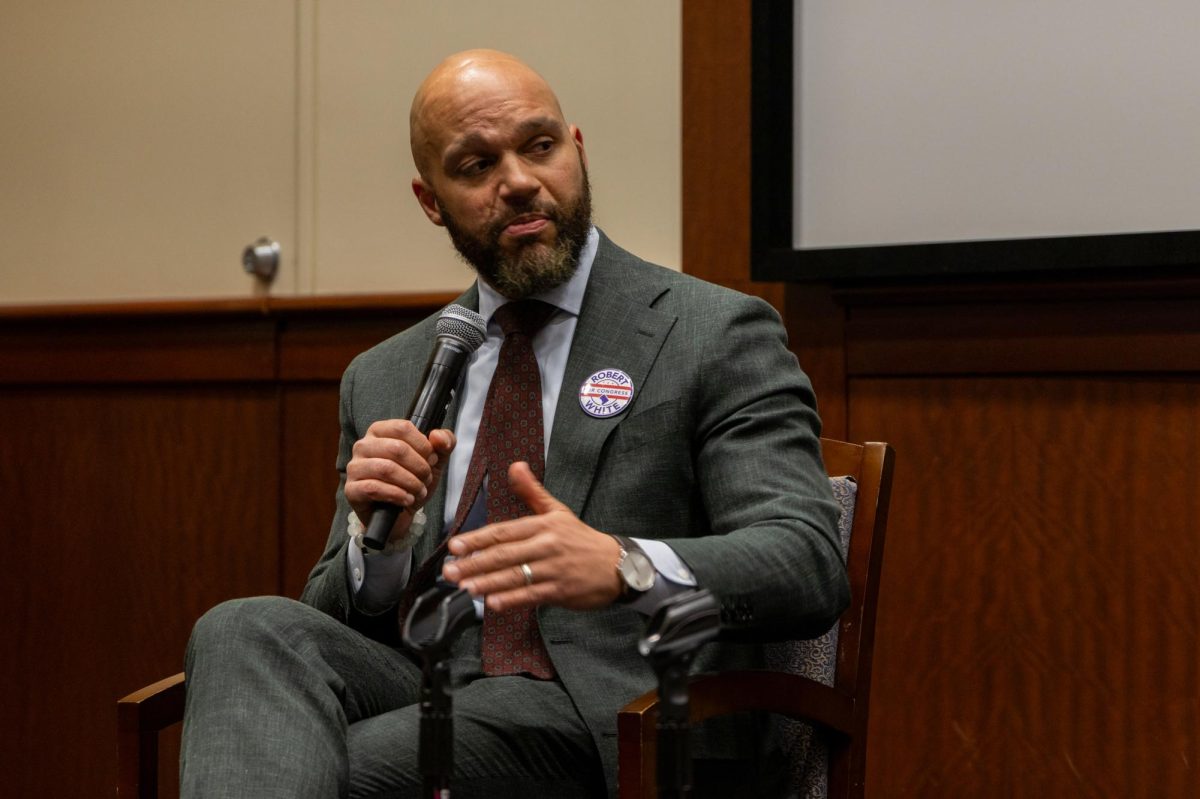
Two contenders to replace Eleanor Holmes Norton as D.C.’s nonvoting delegate to Congress laid out competing visions for how they would solve top issues facing District residents at a candidate forum in the University Student Center on Tuesday.
Democratic primary candidates Robert White, an at-large D.C. council member, and Kinney Zalesne, the former deputy national finance chair of the Democratic National Committee, shared their plans to achieve policy priorities if elected to Congress, like advocating for D.C. statehood and budget autonomy for the city and how they would navigate Capitol Hill as a representative with no formal vote. Ward 2 Councilmember Brooke Pinto, another candidate in the Democratic primary, who represents the ward encompassing GW’s campus, was scheduled to participate in the forum but did not attend due to travel issues caused by a delayed flight back to the District, according to the GW College Democrats, who organized the event.
“Councilmember Pinto regrets not being able to attend,” Drew Godinich, Pinto’s campaign manager, said in an email. “The campaign had a scheduling conflict that we communicated with the forum organizers several weeks ago.”
D.C. residents have elected a nonvoting delegate to the House of Representatives since 1971 who can sit on and cast votes in committees as well as introduce legislation in the House but cannot vote on any measures in the full House.
Norton, 88, a Democrat who has served as D.C.’s nonvoting delegate to Congress since 1991 and is only the second person ever to hold the role, filed to terminate her reelection campaign in January following months of skepticism about her ability to adequately represent the District during a period of unprecedented federal intervention into the city’s governance. Norton’s retirement means District residents will see the first competitive race for their representative in Congress in 35 years.
The winner of the June 16 primary will likely be elected in November due to D.C.’s overwhelmingly Democratic electorate.
Organizers originally formatted the event as a head-to-head debate but changed it to a series of “parallel discussions,” where each candidate spoke separately because candidates were not available at overlapping times Tuesday. The forum’s moderator, School of Media & Public Affairs Director Peter Loge, said he was “really disappointed” about the change in format.
“This should be a place for civil, honest, open debate,” Loge said. “One of the challenges we have in this country is the people who disagree, even strongly, can’t figure out a way to talk to each other about areas in which they agree or find agreement even when they disagree.”
White said if elected to Congress he would focus on building national support for D.C. statehood, arguing the issue must gather political support outside the District to gain traction on the Hill. He said Democrats across the country have an incentive to support statehood because it would add more Democratic members to the Senate, especially as states race to draw new congressional maps for 2026.
“D.C. becoming a state would be two Democratic senators, which would do more to preserve democracy and more to shift the balance of power for the next decade than any of these battles,” White said.
White said bipartisan support for D.C. priorities is unlikely in the current political climate, adding that Republicans will not back statehood efforts because it will disrupt the balance of power in the Senate and give Democrats better prospects at controlling the body. He said progress will require public pressure and a more aggressive approach from Democratic leadership if they regain power in Congress.
White, who chairs the D.C. Council’s housing committee, said the federal government must play a larger role in addressing the District’s housing affordability crisis, including expanding housing vouchers and investing in public housing. He said rising costs have displaced longtime residents from the city, including most members of his family.
“Right now, D.C. taxpayers are paying a ton of money,” White said. “We can’t afford to anymore.”
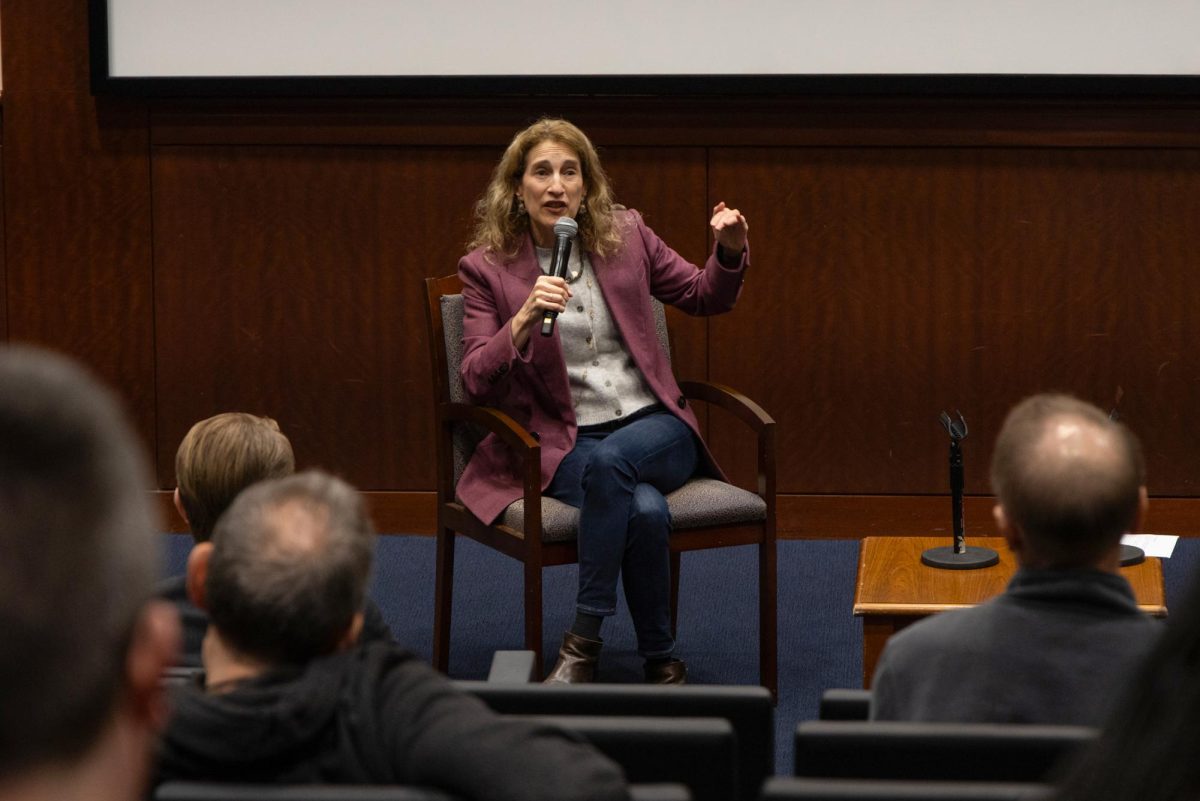
Zalesne, an attorney and nonprofit leader and the former president of Peer Forward — a nonprofit connecting low-income students to colleges — said she would rely on coalition building and building relationships with representatives across the nation to advance D.C.’s priorities in Congress. She said D.C.’s delegate must know how to build political partnerships on a national stage, experience she said she gained while working for the DNC, and her opponents who only have local experience, like White and Pinto, have not learned to negotiate effectively.
“D.C. Council is 13 Democrats, some of them are called independent, but they’re all Democrats,” Zalesne said. “So the biggest coalition any D.C. councilmember has ever had to build is six other D.C. Democrats. That’s not a big coalition.”
Zalesne said she supports implementing a commuter tax to fund shared regional infrastructure across D.C., Maryland and Virginia. She said the revenue from a commuter tax could be placed into a joint fund to support transportation, waterways and other shared systems between the three governments.
“I want to fund shared interests with this commuter tax,” Zalesne said. “So we’ve got to break through some of the old stigmas and the old inertia and the old, you know, that can never be done.”
She said she would also work to build a capital caucus if elected to Congress, which would consist of her and other members representing Maryland, Virginia and nearby states like Pennsylvania to discuss shared regional interests, like economic development.
“We should take our rightful place as a regional power,” Zalesne said. “It will be better for us to grow our economy, which we need to do. We need to be less dependent on the federal government, and we can do all that if we’re a regional power.”
Both White and Zalesne said before statehood D.C. should have budget and legal autonomy from Congress — including giving the D.C. mayor the authority to control the District’s National Guard troops. White and Zalesne agreed that in order to give D.C. more autonomy, Democrats would need to win a majority in Congress and would likely need to take back the White House.
Congress voted early last month to overturn a D.C. Council tax law — something it has done only five times in the District’s fifty years of home rule — stripping the District of roughly $600 million in revenue and throwing the tax filing season into disarray. Congress also voted in 2023 to block a D.C. crime reform bill after the Council passed it unanimously after years of reviewing and overhauling the code.