
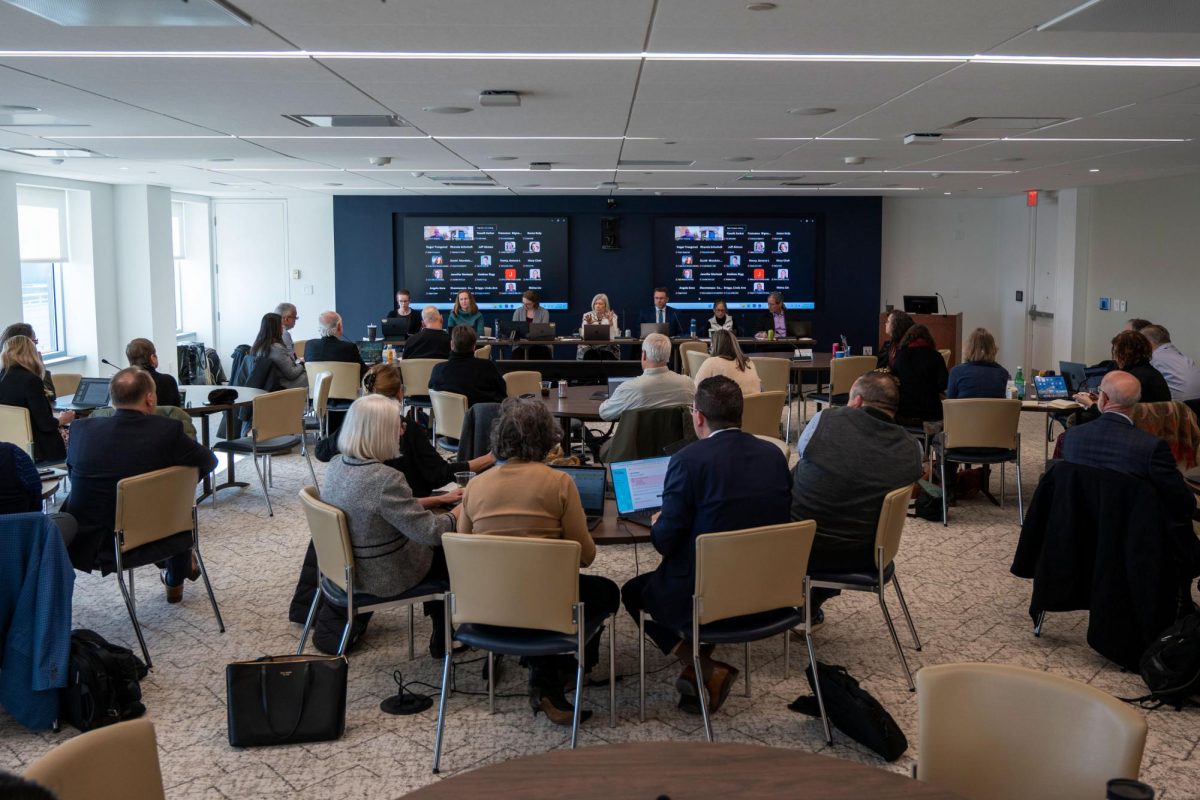
Faculty senators called on officials to provide greater transparency around the process for budget-cut decisions and the broader impact those moves could have on GW’s academic mission at a meeting Friday.
Senators said University President Ellen Granberg and Interim Provost John Lach should provide more concrete details about GW’s budget planning process for fiscal year 2027, including explaining how officials are weighing broader institutional priorities, like research and the future of doctoral education. Faculty also voiced concerns over the decision-making process that led officials to reduce doctoral student funding packages for the next academic year, cautioning that the move could undermine GW’s reputation and its broader academic mission.
“I think we all know from psychology that when we understand the reasoning behind things, it’s easier to accept them,” Faculty Senator Jennifer Brinkerhoff said. “Those criteria could be anything from this is in the best interest of our students, this is what serves our society.”
Brinkerhoff said faculty remain concerned about how officials will make difficult budget decisions, which officials foreshadowed last month after ordering each unit to make budget contingency plans. She requested that officials identify their reasoning and criteria for any decisions about the restructuring or potential elimination of programs or units, along with any potential layoffs.
Officials told the Faculty Senate last month they instructed school and unit leaders to prepare budget contingency plans that include five, ten and 15 percent reductions for FY2027, which would come on top of existing budget cuts in FY2026.
She also requested that Granberg and Lach facilitate a discussion with all school deans to discuss how officials make decisions across different units, adding that the University operates on a decentralized model and it could be beneficial to understand other units’ decision-making to see how they can build on each other’s strengths and compensate for each other’s weaknesses.
“I don’t think it’s too much to ask, but having those specific criteria would be extremely helpful for us to kind of walk the path with you and understand the reasoning,” Brinkerhoff said.
Granberg said Brinkerhoff’s requests were “really well taken,” and she and Lach could follow up with a response to her requests about the criteria officials will use for their budget decision-making and facilitating a discussion with the deans. Lach said the Faculty Senate would discuss her budget model request, including a timeline, during the executive session portion of the meeting.
Faculty Senator Ilana Feldman said the process officials used to decide which Columbian College of Arts & Sciences doctoral programs would halt admissions next cycle concerned her, as the decision could cause reputational harm given some prospective students had already submitted applications.
Officials opened doctoral student applications last fall, though five programs decided after the fact to not admit any new students and refunded application fees to those who applied.
She questioned officials’ broad cuts to doctoral programs without considering how they would affect programs of different sizes, asking officials what they are doing to support the future of doctoral education at GW amid what she called “shaky grounds” and uncertain planning processes.
CCAS Vice Dean of Programs & Operations Kimberly Gross confirmed last month the college will cut the number of doctoral packages by about 7 percent next year, shrinking cohorts in 13 programs and pausing admissions in five.
“We’ve also talked a lot in the senate and other contexts about the importance when we have to make difficult decisions, of doing those well and in ways that are thoughtful and that have the least harm to the education, research, faculty, students, all of those things,” Feldman said. “And I’m quite concerned about how this process unfolded.”
Lach said Ph.D. students are part of the “lifeblood” of GW’s research enterprise and officials’ decisions regarding doctoral education were based on a variety of factors, including the anticipated rise in costs of each doctoral student, in part due to market pressures.
Faculty Senator Amita Vyas said research investigators and trainees across units and schools at the University are worried about the future of research and their ability to conduct clinical research, especially since it is a key component of the strategic framework officials are working to implement. She asked Granberg how research considerations are playing a role in officials’ negotiations with Universal Health Services to end GW’s financial support for the Medical Faculty Associates and how research may be impacted.
Granberg said officials are actively discussing with UHS what research will look like under a deal, adding that she expects officials to expand the number of sites where GW faculty can conduct research after the parties complete the deal. She said she will charge the incoming School of Medicine and Health Sciences Interim Dean Andrew Artenstein to work with faculty to identify other sites that may be appealing for research.
“We absolutely intend, I absolutely intend, to maintain health research and clinical research, and so we’ll be in a little bit of an evolution, but I think there will probably still be research at GW University Hospital, but also at other places,” Granberg said.
Faculty Senator Arthur Wilson asked Granberg to expand on reports of staffing shortages at Cedar Hill hospital — a $434 million facility in Ward 8 staffed by MFA physicians and operated by UHS, which also runs GW Hospital.
D.C. leaders reported earlier this month that severe staffing shortages at Cedar Hill hospital are tied to ongoing negotiations between GW and UHS over the debt-ridden MFA. Deputy Mayor for Health and Human Services Wayne Turnage said UHS’s staffing shortages have hindered the MFA’s ability to deploy its physicians to Cedar Hill, because the medical enterprise does not want to send its staff without sufficient nurses to support them.
Granberg said there are no issues with providing physicians to Cedar Hill and clarified that GW is solely responsible for providing physicians. She said UHS is in charge of handling staffing, equipment and advertising at the hospital.
She said GW currently maintains an independent agreement with UHS to provide physicians who staff Cedar Hill, though the relationship could either stay the same or change depending on the outcome of ongoing negotiations with UHS over the MFA. She said Cedar Hill is a piece of officials’ discussion with UHS.
“We have no involvement in running the hospital, none of that,” Granberg said. “That’s all handled by UHS, which is the one that actually has the contract with the city.”
Granberg said the provost search committee shared a list of finalists for the position, who will soon visit campus and interview with the Faculty Senate Executive Committee. She said officials expect to conclude the provost search by the end of March and announce the new provost by late March or early April.
The Faculty Senate voted unanimously to move to executive session at the end of its meeting — which lasted for over 45 minutes — to hear an update on GW’s new budget model, which included input from officials from the accounting and consulting firm Grant Thornton.
The senate unanimously passed a resolution presented by the Educational Policy & Technology Committee Co-Chair Thomas Choate to extend a temporary change to the number of academic integrity violation panel members from five to three, including at least one student and one faculty member.
The Faculty Senate first temporarily modified the number of panel members from five to three in March 2024 in an effort to expedite academic integrity hearings after reports of academic integrity violations rose by 313 percent from fall 2021 to fall 2023. The senate extended the policy again in January 2025 due to the low number of faculty members interested in serving on panels, resulting in a backlog of cases.
Choate said even though the number of academic integrity violations has “stabilized” since the initial popularization of generative artificial intelligence programs, the number of faculty members serving on panels has continued to decrease, falling from 24 to 23 this year, prompting EPT to consider extending the policy again. He said the lack of faculty volunteers has made it difficult for the Conflict Education & Student Accountability office to find panelists and solve cases in a timely manner.
“CESA is facing some challenges in closing these cases in a timely manner due to difficulty still in scheduling the panels,” Choate said. “So in fact, in spring 25 compared to spring 24, 55 percent more of these cases overran the spring semester and were still open when the summer began again.”
Interim Vice Provost for Faculty Affairs Emily Hammond presented the University’s annual faculty salary equity review report, which identifies outliers in faculty salaries to adjust and make faculty pay more equitable across the University. They said deans can decide how many adjustments to make while weighing factors like the number of promotions individual faculty members have had in the past, the faculty member’s performance and the school’s overall budget.
CCAS had the most outliers at 25 and the most adjustments at 14, and the Milken Institute School of Public Health had the second most outliers at 11 and the second most adjustments at three, according to their presentation.
Isaac Harte and Zoomel Ghauri contributed reporting.