
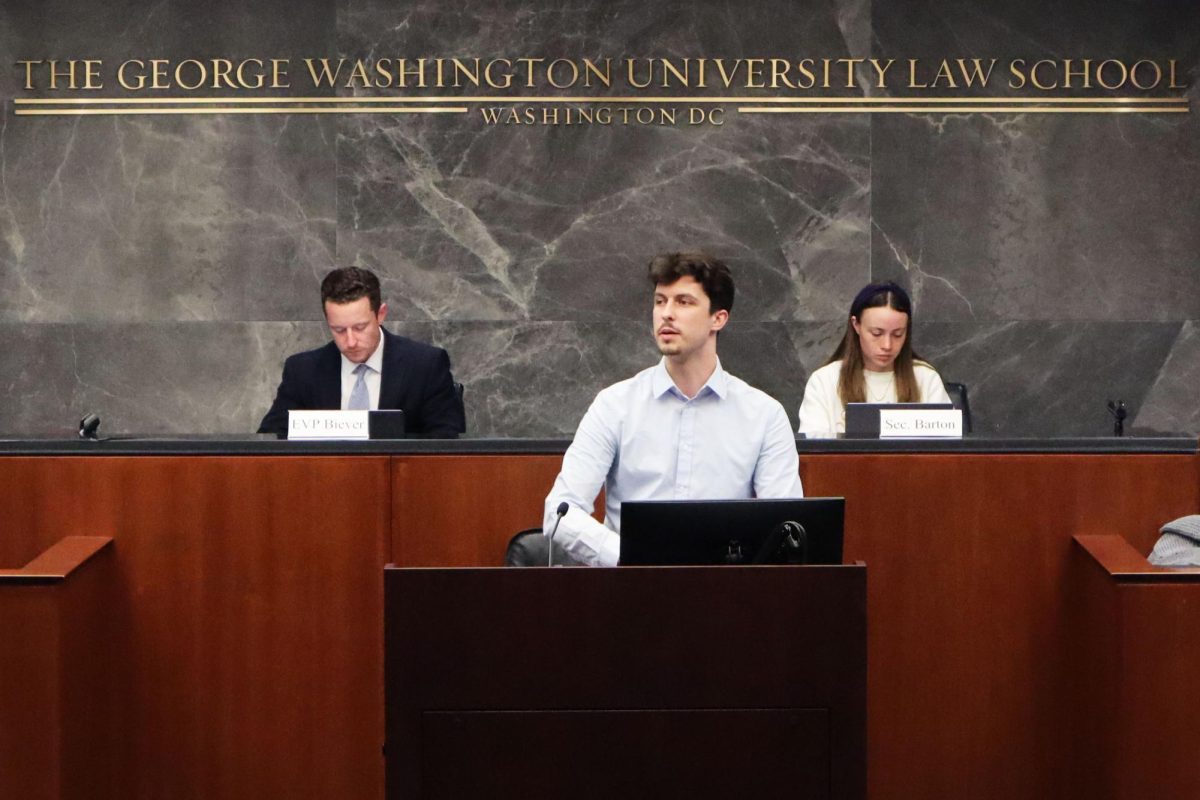
The Student Bar Association Senate passed a bill to create an emergency relief fund for part-time law students affected by the federal government’s ongoing shutdown at a meeting Tuesday.
Senators passed the Government Shutdown Relief Fund Act, creating a $2,000 fund for the SBA Senate to provide financial stipends to part-time law students employed by the federal government directly impacted by the shutdown that began Oct. 1. SBA President Amanda Hichez said the executive branch and SBA senators collaborated to create the bill after hearing about classmates’ financial difficulties after being furloughed from their federal jobs due to the shutdown or forced to work without pay.
Hichez said the funds for the shutdown relief fund will come out of the SBA executive branch’s $75,000 budget this year and will not affect the amount of money in the senate’s ad hoc fund — money SBA senators distribute to student groups that request extra funding throughout the year. The act transfers $2,000 from the executive branch and authorizes senators to distribute funds to part-time students put out of work by the federal government, who can request stipends during the shutdown.
“Hopefully that’s a good incentive to just be as generous but practical as possible when it comes to allocating to students,” Hichez said.
The law school had 233 part-time students in Fall 2024, the most recent enrollment data available, according to GW’s enrollment dashboard. As the government shutdown stretches into its fourth week with no end in sight, roughly 730,000 federal employees are working without pay, while another roughly 670,000 have been furloughed, according to the Bipartisan Policy Center.
Hichez said only part-time students are eligible for the fund, because GW Law strongly discourages full-time students from working a full-time job while enrolled, meaning virtually none work for the federal government.
SBA Vice President of Finance Julia Tamborello said the SBA does not have a good method of estimating the number of students impacted by the shutdown through furloughs and firings so the fund is a “starting point” and can be expanded if there is a large demand.
“If there is a bigger need than anticipated, we can address that then and cross that bridge when we get there and add more money,” Tamborello said.
Tamborello said the SBA executive branch has spent $40,925.34 of its budget so far this year and has a remaining fund of around $34,000. Tamborello said the executive has spent the largest portion of funds on the venue for the SBA’s annual social mixer “Lawloween,” which she said cost about $16,000 and that the SBA has already recouped the cost in ticket sales.
Senators also passed the Committee Reform Act and Committee Assignment & Membership Regulation Accountability Act, or CAMeRA Act, both of which place new duties on the SBA’s committees, including requiring them to meet at least twice per semester and publicly advertise their meeting schedules.
The SBA’s seven committees, ranging from academic policy, to finance, to student life, debate and develop policies and bills for the wider SBA Senate. Prior to the reforms, the SBA Executive Vice President created the committees and senators could self-select which committees they wanted to serve, but under the new rules the SBA Senate can create its own committees, and the SBA Executive Vice President will have the power to assign senators to committees.
SBA Sen. Thaddaeus Canuel, who introduced the Committee Reform Act, said the bill also adds language to the SBA’s bylaws allowing the Senate to create temporary special committees to discuss short-term issues at the law school, a change he said is necessary because previously the SBA could only create permanent committees to discuss temporary issues.
“We identified a problem, which was that there are almost no requirements or regulations on multiple committees,” Canuel said. “We wanted to ensure that in future years, that committees are transparent and accountable and that their records are available to the public.”
The bill also adds new requirements for SBA Senate committees, Canuel said, including holding at least two meetings per semester and posting meeting agendas 48 hours prior to the committee meeting time. Canuel said the bill also requires committee chairs to advertise their meetings in the SBA’s weekly newsletter and make their minutes publicly available for review by law students, all standards that were not previously mandated.
SBA Senators amended the bill to exclude the Finance Committee from requirements to advertise meetings at the request of SBA Sen. Yasameen Ganji, the Finance Committee chair because committee holds meetings in closed session while debating funding requests.
The bill also requires all committee chairs to write a “transition report” at the end of each year to be shared with the next year’s committee chair, to ensure that incoming committee chairs understand their duties, responsibilities and the history of their committee.
“Whoever takes over the committee next year is going to have that report, is going to have that information for how to access records, how to get access to accounts, to know what the committee had been doing last year,” Canuel said.
The CAMeRA Act, which will go into effect in Spring 2026, authorizes the SBA executive vice president to assign senators to committees instead of senators choosing which committees they want to serve on themselves. SBA Sen. Callie Stevens, the sponsor of the bill, said the SBA vice president will review a list of senators’ preferences and assign them to at least one committee based on the committees’ needs and senators’ workload balance.
SBA committees have had lopsided membership levels under the current system, Stevens said, with some like the Student Life Committee having six members, and others, like the Academic Policy Committee only having one. She said although some committees, like the Finance Committee, have greater workloads and need more members, the new system will require at least three senators to serve on each committee.
“The current way that we sort of really self-select committees just probably isn’t workable for the long term,” Stevens said.
The next SBA Senate meeting will be held Nov. 4 at 9 p.m. in the Burns Moot Court Room in Lerner Hall.