

Officials are continuing to review whether GW will implement institutional neutrality after former Provost Chris Bracey announced the University was engaging in discussions around it last spring, although faculty interest in the policy has waned as they shift their focus to what they see to be the University’s more pressing issues.
As more and more universities moved toward implementing institutional neutrality after the outbreak of the war in Gaza, Bracey spearheaded the University’s top leadership’s interest in such a conversations — which included his comments in April about how officials would “likely” bring an institutional neutrality presentation to the Board of Trustees and would form a task force to make recommendations about adopting a policy over the summer — though the status of those talks are unclear after he stepped down as provost in June. Faculty leaders’ interest in such conversations with officials dwindled over the summer after the Faculty Senate voted to return a resolution opposing the policy to committee in April, as they sought to clarify the resolution’s wording — a move higher education experts supported as they encouraged both faculty and officials to focus on the University’s immediate issues.
University spokesperson Kathy Fackelmann said officials are continuing to review the University’s stance on institutional neutrality — a comment that came three months into Interim Provost John Lach’s tenure. She said officials will engage with community members if they were to begin considering adopting such a policy.
“If the University does consider adopting a position on institutional neutrality, we will actively engage with faculty, staff and students as part of the process,” Fackelmann said in an email.
Co-Chair of the Faculty Senate’s Committee on Professional Ethics & Academic Freedom Dwayne Wright, who stepped into leading the committee that sponsored the institutional neutrality resolution in May, said the committee decided to table the resolution after the Faculty Senate Executive Committee didn’t include the policy in its charge to the committee chairs with tasks to consider addressing during this year’s senate term. He said the committee’s focus has since shifted to what he described as “more immediate threats,” pointing to the University’s growing budget deficit — which resulted in the layoffs of 43 staff members on Tuesday — and an August letter from the Department of Justice accusing GW of being deliberately indifferent to campus antisemitism following Hamas’ Oct. 7, 2023 attacks.
Wright also added that leadership and membership changes within both the Faculty Senate and the PEAF committee, which took effect at the start of the new senate term in May, have further complicated the resolution’s future, as it remains unclear where the new senators and committee members stand on the issue of institutional neutrality. He said the committee met with Lach in late August, where there was no mention of institutional neutrality because nobody asked about it, and Lach didn’t mention the subject.
“I haven’t talked to Provost Lach about it,” Wright said. “I haven’t heard anything from anyone in the provost office about this since the resolution was sent back, so it might not be a current priority of the administration or personally of the provost.”
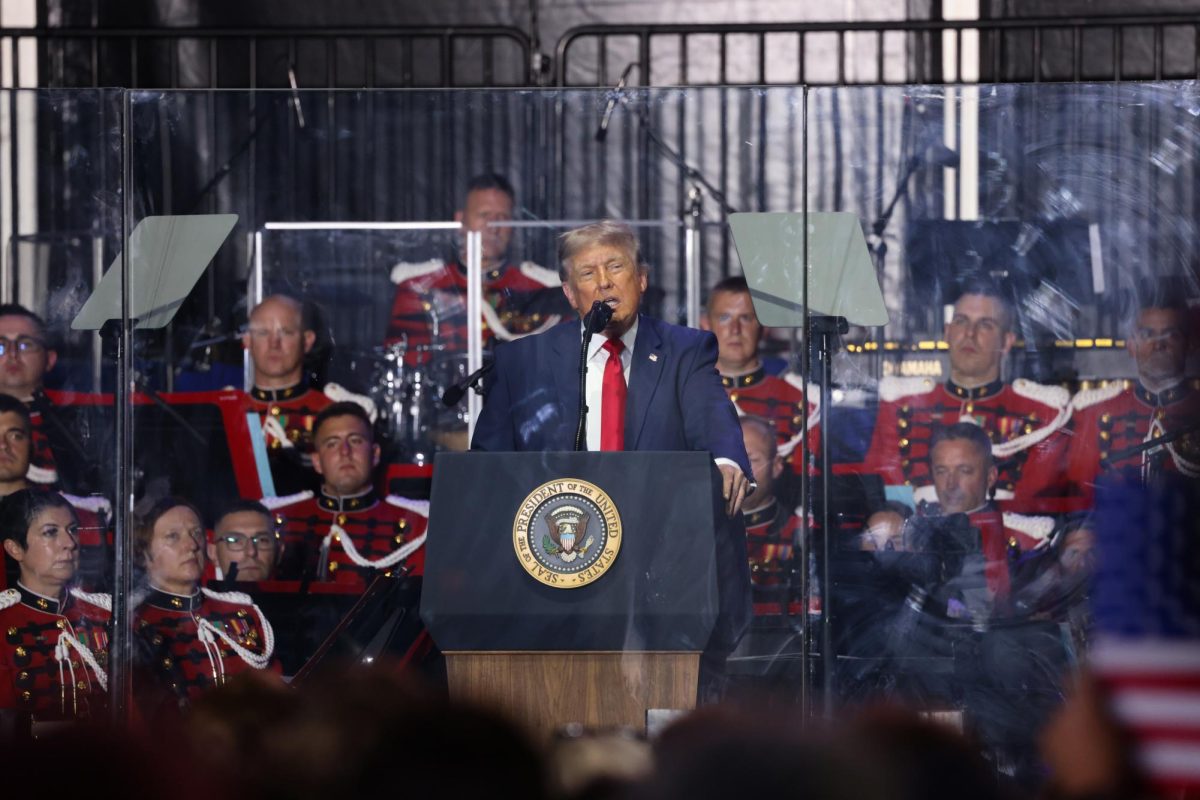
Adopting a stance of institutional neutrality would require GW to refrain from issuing statements regarding any social or political issues, specifically those that do not directly affect the University’s mission, instead leaving those conversations to students and faculty. Institutional neutrality would mean University President Ellen Granberg could not put out statements like she did directly following Hamas’ attacks and the outbreak of the war in Gaza that described Hamas’ attack on Israel as “evil,” for example.
A desire to refrain from commenting on social and political issues has led more than 140 schools to adopt institutional neutrality after Hamas’ 2023 attacks as university officials struggled over what to say in response to the events to avoid appearing to have taken a side, in comparison to the eight schools that had institutional neutrality policies before the war. Three of GW’s 12 peer schools, Tulane and Syracuse universities and the University of Southern California, adopted policies of institutional neutrality in 2024.
Conversations about institutional neutrality at GW publicly began last November after a University spokesperson said officials weren’t considering implementing such a policy. Around the same time, PEAF formed a subcommittee to research the topic and bring specific proposals to the whole committee regarding institutional neutrality, Guillermo Orti, the committee’s 2024-25 co-chair, said in an email.
The subcommittee then brought the resolution opposing institutional neutrality to the Faculty Senate in April before they passed it back to the committee for further review, where it ultimately lost momentum.
Experts in higher education said universities adopted institutional neutrality policies to dodge commenting on divisive issues that may seem like they are taking a specific stance, which doesn’t help an institution, like GW, whose students are politically active and want to hear administrators’ thoughts on global issues. They said GW should rather focus on more pressing issues, like its budget deficit and the attacks President Donald Trump’s administration has exerted on institutions of higher education, rather than adopting an institutional neutrality policy.
Peter Wood, president of the National Association of Scholars, said more “existential” issues, like those relating to the financial health of the institution and legal problems posed by the government, should be at the top of a university’s list of priorities rather than dedicating time to developing a neutrality policy. He also added he doesn’t support the policy for any university generally because it indicates a school is “ducking” from commenting about a set of issues, especially when they implement the policy in response to a controversial issue.
“Particularly in cases where the college or university finds itself in the midst of lots of controversial issues, to adopt institutional neutrality makes things worse,” Wood said.
Jamie Herman, the associate director of educational and professional initiatives at the Janet Prindle Institute for Ethics at DePauw University, said GW’s adoption of institutional neutrality could restrict free speech at the University because some students, faculty and staff may worry that a statement they make would be perceived as speaking on behalf of the institution.
She said there are a lot of questions about the enforcement of institutional neutrality policies and the specific conditions they have, like whether specific statements made on political, social and cultural issues by a specific person would be on behalf of the whole University.
“On the other hand, though, if the institutional neutrality policy comes with additional restrictions on what individual schools, individual departments and then various bodies that kind of comprise the institution are allowed to do and not to do, that, to my mind, seems actually like a non-neutral institutional neutrality policy,” Herman said.
Holden Thorp, a chemistry professor at GW and former chancellor of the University of North Carolina at Chapel Hill, said the University would be better off not adopting an institutional neutrality policy, suggesting that officials should simply decline to comment on certain issues when necessary. He said members of the University community will be upset with leadership for staying silent on controversial topics regardless of whether a neutrality policy is in place, and ultimately, it’s up to Granberg to decide when and how to speak out.
“One of the reasons people come to GW is to be politically active, so of course everything you do as an administrator is going to be viewed through a political lens, and that’s part of what you sign up for when you come here to be an administrator,” Thorp said.