

The Columbian College of Arts & Sciences hosted two graduation ceremonies for over 1,300 students in the Charles E. Smith Center Saturday, where speakers told the graduates to stay committed to their “values” as they enter the workforce while students protested the war in Gaza during the ceremony.
Cecilia Culver, the student speaker at the first ceremony and an economics and statistics graduate, strayed away from her approved speech by CCAS administration to call on the University to divest from Israel while at least 20 students in the audience donned keffiyehs and others waved Palestinian flags. Speakers challenged graduates to welcome different perspectives and commit to difficult conversations with people they disagree with as they move forward in their careers.
Two GW police officers sat to the left of the stage during the second ceremony and confiscated one student’s flag, which the student offered to the officers when they appeared posed to take it.
Culver said the University “repressed” individuals who had the “courage” to point out the “blood” on University officials’ hands instead of engaging in negotiations with students to divest from Israel.
“I am ashamed to know my tuition is being used to fund this genocide,” Culver said.
Culver’s speech was met with cheers from the crowd and other graduates. She received a standing ovation from the graduates at the conclusion of her speech.
CCAS Associate Dean of Undergraduate Students Rachel Riedner said Culver strayed from her prepared remarks. She was cut off by graduates in the crowd who chanted “Free, free Palestine” while others shushed the protesters during Riedner’s speech.
Officials said they are investigating whether Culver violated the University’s events protocol or the Student Code of Conduct.
During her speech at both ceremonies, Riedner said community, empathy and leadership resonate most with her during “this age of uncertainty.” She said higher education does more than just prepare students for a career because it signals values including critical thought, intellectual honesty, dialogue and inclusive and diverse communities that welcome different perspectives.
“We don’t always think the same way, but we commit to staying in the room and at the table even when conversations are difficult,” Riedner said.
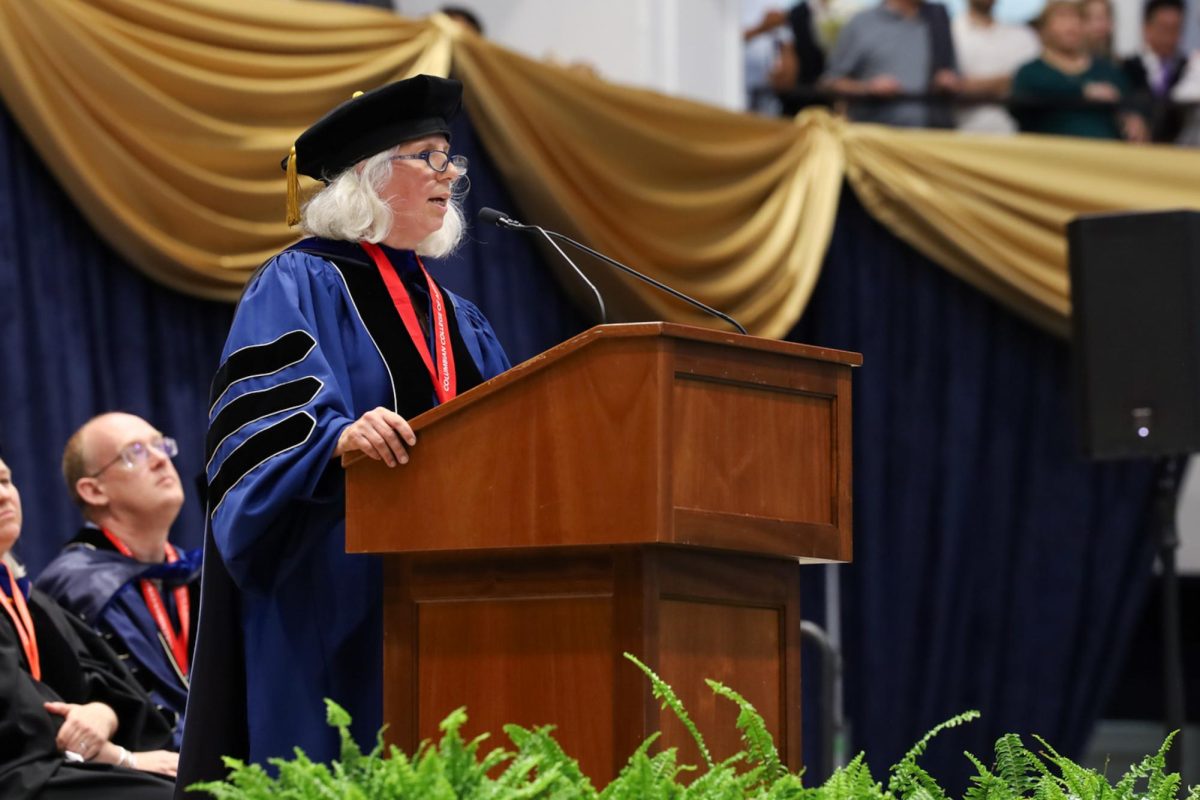
Peter Loge, an associate professor and director of the School of Media and Public Affairs, said at the first ceremony all times are unprecedented and the graduates will walk away from GW trying to make sense of it. He said the graduates will build and be part of communities and will shape and be shaped by the world to make the unprecedented times predictable.
“You can either be the victim of the wind and the rain or you can seize the storm and say it is mine,” Loge said. “You are George Washington University students, you are not passengers in time. You are not victims of the storm. You are storm chasers.”
Loge drew upon SMPA graduate Aaliyah Guzman’s advice in an April Hatchet opinions piece and said students should make sure the work they do and the internships they accept align with their values. He said the graduates should “hold fast” to their footing and “be true” to themselves as they navigate unprecedented times.
“You choose who and how you want to be in your time,” Loge said.
At the first ceremony, Kavita Daiya, the CCAS associate dean of academic innovation, presented the Robert W. Kenny Prize for Innovation in Teaching of Introductory Courses to assistant teaching professor of writing Nabila Hijazi and the Columbian Prize for Teaching and Mentoring Advanced Undergraduate Students to Eric Grynaviski, an associate professor of political science and international affairs.
At the second ceremony, Antonio López, the faculty speaker and chair of the English department, recalled some memorable stories as a professor over the past 36 years of his career.
López spoke about a time he gave one student in an introductory course a C plus grade, before the student advocated for a B minus grade. López said the student did not receive the B minus he advocated for, but López said he “appreciated” the courage the student showed.
“I connect your excellence, class of 2025, with the excellence of the students of yore,” López said.
López also recalled his time as a student at Miami-Dade Community College, when he became a tutor at the college’s writing center. López said the stories of his experience as a professor and as a student in higher education express qualities that each graduate has in their own way.
“Grads, each of you, in your own way, your own degree, possess qualities of these higher ed stories,” López said. “Your creativity, self acceptance, initiative, self confidence, courage, self advocacy and yes, defiance, are all a part of your story.”
Quinn Stefan, the student speaker at the second ceremony and a physics and geological sciences graduate, said the physics department at GW introduced her to her passion for the subject and she “loves” the CCAS graduation ceremony where many majors and interests are represented.
“I bet the vast majority of you are not attached to a specific subatomic particle, but may have something so specific to your own field that’s become special to you over your time at GW,” Stefan said.
Stefan said she hopes her fellow graduates will keep learning, in whatever field they choose to pursue. She added no matter what field a graduate is in, their work is “important.”
“I love the human need to keep advancing and to keep learning,” Stefan said. “Research is important. Learning is important.”
Daiya presented the Robert W. Kenny Prize for Innovation in Teaching of Introductory Courses at the second ceremony to teaching professor of French Brad Marshall and the Columbian Prize for Teaching and Mentoring Advanced Undergraduate Students to mathematics professor Joel Lewis.