


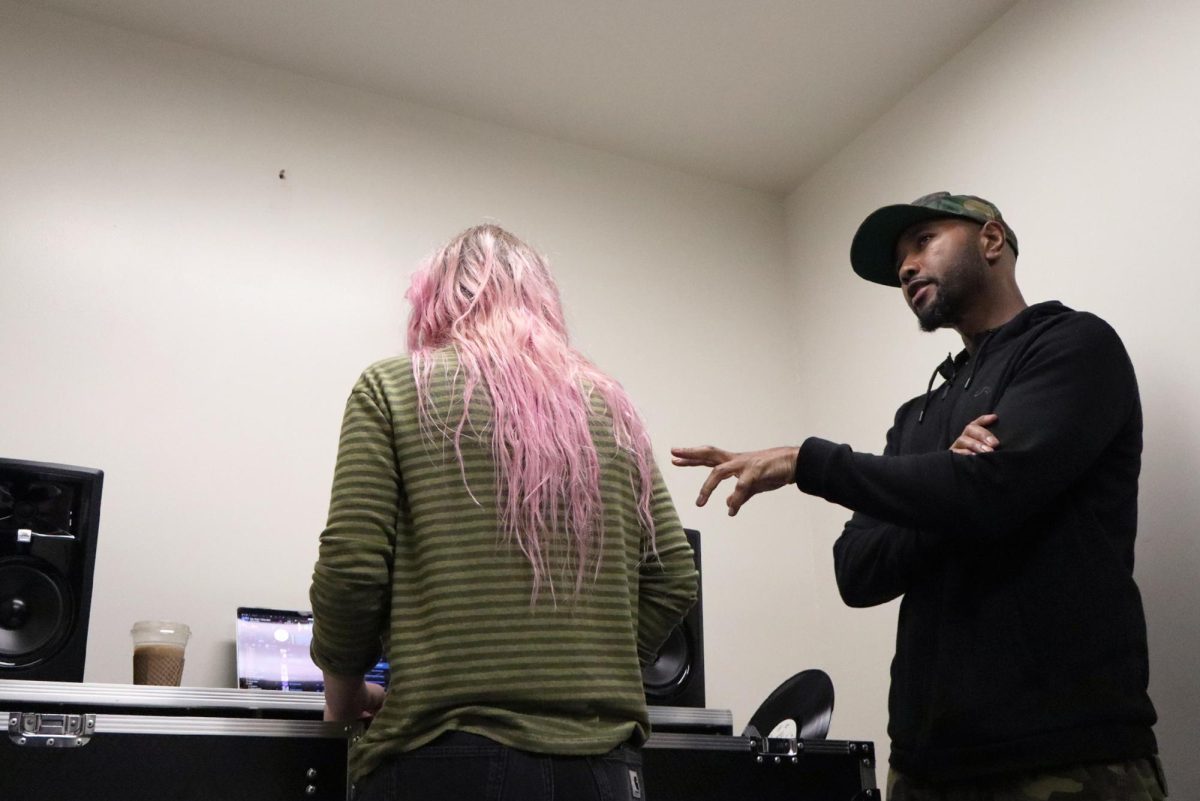
Once a week, student Kendall Larade and professor Ron Brown transform a shoebox-sized Phillips Hall basement classroom into a nightclub, curating headbanging beats and vibrant tunes from a turntable propped on top of a makeshift table.
Larade, also known as DJ oatmi1kprinc3ss, is a senior music and biology double major, and the first student in the Corcoran School of the Arts & Design to take turntable lessons from music professorial lecturer Ron Brown, also known as DJ RBI. After three semesters of weekly, one-on-one lessons to learn the technique and musical skills of the turntable, Larade will culminate her GW DJ education in her capstone performance “INTO THE GROOVE” as a part of the school’s NEXT Festival on Friday.
In preparation for her performance, Larade set down her Whole Foods oat milk latte on Tuesday afternoon next to her turntable setup in a Philips basement room and got to work. Once Brown entered the dimly lit room a few moments later, Larade started playing her set, her hands flying from the turntable controls to her computer, bopping her head along to the beat as Brown watched intently from the sidelines, jumping in with feedback on her transitions and commending her music choices. A majority of the songs were dance tunes spanning a variety of genres, some with strong bass beats and looping transitions, each one flowing easily into the next.
Brown said he has taught DJing in the DMV area independently for about 25 years and was initially a guest speaker in Music Department Chair Loren Kajikawa’s Hip Hop History & Culture course just before the COVID-19 pandemic.
Brown moved to co-teaching the class starting in 2023 for two years, during which Kajikawa would lecture on the genre’s evolution, while Brown would sit behind a turntable, demonstrating different DJ techniques and playing samples for students. Despite this, Brown said he wanted to expand his role in Corcoran and directly teach the turntable.
He said he developed his DJing and Turntablism performance study course and taught his first student, Larade, starting in the spring 2025 semester, instructing her on basic turntable skills like scratching, controlling the vinyl records and transitioning into different songs. He said he currently teaches three students, but has received growing interest from more students who want to take the course next semester.
Brown said his hip-hop background as a DJ and as the director of the District’s National Hip-Hop Museum influences his teaching style, not just in how he teaches the turntable, but also in how he educates students about the history behind techniques and the genre itself. Though his students may not be following the hip-hop path directly, Brown said the genre influences different styles, as it is made up of a combination of house, reggae and R&B music.
“The rest of the things that are inherent to what house DJs would do, like messing with echoes or using filters and things like that, that’s been absorbed into hip-hop,” Brown said.
He said he hopes his students will develop their personal styles and identities as DJs through his teaching beyond just mastering basic turntable skills.
“I say, play what you like to play,” Brown said. “Play what drives you, what inspires you, makes you excited and that often will help people figure out what their styles are going to be.”
Larade said she was always an avid music listener, but it wasn’t until she became involved with WRGW in her first year, and a fellow member of the organization taught her basic lessons about the turntable, that she decided to pursue the art form further. Later that year, she said the University reached out to WRGW, asking if anyone would be available to soundtrack their annual “Sexsonian” exhibit, and Larade jumped at the opportunity to perform her first DJ gig.
From there, Larade said she continued to DJ at house parties, community events around GW, local venues like Busboys and Poets and even a wedding. She said she also plays on her own WRGW show where she improvises her set on the spot each week, playing around with songs she’s never heard before.
“It’s really nice because I can be purely creative, because I don’t have to think about who’s listening, necessarily,” Larade said. “I want it to be a good groove, but I can be as experimental as I want.”
In her sophomore year, Larade said she started a DJ workshop through WRGW where she taught interested students “elementary mixing skills,” beat matching and song selection.
(Josh Steinberg | Staff Photographer)
Larade said she first met Brown in her sophomore year after enrolling in his Hip Hop History & Culture course. After discovering their shared love for the art of the turntable and Brown’s prior DJ experience, Kajikawa paired them for one-on-one classes taught by Brown. She said her sessions with Brown consist of mixing beats, discussing the techniques they use and why certain songs go together.
“He comes from a very hip-hop background, and that’s not necessarily my background,” she said. “So we have a lot of different perspectives that can go together in unique ways.”
She said she presented her idea for a DJ set for her capstone project to all the music faculty at the end of the fall semester, answering many of their questions and explaining the importance of DJing in the broader music scene. She said most of the music faculty were “overwhelmingly supportive” of her endeavors, though most of the questions concerned the venue and how to create an atmosphere that encourages attendees to dance and fully engage with her set.
“It was really important to me that we host my capstone in the Corcoran rather than an outside club or venue,” she said in a message. “Mostly for accessibility but to prove the Corcoran has the resources to continue its DJ program.”
Larade said DJing exists outside of the “musical canon,” unlike the classical, Baroque or romantic eras of music that academia often covers, from which electronic and dance music are often excluded.
“Other students that are performing on saxophone or trombone or guitar, didn’t have to explain why it is valuable for them to do that, I had to lay the groundwork for that to be done,” she said.
Larade said she sees DJing as a “narrative device,” taking records or individual songs and forming a new message through arranging, layering and remixing beats.
“It’s beyond just introducing a track and talking about it like you would on the radio, you’re creating something new, and that kind of like sampling culture, I think it’s more creative than people think,” she said.
Larade said she wants her capstone set to be largely improvisational, featuring mostly dance music, but she has some planned transitions as the set is only one and a half hours, compared to the three to five hour sets she’s used to performing at parties and events.
“I’m basically creating the skeleton of a set, and then I can modify it based off of how the audience is responding,” Larade said.
Larade’s performance will take place in Gallery 1 in the Flagg Building on Friday, where she said she will be surrounded by two photojournalism exhibits, one on dance music culture and another focused on go-go music and photographs of the D.C. hip-hop scene.
“I just want people to dance,” she said. “That’s the only expectation.”