
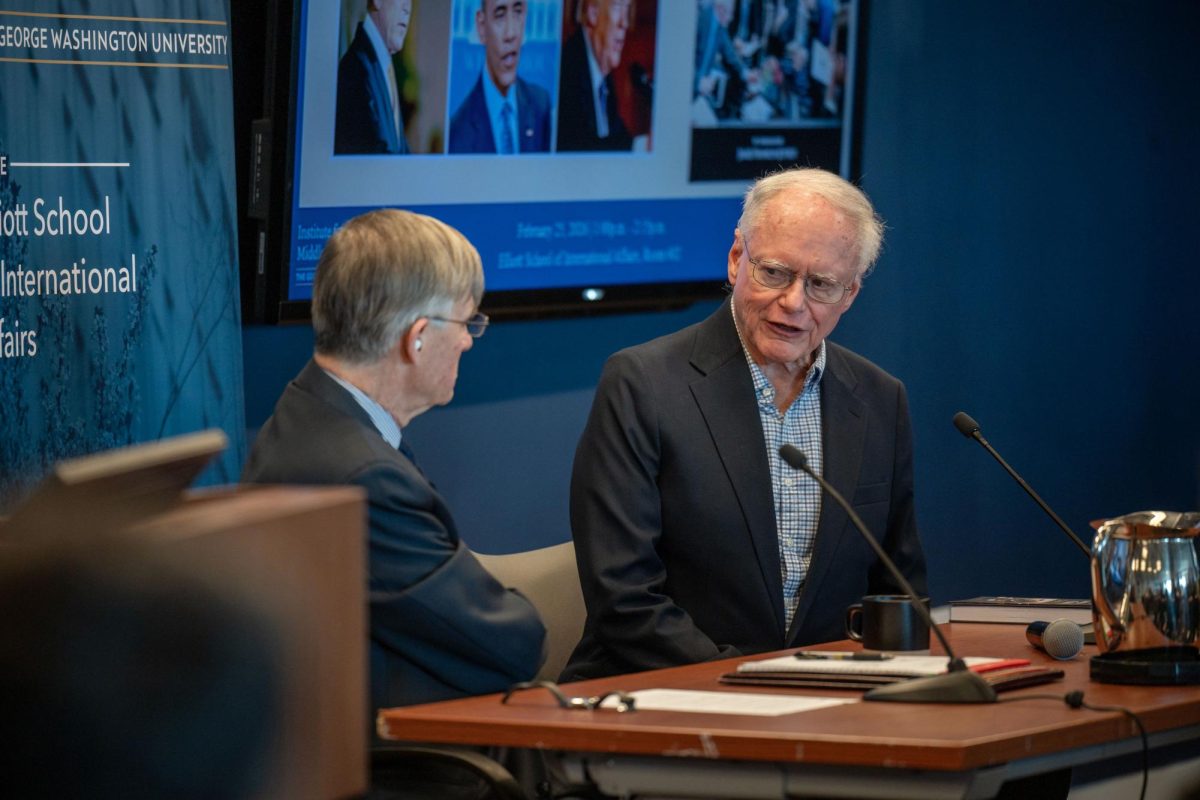
A former U.S. ambassador discussed the impact of U.S. foreign policy on Middle Eastern stability and the significant role foreign service officers play in international politics at the Elliott School of International Affairs Wednesday.
James Jeffery, a former career ambassador — the highest rank in U.S. Foreign Service — serving in countries like Albania, Iraq and Turkey, discussed his memoir “Middle East Crises: Expeditionary Diplomacy with the Bush, Obama and Trump Teams,” which explores his experiences with Middle Eastern diplomacy under three U.S. presidents. Gordon Gray, the Kuwait Professor of Gulf and Arabian Peninsula Affairs, moderated the discussion.
Jeffery’s book explains the role of U.S. diplomacy in the Middle East over time and the necessity of American leadership in the region. Jeffery served as a foreign service officer for 35 years under Presidents George W. Bush, Barack Obama and during President Donald Trump’s first term, serving as deputy national security advisor under Bush and eventually ascending to the highest rank in foreign service of career ambassador.
Jeffery said the United States built a global collective security system after World War II to contain the spread of communism, beginning with institutions like the United Nations and expanding through a network of international alliances. He said although the system was originally designed around anti-communist Cold War sentiment, it has evolved over time and contributed to greater global stability than the era before World War II.
“A world destroying itself ultimately, with two atomic bombs dropped, we have avoided that awful situation now for 80 years, and not all of it, but much of it is because of the collective security system,” Jeffery said.
Jeffery said the Middle East is a “crucial part” of Eurasia because of its energy resources, which he said are critical to the global economy. He said security threats in the region — including terrorism and the proliferation of weapons of mass destruction — often spill across borders and disrupt global markets, trade routes and international stability, which he said explains why the United States plays a central role in Middle Eastern affairs to serve as a stabilizing force in the region.
“The real problem has been internal discord, animosities, dysfunctionalities, and other problems that make the region incapable of defending itself and are contributing to a common defense,” Jeffery said.
Jeffery said every president wants what is best for America but has “very different ways” of approaching that goal. He said a part of that approach is who the president trusts, and it is valuable for envoys to build that trust with the presidents they serve.
Jeffery said foreign service officers can significantly shape how the public judges a presidency by dictating diplomatic moves they make, even if they are not the ones held publicly accountable. He pointed to Joe Biden’s presidency, which he said was heavily defined by the chaotic execution of the U.S. troop withdrawal from Afghanistan in 2021, when Taliban forces encircled Kabul and the U.S. evacuated its embassy which resulted in the deaths of at least 13 U.S. citizens and 60 Afghan civilians.
“As I tell foreign service officers, ‘Hey, you’re lucky.’ You’re the only bureaucrats buried in the bureaucracy and U.S. government that can destroy presidencies, mainly by letting your embassy or diplomatic establishment get overrun,” Jeffery said.
Jeffery said the book also describes how foreign service officers and diplomats work with the military, intelligence community and economic actors in the U.S. government.
He said foreign policy decision-making since the 1970s has become increasingly centralized in the White House and shaped more heavily by the military, while the State Department’s influence has declined. Jeffery said the growing role of the military in directing foreign policy is “unfortunate,” because military officers often bring a more limited view of diplomacy to the process.
“Diplomacy is not just what we do in the field,” Jeffery said. “It is the coordination of foreign policy, somebody has to do that.”
Jeffery worked as a U.S. special representative for Syrian engagement and a special envoy to the global fight against ISIS coalition. He helped manage the “maximum pressure” campaign under the first Trump administration, a series of harsh economic and diplomatic sanctions to put pressure on the Syrian Assad regime.
Jeffery said the presidents he worked with had different views on the right policy to deal with conflict in the Middle East. He said Bush and Obama wanted to transform the region into democratic regimes, while Trump took a more crisis management approach.
Jeffery said being a foreign service officer was the best profession he could have imagined. He said every day was a challenge and presented him with something new, sometimes forcing him to face dangerous and intellectually demanding situations.
“There’s no more important profession, there’s no more rewarding profession,” he said.