
A journalist discussed the challenges reporters face in accurately portraying Taiwanese history amid Chinese claims over Taiwan at the Elliott School of International Affairs on Monday.
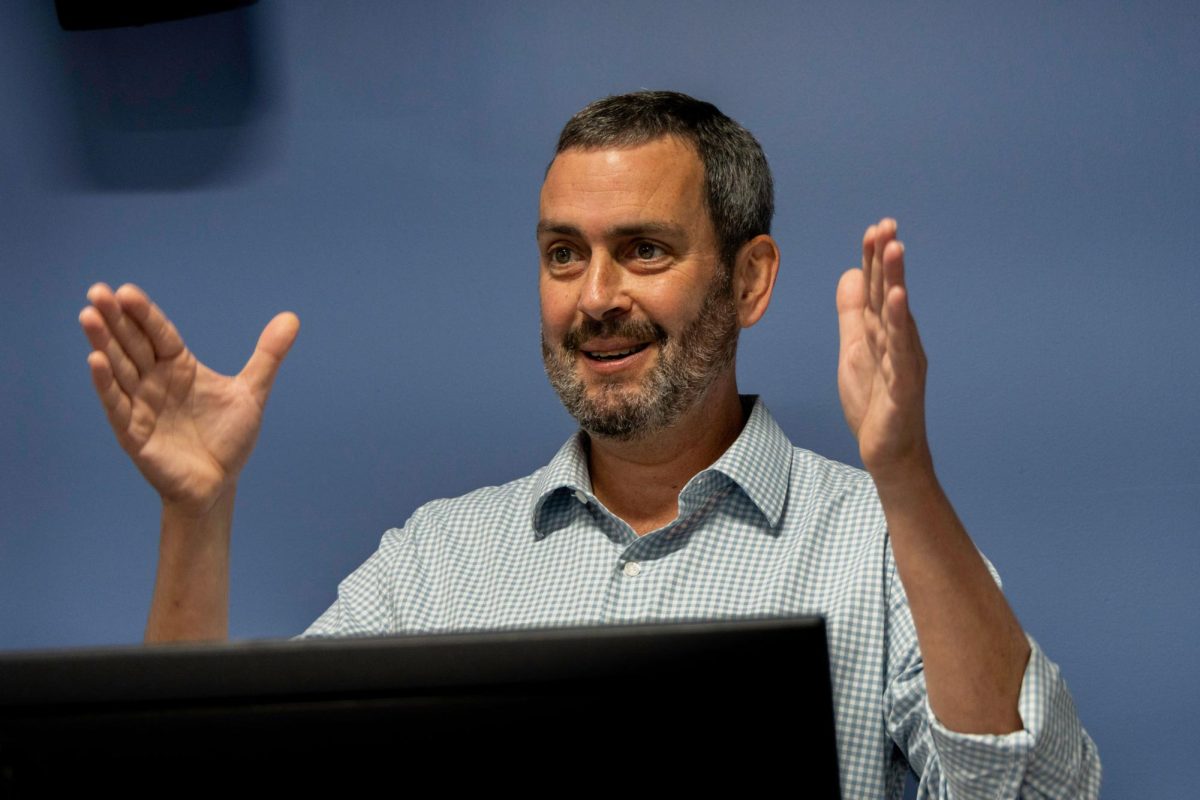
Chris Horton, a freelance journalist who has lived in Taiwan for 10 years, said the media’s portrayal of Taiwanese history is often inaccurate and overly focused on recent history, ignoring the island’s long and complex past before its relationship with China. Horton discussed his new book “Ghost Nation,” which provides a comprehensive account of Taiwanese history, with Richard Haddock, the assistant director of the Sigur Center for Asian Studies, as part of a series the center hosts with support from a grant from Taiwan’s Ministry of Education.
Horton said the media takes “shortcuts” when describing Taiwan, ignoring its long history independent of China, resulting in inaccurate descriptions of its past and current political status. Horton said journalists cannot detail Taiwan’s entire history in every article because it would “put people to sleep,” but he aims to include a broader account of it so his readers understand the proper context.
“Basically, I try to say that the Chinese Communist Party claims Taiwan as its territory, despite having never ruled it,” Horton said.
Taiwan, officially the Republic of China, operates as a self-governed, democratic entity with its own military and economy, but its sovereignty is heavily disputed by the People’s Republic of China, according to the Council on Foreign Relations, an independent, nonpartisan think tank. China claims Taiwan as an inalienable part of its territory and seeks unification, while Taiwan asserts its status as an independent, sovereign state.
Horton said he has “a lot” of responsibility as a journalist in Taiwan because the language used to describe it is a “minefield,” where deciding whether to label it as a country or territory could be perceived as bias.
He said an editor at a “top three” U.S. publication once told him he could not write “Taiwanese people” in a story because it implies they have a national identity. Horton said the editor later allowed the term’s use after Horton said not using the phrase could also be perceived as the publication being pro-China.
“We say the people of Taiwan, or the people on Taiwan, because if you say Taiwanese people, you’re suggesting kind of a nationality, like a national identity. And I’m like, ‘Well, it’s kind of what I’m feeling here,’” he said.
Horton said many media outlets treat Taiwan as if it only started existing in 1945, when the United States facilitated China’s takeover of Taiwan from Japan following World War II. He said when China took control in 1945, “nobody” in Taiwan spoke Mandarin and instead spoke Japanese, Taiwanese and indigenous languages.
Horton said Japan “created” modern Taiwan during its rule on the island from 1895 to 1945, introducing the rule of law, education and modern health care that still define it today. He said the People’s Republic of China claims Taiwan has been a part of its territory since the country’s inception — China has also repeatedly threatened to invade the island to reclaim it.
Taiwan is not recognized as a sovereign state by most countries, including the United States, but the United States instead pursues a “One China” policy, acknowledging that China claims Taiwan while not endorsing or rejecting it, Horton said.
He said modern Taiwanese politics are characterized by debates over national identity, with one side supporting a separate Taiwanese identity and another side in favor of Taiwan being considered ethnically Chinese. Horton said politics in Taiwan are dominated by the DPP, a party favored by the United States because it opposes closer relations with China, and the KMT, which governed Taiwan from 1949 to 2000 and generally favors closer relations with China.
“They’re more or less quasi proxies for the Chinese and American governments at this point, when viewed through a foreign policy lens,” Horton said.
Horton said Lai Ching-te, the current President of Taiwan since 2024 and a member of the DPP, is facing challenges from the KMT, which controls the legislature and sent a delegation to Beijing to participate in a neutral think tank exchange about topics, like tourism and medicine. He said U.S. officials are criticizing the KMT for its increasingly close relationship with China and efforts to stifle Ching-te’s independence efforts.
“Usually, U.S. officials kind of avoid this stuff, singling out one party,” Horton said. “The U.S. is always kind of like we don’t have a preferred party, we treat them all equally, but now you’re starting to see some criticism focused at the KMT.”
Horton said the KMT is more aligned with China than ever before and that the party has shifted from supporting unification with China only if Taiwan’s government leads it as the old Republic of China, to now simply being pro-unification.
“If there’s going to be unification, there’s only one real way to unify, and nobody really wants to talk about that,” Horton said.