

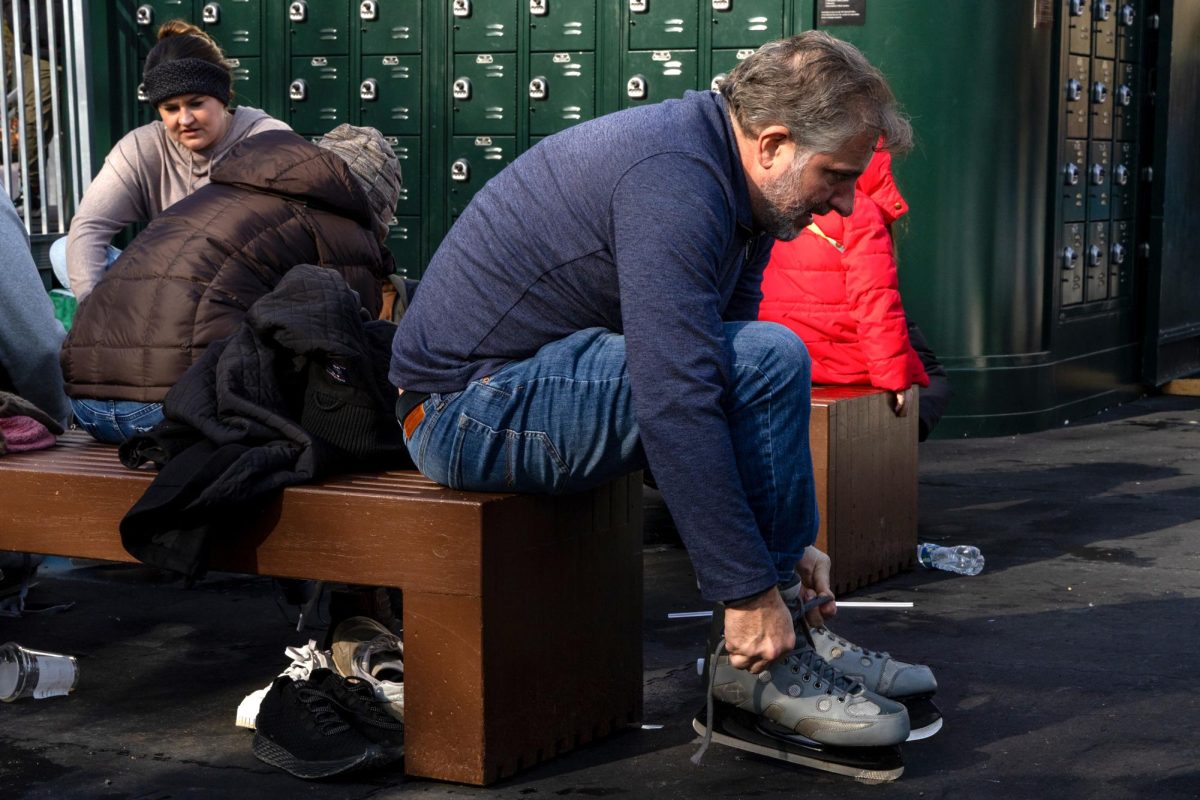
On the first chilly nights of November, as holiday rinks glow to life across D.C. and families shuffle across the ice beneath strings of lights, GW’s figure skaters are already deep into their season, training year round while the rest of the city dusts off its skates for winter.
While most people treat skating as a seasonal outing at places, like the National Gallery of Art rink or Washington Harbour, the 46 members of GW Figure Skating spend the year practicing in indoor rinks at the Mount Vernon Rec Center. Skaters said the club has become a community where students of all skill levels support each other, share technique tips and stay connected to a sport many thought they’d leave behind after high school.
The team practices every Friday morning and is preparing for its first post-COVID collegiate competition, set for the end of January at Massachusetts Institute of Technology — a return to the competitive environment many members grew up with.
Senior Elena Latsis, the club’s outgoing president, has skated since age 5 and competed throughout high school in Boston, Massachusetts. She said she joined — and later led — GW Figure Skating to recreate the sense of belonging she found on the ice as a kid.
“I think it’s easy to stop skating when you get busy at college if you don’t have a team to practice with,” Latsis said. “Basically I wanted to help build this community here at GW.”
She said the competition format she experienced in high school, where teams performed both individually and together, mirrors the collegiate structure and helped her transition smoothly into the club.
“The high school competitions actually were made to copy the college level, so the collegiate level is very similar to high school,” Latsis said.
She said that similarity motivated her to join the GW team for the community and to find new friends to skate with, as college skating has more practices with the team, compared to high school where they typically practiced in their own time.
With the rush of seasonal skaters crowding D.C.’s rinks, Latsis said the club faces unique challenges as a winter sport that practices year-round — from the cost of traveling long distances to indoor rinks to the limited availability of practice times. Even so, she said the effort is worthwhile, giving skaters the space to refine their skills and support one another.
Latsis said members often rely on long Metro rides or Ubers to reach the Mount Vernon Rec Center because most skaters don’t have cars. In the winter, however, she said indoor rinks tend to be less crowded, giving the team more flexibility during their Friday morning practices.
“I think it’s that we have a wide variety of levels, but the more advanced skaters, we have a few of them who are doing jumps and spins and all that,” she said.
First-year Macaella Sikhoya, who is majoring in biology and serves as the competition coordinator for the team, said she has been skating since she was 3 years old, following in her cousin’s footsteps after her mother signed her up for lessons. She said she got involved early with the team, attending the first practice of the year, decided to stick with the sport all the way into college because it’s been the only consistent aspect of her life, and she enjoys how “therapeutic” skating is.
“It’s the one sport that I ended up sticking with all throughout elementary school, middle school, high school, and I knew that it was something that I wanted to continue on in college to the fullest capacity that I could,” Sikhoya said.
She said she has enjoyed being in the organization as a way to keep up her skills with fellow members who have come from different backgrounds of skating, bonding over likes and dislikes of the sport.
Sikhoya said her love for figure skating comes from its role as an “expressive outlet,” giving her space to be creative while skating alongside a supportive, tight-knit team. She said she values being part of a community that shares her passion, adding that members often bond outside the rink, most recently by watching the Grand Prix Figure Skating Final together.
“It’s just fun to skate with other people that have the same love for the sport that you do,” Sikhoya said.
Margaret Macdonald, a sophomore majoring in international affairs and the club’s incoming co-president, said she came to figure skating later than most, picking up the sport in high school after discovering skating videos on YouTube. After taking beginner lessons at an outdoor rink, she said she quickly realized how personal the sport can be, from choosing music and choreography that reflect the skater to adjusting to new techniques on the ice.
Macdonald said she wanted to pursue skating at GW because she hadn’t been in a figure skating community previously due to her late interest, also wanting to take advantage of reserved ice time the club has.
“Whatever music you pick is very reflective of who you are, your desires, you’re enjoying everything that represents you as a person,” she said. “So I just found that really beautiful.”
She said skaters in the organization understand that everyone may be coming from different points in their careers and are supportive of each other’s advancements and skills.
“I’m so grateful to know them, and they’re all so nice and so willing to help you, and they know there’s never any kind of superiority,” Macdonald said. “We’re all friends, it’s just a really nice community to be around, and it’s not toxic, not competitive at all.”