

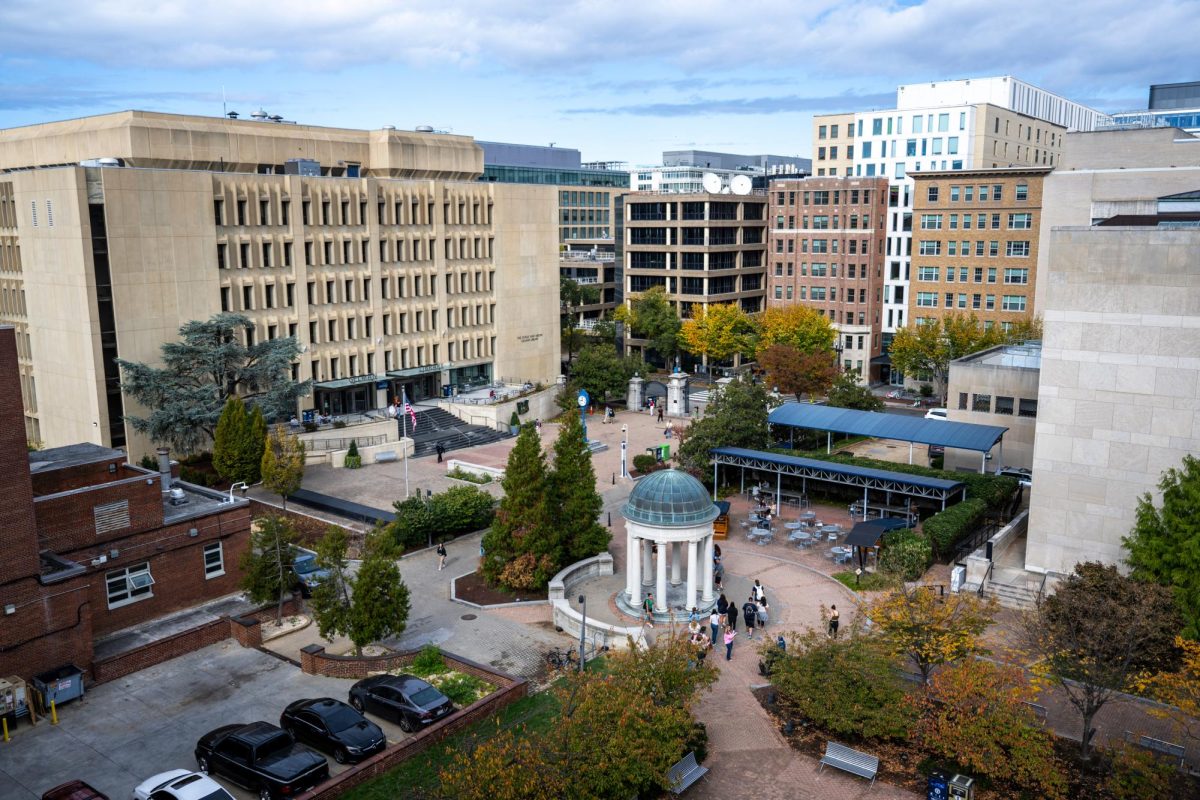
Community members said they hope university officials will increase gathering spaces for students on campus and preserve historic Foggy Bottom sites as they gather community input for the 2027 campus plan.
Officials over the last few months have hosted listening sessions for campus stakeholders, presentations to community groups, public town halls and on-campus tabling to solicit community input for a new 2027 campus plan, which will will serve as an outline of how officials will develop GW’s campus for the next 20 years, according to the plan’s website. In these sessions, student and Foggy Bottom leaders said they have advocated for continued community engagement throughout the campus planning process, increased communal spaces on campus and the preservation of historic GW and Foggy Bottom buildings.
The campus planning team, which is comprised of GW officials as well as representatives from Sasaki Associates and LINK, two consulting firms the University announced it had hired at the May Faculty Senate meeting to assist with the campus plan, has identified eight guiding principles — including building a cohesive physical campus identity that distinguishes GW from other city buildings and prioritizing sustainability — to help shape the new campus plan.
The 2027 campus plan will also detail possible new building developments and projecting student enrollment numbers for the next 20 years, the campus planning team shared in October.
The University’s current campus plan is set to expire in 2027, two decades after District zoning officials approved the plan in 2007. The new campus plan’s eight principles also serve to ensure the plan is in like with the University’s strategic framework that will be released this fall. The Foggy Bottom Association and the Foggy Bottom and West End Advisory Neighborhood Commission were among the community groups the campus planning team has engaged with since August to solicit feedback on the plan.
Residence Hall Association President Urja Mehta said she is on the campus planning steering committee that has been tasked with adding a student perspective to official’s discussions when creating the campus plan. She said the committee meets monthly and consists of student leaders like the Student Government Association President Ethan Lynne and SGA Vice President Liz Stoddard.
Mehta said student leaders should be involved in the planning process because students are ultimately the ones who are going to be “living this reality” that the campus plan creates as they both live on and attend classes on campus.
“Having the opportunity for student leadership to share our voice, not just me, but other student leaders as well, ensures that the decisions that are being made and the plans that are being proposed are by students, for students,” Mehta said.
Mehta said officials will partner with the RHA at the beginning of the spring semester to table in all of the residence halls in order to raise student’s awareness of opportunities they have to influence the campus plan. She said she is particularly interested in how the plan will address issues in residence halls, like including accessibility for students and community members with disabilities.
“A lot of our more historic buildings are not accessible, and I think that’s should be a main priority, making sure that all students are able to access all residence halls,” Mehta said.
Mehta added that she would also like to see the campus plan commit to adding more common areas in all residence halls like the ones in the renovated Thurston Hall to foster opportunities for students to interact with one another.
“Every hall is different but just more community spaces, more study spaces, more connection spaces across the campus, so every student is having access to those types of connection points,” Mehta said.
University spokesperson Claire Sabin said the campus plan will serve as a “critical bridge” between GW’s strategic framework and students’ lived experiences on campus. Officials released a draft of the new strategic framework for community feedback in April, which highlights three priorities, including preparing students to be resilient leaders, strengthening the University’s foundation of excellence and generating scholarship with impact — all of which they said are guiding their priorities for the campus plan.
“As the planning process continues over the next year, GW’s planning team will share the evolving concepts for the Campus Plan with the GW community to ensure our work and outcomes directly connect to the shared vision, priorities, and goals outlined in GW’s Strategic Framework,” Sabin said in an email.
Sabin said GW’s long-term sustainability commitments and the new strategic framework are guiding the development of the plan. Sabin said about half of the University’s greenhouse gas emissions come from GW’s buildings, and the University is working to lower emissions in the coming years by replacing all natural gas-burning equipment with electrical equipment. Officials have committed to reducing GW’s greenhouse gas emissions by 40 percent by 2025 — and as of fiscal year 2023, emissions had been reduced by 30 percent.
“New development on the Foggy Bottom Campus to enhance academics, research, housing, and the student experience will seek to optimize energy efficiency and GHG emissions in alignment with GW’s sustainability priorities,” Sabin said in an email.
The campus planning process is in its second of four phases, according to the campus planning committee’s October’s presentation. The process timeline states officials will share initial findings from their conversations with community members and an interactive community survey before December and then move into developing possible plan scenarios, which they will present to the community for feedback during the spring semester.
Frank Leone, co-chair of the FBA history project committee, said he is most concerned with how the University will approach the historic parts of campus as the University is planning renovations over the next 20 years. In 2007, GW implemented a comprehensive historic preservation plan for the Foggy Bottom Campus. Under the plan, six campus buildings, including Fulbright, Madison and Munson Halls, were designated as D.C. historic landmarks.
Leone said he does not have any specific buildings that he would like to add to the preservation list but hopes to see the University commit to preserving its existing historic buildings with documentation if officials decide to renovate or demolish them as part of the plan. Leone said the history of the Foggy Bottom neighborhood, primarily when it was the center of a working class African American community that was displaced by gentrification beginning in the 1950s, is worth remembering.
“We can’t give people their houses back, but we can remember how they were displaced and what kind of a neighborhood it was before GW expanded and before urban renewal and development,” Leone said.
SGA President Ethan Lynne said the University has done an “exceptional” job of including student voices in the campus plan process. Lynne said he was involved in a search committee last semester that helped select the advising firms used to complete the plan.
Lynne said he feels that officials are listening to the concerns he has shared about how the plan can improve student life on campus, like providing additional community spaces for students.
“I advocated especially for increased spaces on campus for students to study and for student orgs to use for meetings and events,” Lynne said in an email.
John George, president of the FBA, said he would like community participation in the planning process to be defined by regular communication from the University received by Foggy Bottom residents through newsletters, email distributions and community forums and meetings. He said this participation is beneficial to the broader Foggy Bottom community because it gives residents more insight as to what officials are including in the campus plan.
George said he is in contact with Executive Director of Government and Community Relations Kevin Days and is pushing for continued communication with officials because of the impact the campus plan might have on Foggy Bottom residents and business owners. He added that if officials make large-scale decisions like expanding the boundaries of the campus, the Foggy Bottom neighborhood should looped in on the University’s intentions.
“Everybody who’s impacted along the way has to know what’s happening, and so no one should be surprised,” George said.