


Chief Financial Officer Bruno Fernandes defended officials’ decision to suspend merit-based salary increases and cut the University’s expense budget during Friday’s Faculty Senate meeting, calling it the “least disruptive” way to avoid “institutionalized” layoffs in response to faculty inquiries.
Faculty senators questioned officials on their rationale for reducing the University’s fiscal year 2026 expense budget by 3 percent and freezing merit-based salary increases, pressing them on whether they considered alternative cuts. Fernandes said he and other officials will review all University expenses, including administrative costs, like consulting projects and executive salary increases, after each dean and division leader submits a 3 percent cut plan to preserve student resources.
Provost Chris Bracey, Fernandes and Chief of Staff Scott Mory said in an email to faculty and staff late last month that GW will cut its FY2026 total expense budget by 3 percent to address a “structural deficit” after the University’s expenses have surpassed their current revenues in recent years, creating a “significant and unsustainable gap” that compounds annually. They also said usual merit-based staff salary increases will “not take place” in July, but officials plan to “revisit” the decision later in the year after determining fall enrollment revenues.
“If we didn’t do this, then my concern would have been that we would have had to take stronger measures, which would have been more detrimental to the University,” Fernandes said at the meeting.
Faculty Senator Ilana Feldman, a professor of anthropology, history and international affairs, asked officials what factors they considered when making the decision to halt merit salary increases and if there were alternative cuts that could have been made. She also asked officials what they are looking to see, like enrollment increases, in order to reinstate merit-based salary increases for faculty and staff.
Bracey said officials opted to halt staff and faculty merit salary increases instead of “more substantially” reducing the budget to combat higher education “headwinds” and a “structural deficit” from University expenses exceeding revenues in recent years. He said officials wanted to avoid faculty and staff layoffs while addressing the budget deficit by cutting expenses, like merit salary increases.
Bracey said officials will resume faculty and staff’s merit increases if the University sees “liquidity” from boosted enrollment rates, particularly from graduate students. University President Ellen Granberg said the University would consider faculty’s performance reports from this year for future years’s merit increase considerations since performance reviews are not being utilized this year.
Faculty Senator Harris Mylonas, an associate professor of political science and international affairs, said officials previously stopped merit salary increases, including promotion salary increases, in 2020 due to budget challenges during the COVID-19 pandemic. He asked officials if the current halt to merit-based increases applied to both faculty and staff and included promotion-related salary increases.
Bracey said the pause on merit increases won’t affect promotion salary increases, though not stipulated in budget reduction announcement. He said officials wanted to “preserve” promotion increases, and officials should have stated “more expressly” in the announcement that promotion increases would not be affected.
Bracey also confirmed that the merit-based salary increase halts apply to both faculty and staff.
Faculty Senator Jamie Cohen-Cole, an associate professor of American studies, asked if the revenue the University receives from tuition increases will go to schools to reduce or avoid layoffs and maintain classes and student advising services.
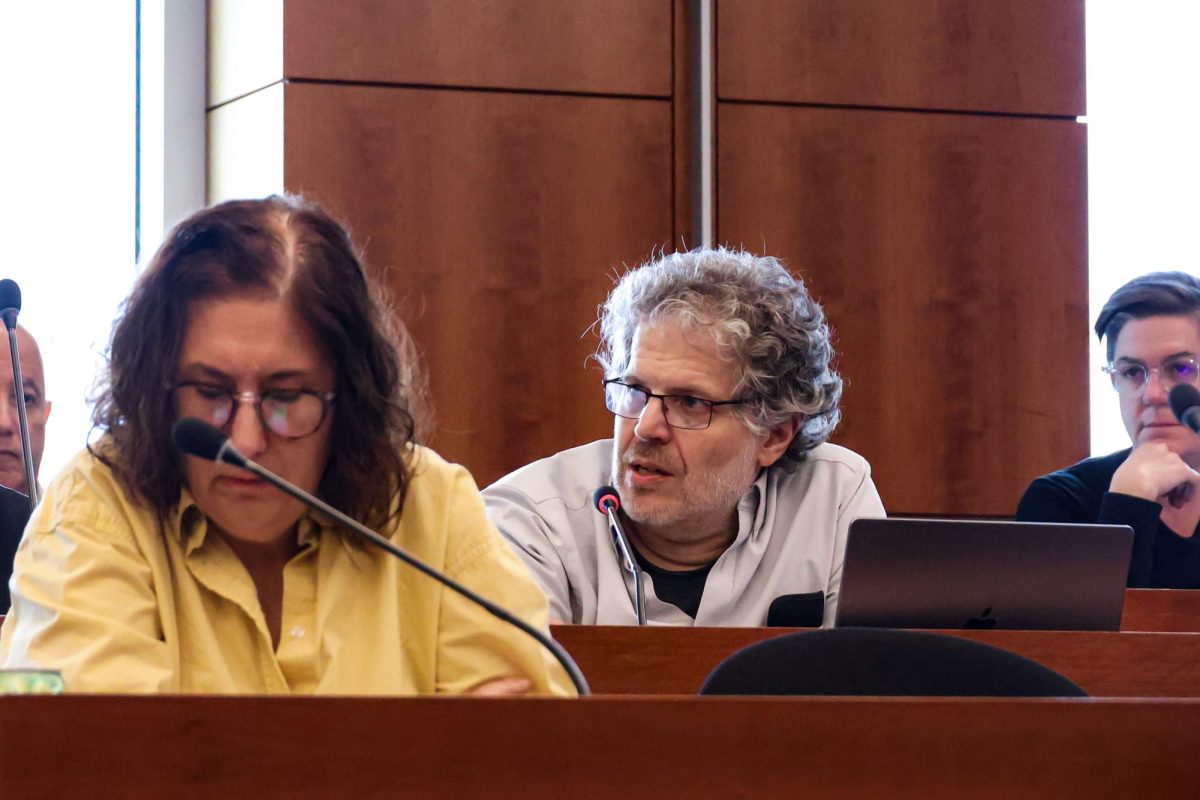
Cohen-Cole said officials spend “lots of money” on consulting projects, like for academic analytics, improving federal funding opportunities, severance pays to former executives and with current executive and executive staff salary increases. He asked Granberg, Bracey and Fernandes if they’ve considered reducing the budget in those areas to ensure additional cuts aren’t made to classes, advising and career staff, given students’ tuition keeps the University functioning.
Former University President Thomas LeBlanc and former CFO Mark Diaz received severance payments amounting to $1,167,000 and $976,440, respectively, during FY2023, according to University tax forms. Fernandes said the upcoming form 990 for FY2024 released in June of July will show additional payments to former officials.
Bracey said this year’s tuition increase is similar to previous years where tuition rates rise while the distribution of revenues stays the same, and a “fraction” of that tuition increase goes to schools and financial aid.
Officials announced in March that undergraduate tuition will increase by 3.5 percent, or $2,360, for the 2025-26 academic year, the first time since 2022 that the increase has been under 4 percent.
Granberg said she agreed with Cohen-Cole that officials should be “mindful” of the money used for consulting while officials work to reduce the budget. She said officials will want to watch themselves to ensure what they’re doing is going to benefit the University.
Granberg said she’s “cautiously optimistic” about the size of the incoming class of first-years in the fall. She said early enrollment indicators “reflect positively” on the “strength” of academic programs.
The University received over 27,000 applications this year and over 5,000 admitted students came to GW in April for their admitted student visits, Granberg said. GW’s number of applications has remained steady over the years, including the University receiving 27,094 applications in 2023 and 27,266 applications in 2022.
Granberg said as of Friday, GW has received 124 less graduate student deposits compared to those received last year. She said the University received fewer early deposits from international students.
During his provost report, Bracey said the University recently finalized a permanent policy review process for the development of new University policies or revisions to current policies that engages the GW community. He said officials, in collaboration with the Faculty Senate, Student Government Association and Staff Council, developed the procedure over several months.
The new review process comes after the University entered a voluntary settlement with the U.S. Department of Education’s Office of Civil Rights in January to resolve two Title VI complaints from 2023 that alleged anti-Palestinian discrimination and antisemitism on campus. The OCR identified “concerns” that GW may have “failed” to effectively respond to reports of discrimination and antisemitism on campus in 2023.
Bracey said the community will receive an email next week detailing the finalized policy review process.
Faculty Senator Guillermo Orti, a biology professor and co-chair of the Committee on Professional Ethics & Academic Freedom, said the committee is “not ready” to endorse the policy review process, as they remain unconvinced that officials’ consultation with the community aligns with the principles of shared governance outlined by the American Association of University Professors. He said the committee views the latest revisions as a “positive development” that improves transparency, but they will reconvene this fall to dedicate “sufficient time” to offering additional feedback.
He said the committee provided “critical feedback” to officials on the guidelines for the policy review process, and administration sent the Faculty Senate, SGA and Staff Council, a revised document based on their feedback.
Orti also said the majority of PEAF members agree that the University should not pursue a declaration of institutional neutrality at this time after its resolution at the April Faculty Senate meeting was sent back to committee. He said the committee was unable to provide a revised version of the resolution for Faculty Senate consideration due to time constraints.
Granberg also said “several” visits to universities by the Department of Justice’s task force on antisemitism appear to be “on hold” but did not specify if that included GW. She said Harmeet Dhillon, the new assistant attorney general for the Justice Departments’ Civil Rights Division who took office on April 7, is taking time to “consider how she wants to approach” her new position.
The Justice Department announced in late February that the federal task force would visit GW to investigate whether the University failed to protect Jewish community members from unlawful discrimination and antisemitism but didn’t specify the timeline of their visit. The Washington Post reported in late April that University officials “soon responded” to the department’s probe and agreed to participate in any inquiry from the Trump administration.
Granberg said the University is preparing to renew the Foggy Bottom Campus master plan, which provides a framework for GW’s physical development over the next 20 years, according to GW’s campus plan website. She said the current master plan expires in 2027, and the University chose Sasaki Associates to design and plan for the renewal.
Phil Wirtz, a faculty senator and professor of decision sciences and psychological and brain sciences, said he questions whether or not officials and the Board of Trustees can handle the financial losses of the Medical Faculty Associates, a network of physicians and faculty from the School of Medicine & Health Sciences and GW Hospital, given they failed to provide the Faculty Senate with public updates on their plan to end the losses over the course of the 2024-25 academic year.
Wirtz said the administration’s silence on the MFA’s persistent losses puts the Faculty Senate in an “extremely awkward position,” and raises the question if the Faculty Senate has confidence in officials and the Board’s ability to solve the financial losses.
“You’ve got to understand that at this point, we almost have a crisis of confidence in the ability of the administration and the Board’s to be able to deal with what is really a quite large elephant in the room that’s impacting all of us,” Wirtz said.
Granberg said officials have made progress on their plan to combat the MFA’s financial losses and have discussed “real decisions” to fix the issue, but she cannot currently talk publicly about the situation. She said there’s a “very good chance” officials will provide an update about the MFA in the fall but didn’t specify the exact timeline.
Granberg also said officials have brought “stronger people” in and made changes to the team, working to address the persistent losses. MFA officials brought on former Chief Operating Officer of the University of Maryland Faculty Physicians Bill Elliott last spring to head the institution, replacing SMHS Dean and then-CEO Barbara Bass, who’d held the role since January 2020.
Cohen-Cole presented a joint recommendation report by the Educational Policy and Technology Committee and the SGA that requests officials to revise the current excused absence policy for undergraduate and graduate students to be more “comprehensive and provide more clarity.” He said the groups recommend providing better guidance on the policy, like explaining the type of documentation students need for an excused absence and providing examples to faculty on how to design class attendance policies.
Cohen-Cole said the groups decided to create the recommendation after a lack of alignment where excused absence policies were posted, particularly during the COVID-19 pandemic when the University changed its documentation policy. He said faculty requested the Provost’s Office on May 2 to establish a committee to update and modernize this excused absence policy for undergraduate and graduate students.
The Faculty Senate voted unanimously to reelect Sarah Binder as the 2025-26 senate parliamentarian and Faculty Senate Executive Committee representatives, including its new chair Katrin Schultheiss. The body approved the 2025-26 Senate Standing Committee and Dispute Resolution Committee’s chair and roster and approved the faculty nominations to the Student Discrimination Report Committee.
Arjun Srinivas, Dylan Ebs, Jenna Lee and Tyler Iglesias contributed reporting.