

University President Ellen Granberg is participating in an advisory group to President Donald Trump’s roundtable aimed at promoting regulations for compensation and eligibility in college athletics, a University spokesperson confirmed.
Trump first convened the Saving College Sports roundtable at the White House in March to advocate for large-scale reforms in collegiate athletics, like regulating the process by which student-athletes earn money through name, image and likeness, and establishing structured rules for the transfer portal and NCAA eligibility. University spokesperson Shannon McClendon said New York Yankees President Randy Levine, the group’s chair and a GW alum, invited Granberg to join a committee of university presidents supporting the roundtable, which is made up of sports and media executives, university presidents and athletic directors, lawmakers, professional and collegiate players and coaches and NCAA leaders.
“President Granberg’s involvement reflects the importance of ensuring that mid-major universities like GW are engaged in conversations that could significantly impact student-athletes and shape the future of college athletics as programs face legal, financial and operational uncertainty,” McClendon said.
A University spokesperson said Granberg’s involvement in the advisory group to the roundtable has included one meeting thus far and is focused only on bipartisan athletics reform. The spokesperson said her involvement in the council is not an endorsement of other political positions or policies.
Granberg signed a letter with other roundtable members to Sens. Ted Cruz (R-TX) and Maria Cantwell (D-WA) last week, advocating for the passage of bipartisan legislation focused on college sports reform, which the pair unveiled Wednesday as the Protect College Sports Act. Their bill supplants the previously Republican-backed Student Compensation and Opportunity through Rights and Endorsements Act after a group of Black lawmakers withdrew their support, arguing it would harm minority athletes and benefit only top programs.
Cruz and Cantwell’s new bill would limit undergraduate athletes to a single transfer without restrictions, create a five year eligibility cap, form regulations on NIL and restrict coach movement in the middle of the season.
The bill preserves targeted antitrust protections for the NCAA from the Republican-led SCORE Act in exchange for guarantees of health insurance and scholarships for student-athletes, as well as stricter NIL regulations, which Democrats advocated for. The bill also takes a neutral stance on whether student-athletes can be classified as employees of a university, a position the SCORE Act prohibited and a major reason the bill stalled.
Several other university presidents signed the letter to Cruz and Cantwell, including University of North Carolina Chancellor Lee Roberts, University of Kansas President Doug Girod and University of Utah President Taylor Randall. Over 40 other roundtable members, like former football head coaches Nick Saban and Urban Meyer, Florida Governor Ron DeSantis, and several student-athletes, athletic directors and conference commissioners, also signed the letter.
McClendon said GW is supportive of bipartisan legislative efforts to address the “biggest challenges” in college athletics, including bills like the SCORE Act. Granberg’s involvement in the advisory group comes after she told The Hatchet last September the University can use athletics to recruit stronger students, attract donors and sharpen the school’s national profile.
After an initial executive order in July 2025, Trump followed the roundtable’s meeting with an order in April with similar policies to Cruz and Cantwell’s proposed legislation, seeking to limit eligibility to five years, allow just one, penalty-free transfer for undergraduate student-athletes and standardize NIL policies. Trump’s April order also threatens to pull federal funding from schools that do not comply with its regulations by Aug. 1.
Collegiate athletic leaders have pleaded with federal lawmakers for years to pass legislation regulating NIL since it was first allowed in 2021. After operating without detailed rules and amid a patchwork of state laws that created inconsistencies in how NIL was enforced, the NCAA has since instituted a series of regulations to standardize the process.
Following new NCAA policies in 2024 that allow universities to partner with official NIL collectives, GW adopted “Friends of George,” a third-party mechanism allowing alumni donors to pool funds for GW student-athletes, ensuring athletes receive compensation through NIL.
The University also runs GDUB Exchange, a student-athlete NIL business registry, allowing student-athletes to advertise themselves to brands, collectives and donors. The Atlantic 10 and GW also opted into a landmark legal settlement last July, which permits universities to directly pay their athletes and allocate $20.5 million annually across all sports in addition to money allocated to scholarships.
The NIL market has grown rapidly since its introduction in 2021, with estimates projecting the market to grow from $1.17 billion in 2024 to $2.55 billion in 2026 as universities, booster-funded collectives and corporate sponsors compete to attract top student-athletes.
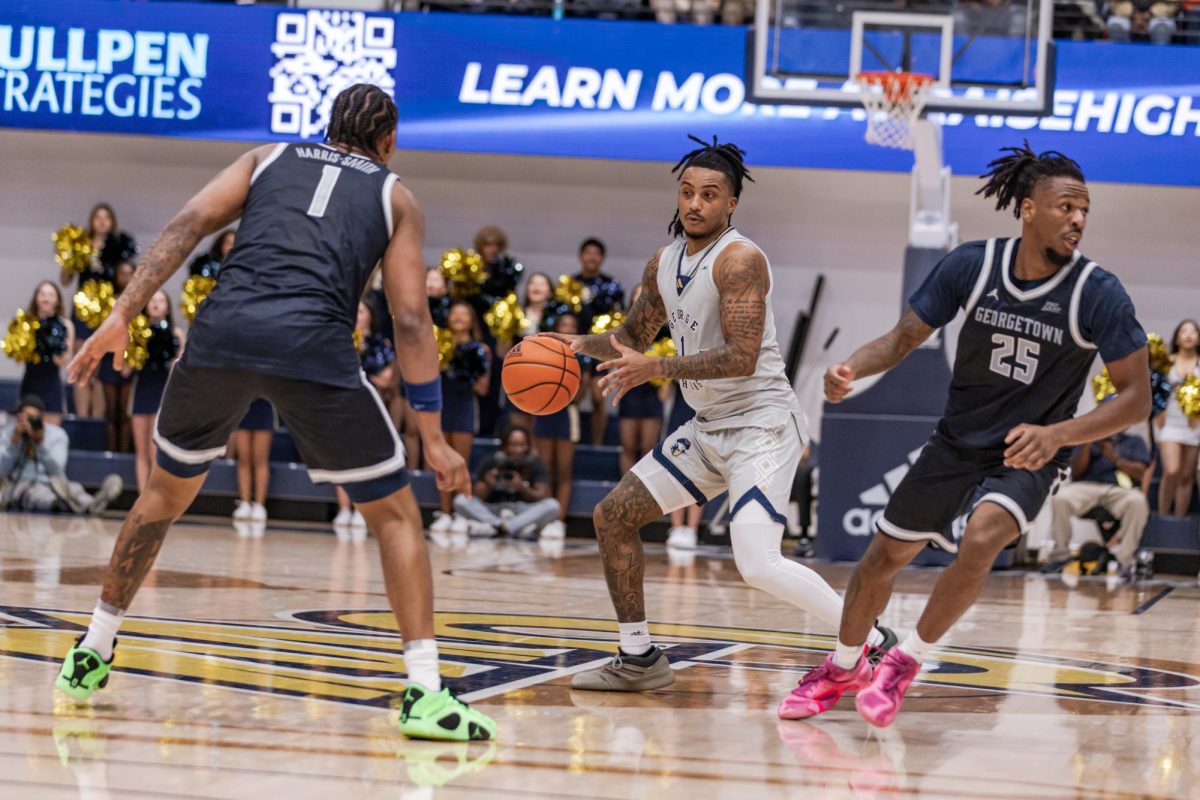
Mid-major athletics programs like GW are currently facing an increasingly competitive and financially strained landscape in the modern era of college athletics. With colleges now able to pay athletes directly and with the struggle to retain top talent against wealthy power-conference NIL collectives, a widening financial gap has threatened mid-major athletic programs’ ability to compete in Division I.
Due to the lack of NIL deals for mid-major schools because of limited exposure, limited highly affluent donors and the unrestricted transfer portal, conferences such as the Atlantic 10 are increasingly vulnerable to losing their breakout stars to the transfer portal — a pattern exemplified by men’s basketball’s six players who left after the 2025-26 season ended.