
Student Government Association members said they are picking up former SGA bodies’ unfinished and unsuccessful efforts to revise University policies to support students’ mental health, including efforts to establish excused days.
Chairs of the SGA’s Committee on Education Policy and Mental Health Assembly said they want to revise University policies to support students’ mental health in the coming year, with plans to consult faculty and officials throughout the process to ensure their plans are feasible and implementable. Committee chairs said they want to continue working on a resolution passed in April by the SGA’s most recent iteration, pushing the University to adopt excused mental health days by introducing it to the Faculty Senate following a previous attempt to do so in 2024, which led to a joint recommendation to GW to revise attendance policies but stopped short of changing them.
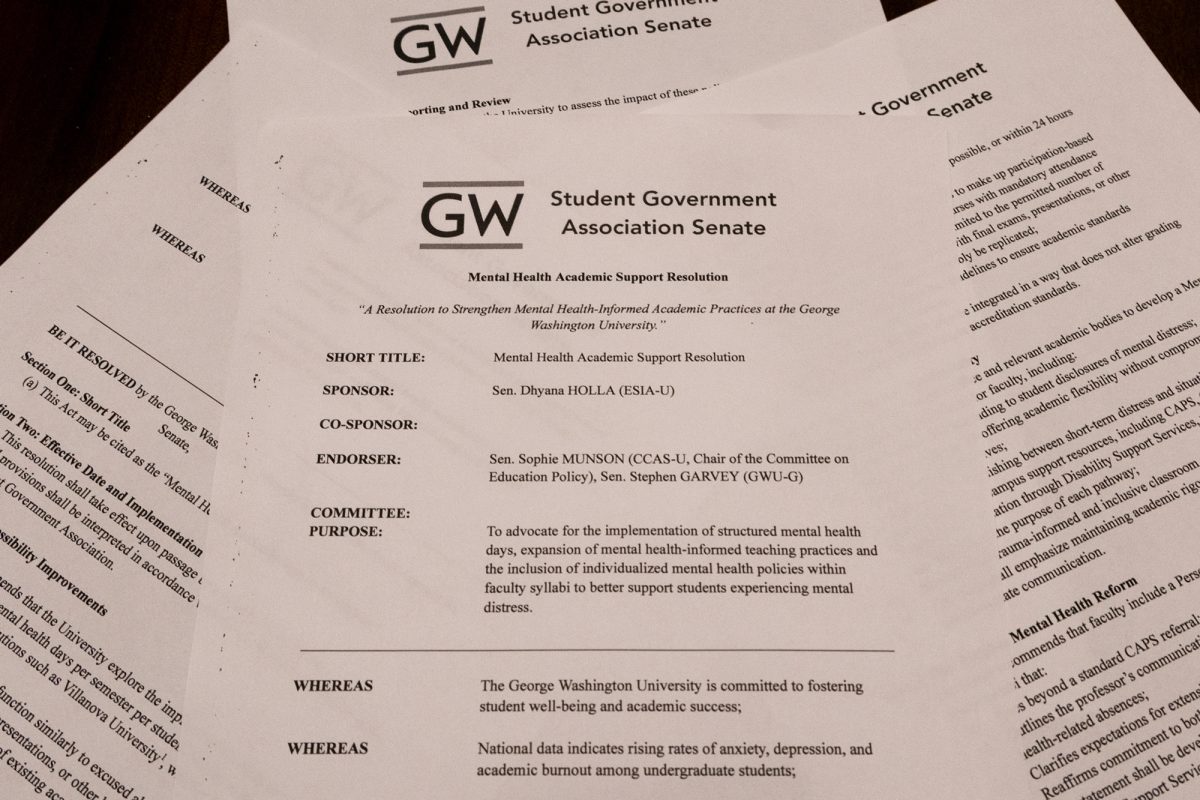
The SGA’s Mental Health Academic Support resolution, passed in April, would allow students to take up to two days off per semester without academic penalty if they notify professors in advance and absences did not conflict with major assignments or activities difficult to reschedule. Senators of this past academic year’s SGA body said national rises in undergraduate students’ mental health struggles were a driving factor for proposing the resolution, as 68 percent of students nationwide said emotional or mental difficulties hurt their academic performance, according to the University of Michigan’s Health Minds Study 2024-25 report.
University policies currently allow for excused absences for “personal circumstances,” like religious observances or documented family and medical emergencies, but give faculty autonomy in setting guidelines for missing work and absences. The Faculty Handbook’s only mention of mental health advises faculty to refer “students in distress” to Counseling and Psychological Services.
The April resolution urges a policy requiring professors to include statements in syllabi for students facing mental health struggles, outlining their policies on flexibility or leniency for coursework and detailing how students can communicate their struggles to them, rather than just referring students to CAPS.
Jivan Ramesh (Law-G), incoming co-chair of the MHA, said the current system, where faculty are not mandated to include these guidelines, can add additional stress on students facing a mental health crisis if they are unable or unsure of how to ask for flexibility.
Ramesh said he plans to introduce the SGA’s resolution to the Faculty Senate’s Educational Policy & Technology Committee with hopes they will join him in recommending excused mental health days to University officials. Ramesh said he would also like to use his seat on the Faculty Senate’s Professional Ethics and Academic Freedom and Libraries committees to solicit more faculty and officials’ perspectives to revise the resolution and improve the chances officials adopt it.
“The resolution is in existence, and I think the main focus right now should be trying to get this to the eyes of the Faculty Senate to see their opinions,” Ramesh said.
Former SGA President Ethan Fitzgerald brought a different resolution advocating for excused mental health days to the Faculty Senate in 2024, leading to the formation of a yearlong ad hoc subcommittee of EPT with SGA leaders, faculty and University officials to revise attendance policies, but it ultimately created no change in GW policies.
University spokesperson Julia Garbitt said the University has expanded student mental health and wellness efforts, including an increased number of counseling and student support offices for students facing “significant” mental health challenges. She said the University currently encourages students to seek assistance without needing to disclose sensitive personal information to faculty.
She said the University discussed mental health days in a 2024-25 ad hoc subcommittee with representatives from EPT, Disability Support Services, CAPS and Associate Provost for Undergraduate Affairs and Special Programs Jeffrey Brand, but did not specify if the University took any further action on developing excused mental health days.
The ad hoc subcommittee — created by EPT and the SGA during Fitzgerald’s original attempts to persuade the University to adopt excused mental health days — recommended in May 2025 that GW revise attendance policies and present findings about considerations EPT and the SGA posed to the University, including what documentation students would need to provide faculty indicating they are facing mental health struggles and how students could request make-up times without burdening instructors, to EPT by April 30, 2026. EPT co-chair Jamie Cohen-Cole said the University did not share updates with EPT during the 2025-26 academic year.
Sen. Zachary Brivio (ESIA-U), incoming SGA EP committee chair, said he is unsure if the EP committee would continue advocating for mental health days because he said he wants to further research student, faculty and University perspectives through speaking with each group. He said before implementing any policy, even if it addresses student needs, he wants to speak with administrators and faculty to understand whether it is feasible.
Brivio said he is sure the EP committee will pursue mental health advocacy in other places, including asking officials to make class registration and academic advising clear and easy to access. He said students have told him the current structures for registration and advising are confusing, serving as stressors, and intensifying existing mental health struggles.
“Ultimately, we can’t do anything if it’s just out of reach for those schools and those deans as professors, so it’s researching their needs as well,” Brivio said.
Cohen-Cole said EPT is also addressing students’ mental health distress at the “root” by trying to relieve financial pressures, which he said is one significant source of anxiety for college students. He said the Revolutionary Promise — full coverage of tuition for students with household incomes of less than $100,000, starting with the class of 2030 — may help students facing mental health struggles from financial stress amid rising tuition.
“I think it’s important to recognize and address the root causes of mental health difficulties from anxiety to depression among students,” Cohen-Cole said in an email.
Eric Grynaviski, an EPT member and political science and international affairs professor, said a policy for excused attendance should be consistent University-wide to ensure students can bring up mental health struggles with faculty, regardless of their personal relationship or comfort with the professor.
“From the perspective of an academic policy, it’s important to have one which makes sure that whether or not a student gets an accommodation doesn’t depend on something like rapport with an individual faculty member,” Grynaviski said.
Grynaviski said the SGA should also consider the prevalence of loneliness among college students when developing mental health policy and promote initiatives that build community, which he said might help students manage their anxiety.
“I think the University renewing its commitments to community building, especially for students in their freshman year, will go a long way to reducing at least certain types of anxiety as they affect college students,” Grynaviski said.