

After a fatal hit-and-run in the West End earlier this month, urban planning experts said D.C. needs to more aggressively enforce traffic laws and implement safer street designs in order to achieve its goal of reaching zero traffic fatalities, first proposed in 2015.
Vision Zero D.C., the District’s arm of a global initiative to eliminate all traffic fatalities and serious injuries by 2024, has seen limited success as annual traffic fatalities have climbed since the program’s launch in 2015. With the District now totaling six pedestrian fatalities in 2026, experts in traffic safety and urban planning said D.C. needs to achieve more of the design and safety goals in the Vision Zero plan, like installing curb extensions and reducing traffic speeds in order to reach zero fatalities, but stressed that the city still remains relatively safe among metropolitan areas.
Pedestrian fatalities in D.C. have risen since 2020, with 52 pedestrians killed on D.C. streets between the beginning of 2022 and the August 2024, before the number dropped in 2025. To date, there have been 141 pedestrian fatalities in the District since Vision Zero began tracking them in 2017.
The Foggy Bottom and West End neighborhood has seen several traffic fatalities in recent years, with a Jeep striking a 61-year old woman while she was using a crosswalk on the intersection of 23rd and L streets this month, a car hitting a graduate student in 2023 while he was cycling through the intersection of Connecticut Avenue and L streets and a construction truck driver fatally striking a cyclist on the corner of 21st and I streets in 2022.
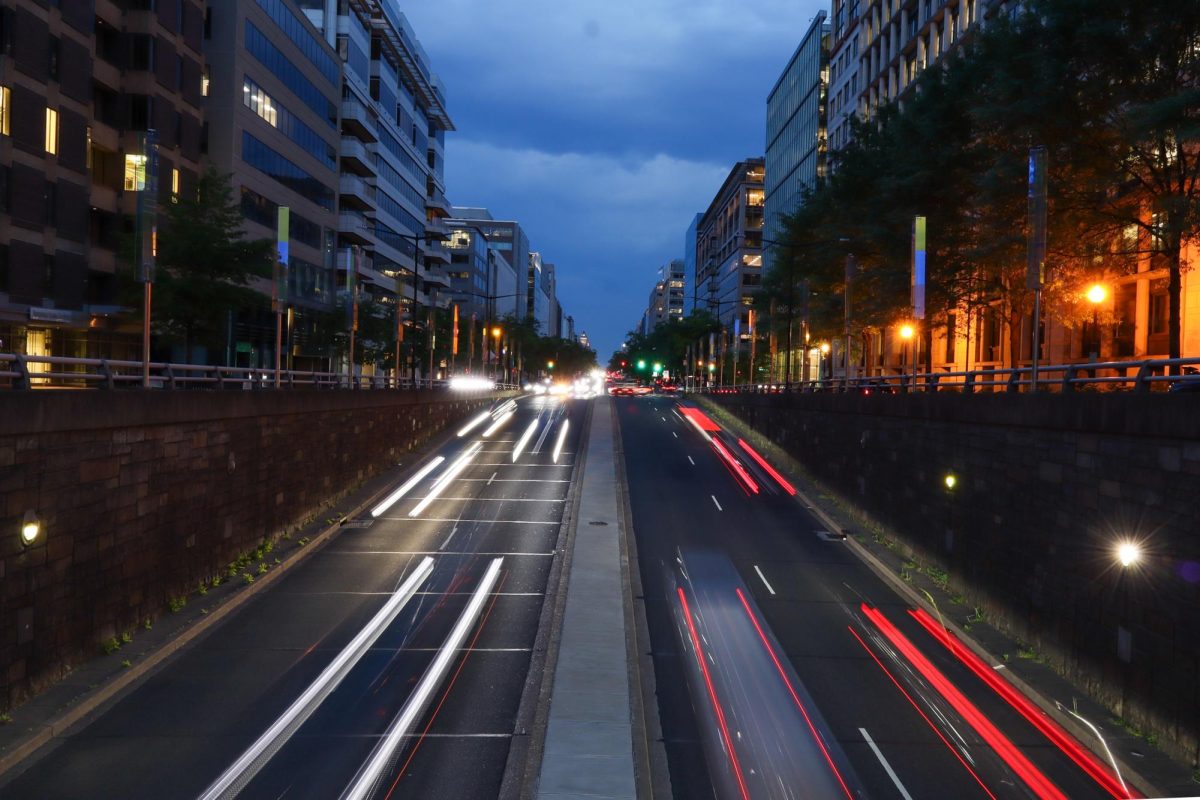
Cheryl Cort, the D.C. and Prince George’s County policy director at the Coalition for Smarter Growth — a group that advocates for more walkable urban development in the DMV region — said D.C. needs “to do a lot more” with regards to its Vision Zero plan by redesigning arterial roads, which are high-capacity urban roads — often with numerous lanes that encourage drivers to speed — to prevent pedestrian fatalities. Virginia Avenue and K and 23rd streets are all considered arterial roads in Foggy Bottom, according to the District Department of Transportation.
“We really need to commit to more rapidly rolling out redesign of arterials where most people are killed,” Cort said. “Vision Zero identifies a high injury network, which are major roadways, which are wider and faster, and the place most likely where the next pedestrian fatality is going to occur.”
Vision Zero fell short of its initial goal of zero traffic fatalities by 2024 — when there were 52 total traffic fatalities in D.C. that year — and a 2023 report from the Office of the District of Columbia Auditor found that Vision Zero lacked adequate funding set aside for the program in D.C.’s budget, but Vision Zero’s director told the Washington Post in 2024 that spending had since increased since the report was released.
A spokesperson for the DDOT, the department that oversees Vision Zero, did not respond to a request for comment.
Cort said D.C.’s automated traffic enforcement, like traffic cameras, is necessary for improving pedestrian safety because enforcing traffic laws more stringently “complements” the “core-effort” of designing streets that are safer for pedestrians with measures intended to reduce driver speeds.
“This is a proven measure for improving safety, discouraging dangerous drivers from speeding, drivers from running red lights,” Cort said. “It’s a proven measure and to take it away means that we will just introduce new hazards into our street, where dangerous drivers can run red lights and speed with impunity.”
Traffic cameras are a major component of Vision Zero, with DDOT installing them across the District. DDOT has committed to placing cameras at locations where crashes frequently occur, according to a DDOT webpage.
Peter Furth, a professor of civil and environmental engineering at Northeastern University, said pedestrian fatalities tend to be spread across cities because pedestrian safety issues are usually systemic problems stemming from the city’s design, rather than problems isolated to a cluster of intersections.
Furth said older, narrower streets — as opposed to wide, multi-lane roads that encourage speeding — tend to be safer for pedestrians.
“They’re just scattered all over the place,” Furth said. “And if you look at where they happened the year before, they’re just all over the place. You cannot solve them by fixing spots. What you have to do is make a systemic change to just make road traffic safer.”
Furth said D.C.’s comparatively low traffic fatality rate is due to a variety of factors ranging from the fact the city was designed before cars dominated the roads to traffic signals that tell pedestrians how long they have to walk long before their time runs out.
“Washington has a uniquely pedestrian friendly way of timing the traffic signals, where they give you a countdown, sometimes starting at 60 or 70,” Furth said. “No other city in the country does that. That’s an amazing thing.”
Furth said one of the most crucial thing cities can do to reduce pedestrian fatalities is to make it harder for drivers to speed. He said speed cameras and changes to the design of a road is effective for accomplishing this.
“The first systemic change is lowering the speed of drivers,” Furth said. “So for if a pedestrian is hit at a speed of 20 miles an hour, they have a very high chance of surviving. At 30, they have less than a 50 percent chance and at 40, they have a small chance of surviving.”
Furth said D.C. should partake in more “road diet” projects, which consist of taking a road that has more than one lane traveling in the same direction and reducing it down to a single lane traveling in each direction. He said multiple lanes encourage drivers to pass, which he said can lead to speeding.
“If you can pass, you can speed,” Furth said. “And if I take away that extra lane so you can’t pass, well, if you can’t pass, you really can’t speed, or not for long, because then as soon as you reach the car ahead of you, now you’re stuck going the same speed they are.”
Robert Schneider, an urban planning professor at the University of Wisconsin—Milwaukee, said achieving Vision Zero’s goals in D.C. will require the District to continue implementing a host of changes, like the installation of curb extensions — which shortens pedestrian crossing distance and improves visibility at crosswalks — and lowered speed limits, both of which will make pedestrians safer.
Schnedier said cities with older, narrower streets and reliable transit systems — like D.C. — are more likely to have a lower pedestrian fatality rate since fewer people will need to drive — and when they do, they are more likely to drive slowly.
“They tend to have narrower streets,” Schneider said, referring to the types of cities where traffic fatalities are lower. “They tend to have good mass transit systems where not everybody has to drive. It gives people more choices. And so those are safer systems overall.”


