
Ryan Gilhuly did not want to just write his senior thesis on the transcendent comedy of ancient Greek theater. He wanted to show it on the stage.
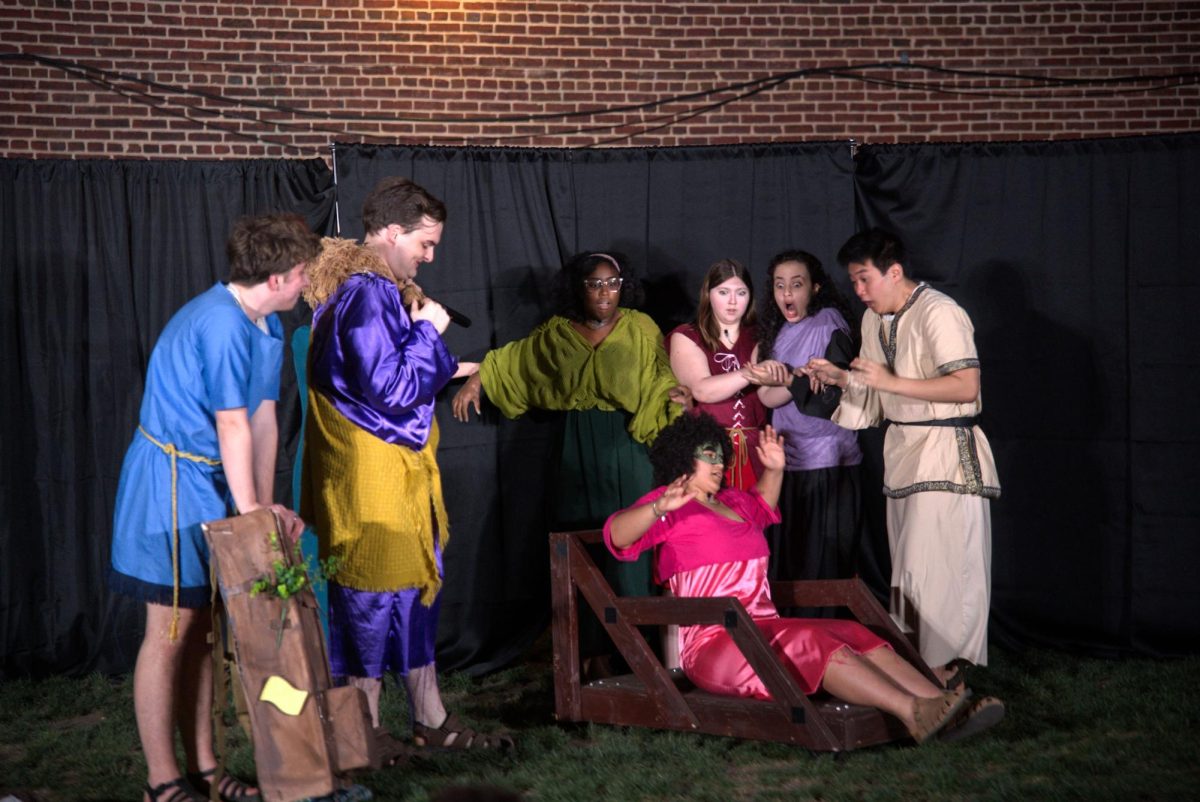
On Friday night, G Street Park transformed into a stage where over 40 people gathered on lawn chairs and blankets to see Gilhuly, a senior majoring in archeology and classical and ancient near eastern studies, unveil his production of “The Frogs,” an ancient Greek comedy written by Aristophanes. While most students write a research paper for their senior thesis, Gilhuly wanted to use his love for theatrical directing and experience with the GW Shakespeare Company to show how he could translate comedy from 2,000 years ago for a modern audience.
“By showing with comedy specifically that the human really hasn’t changed all that much in over 2,000 years, people can see people weren’t that different back then,” Gilhuly said. “It was still just humans finding things funny.”
With that goal in mind, Gilhuly was drawn to “The Frogs,” which follows the Greek god of wine, Dionysus, and his journey to Hades, the Greek underworld, to bring a playwright back to life to save Athens. Gilhuly said much like today’s art, ancient Greek comedy reflected societal issues, and satirical shows were and still are used to bring awareness to the general public about societal issues.
Gilhuly said he began planning “The Frogs” last October, fusing his love for theater with his need to finish his thesis after attending a capstone presentation information session in his department, where he learned he wasn’t restricted to a research paper and could take more creative routes.
“I’ve done a bunch of theater in the past, and I know about classics, and so if I can combine the two, it would be the best of both worlds and means I don’t have to write a long paper,” Gilhuly said.
Gilhuly said that one of his initial goals when considering directing the play was to raise modern societal and political issues, but he eventually opted not to, since the play, unlike most historical Greek plays, isn’t centered on politics but rather on the state of theater, with references that audiences can connect to today. Instead, he chose to focus on translating the play’s comedy, adapting references so a modern audience could understand and better connect with the humor.
“People weren’t that different back then,” Gilhuly said. “It was still just humans finding things funny, and by presenting it in a comedy, it can really help with people’s understanding of the past.”
Creating the production with the GW Shakespeare Company was a full-circle moment for Gilhuly, because he said it’s been a through line of his college career — performing Shakespeare’s “Twelfth Night“ during his freshman year to now directing this production in his last semester at GW. The organization welcomes students with all experience levels and is always open to new approaches to Shakespeare, which Gilhuly said is his favorite part.
While Shakespeare did not write “The Frogs,” Gilhuy said the club often takes other plays and puts a Shakespearean spin on them, performing them in a classical, music-free style.
“They’re always looking for new people and always accepting of new ideas that people have because, especially for Shakespeare things, it’s so open to adaptations,” Gilhuly said.
Sophomore Hayden Adams, an archaeology and classics double major and a performer in the play, said Gilhuly made tweaks to the script to build up her character of an angry maid. Adams said Gilhuly removed a lot of confusing language and contextualized the script to clarify names and references, allowing her jokes to make more sense.
“I definitely have tried to make them my own,” she said. “The maid is the angry side that I don’t usually let out. She’s all my emotions that I try to keep inside.”
Adams said she also had the opportunity to play a member of the chorus of frogs that taunt Dionysus as he rows the River Styx. She said that the biggest challenge of performing as a frog was the physical demands, including crawling around on the floor and staying in time with the rest of the cast.
“I think the hardest role to play has been one of the frogs,” she said. “Not only physically, because we have to crawl around like a frog, but it’s also hard because most of our lines are all in unison.”
First-year Savanna Jones, an international affairs and Asian studies major who is also a performer in the play, said the cast was able to translate the humor and context of the ancient Greek work for a modern audience through extensive research on the play and by using body language, blocking and facial expression to help clarify focus lines.
Jones said it was Gilhuly’s “artistic eye” that drew her to audition for and join the production after she performed in a play he directed last semester.
“Your body shows the context,” Jones said. “It also carries that context to the audience members who might not be as familiar with Greek comedies, Greek plays. So making sure that you know what you’re doing as an actor is really important, so you can carry the meaning across to them.”