
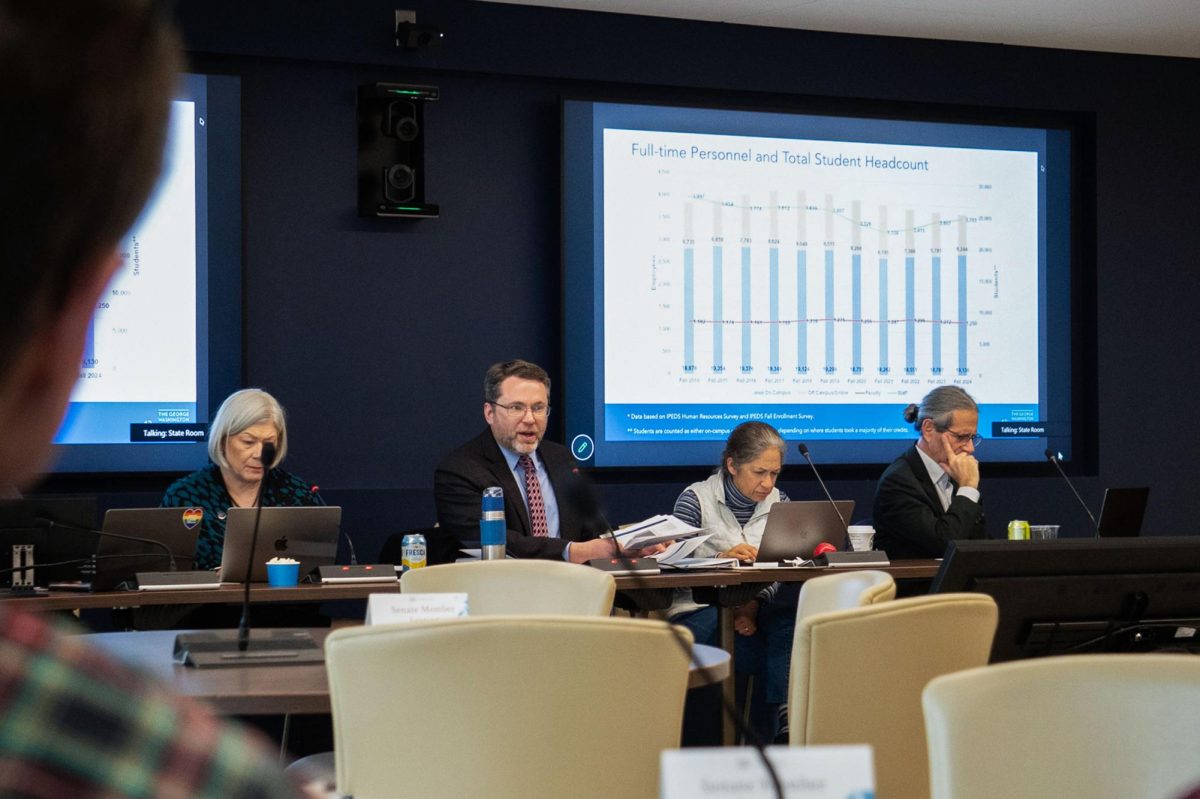
Average faculty salaries in some positions lagged behind peer institutions’ in academic year 2024-2025, according to the annual core indicators report Interim Provost John Lach presented to the Faculty Senate Friday.
Lach shared data at the meeting showing the University paid associate and assistant professors, 0.33 and 5.75 percent less on average than GW’s peer schools, a gap he said officials will need to closely review to determine which factors contributed to the lower pay. The report also shows that the share of tenured and tenure-track faculty relative to contract and specialized faculty remained steady at 70.6 percent, with two schools falling short of a Faculty Code rule requiring that at least 75 percent of regular faculty be tenured or on the tenure track.
The annual core indicators report, presented by the provost each spring with data from the prior academic year, includes key University metrics, like the composition of students and faculty, enrollment headcounts, average salaries and faculty demographic data. Lach said officials want future reports to better reflect the goals in the new strategic framework by including relevant metrics, like on interdisciplinary research.
Lach said the gap in salaries between GW and its peer schools for average associate professor pay narrowed, with peer institutions as of 2024-25 offering slightly higher pay on average — $132,242 in 2024-25 compared to GW’s $131,800.
“We need to sort of dive into this and see what happened,” Lach said, adding that promotions and lack of merit increases could affect the data.
Lach said officials also need to examine the gap in assistant professor salaries, which have historically lagged behind the average at peer institutions. Assistant professors at GW in 2025 earned an average salary of $108,100, compared to $114,691 at peer schools, according to the report.
GW neared the average assistant professor salary in 2019, when it sat at $102,600 compared to the market basket average of $102,633 and remained close to the average in the years following, though the gap widened again in 2025, according to data in this year’s report.
Full professors’ salaries at GW remain above the average at peer institutions, with GW professors earning about $203,000 on average compared to $198,191 at other market basket schools, according to the data.
The University had 22 fewer tenure or tenured-track faculty members in 2025 — dropping from 809 in 2024 to 787 in 2025 — per the report. The Columbian College of Arts & Sciences and the Graduate School of Education and Human Development did not meet the Faculty Code clause requiring that 75 percent of regular faculty be tenured or on the tenured track.
The Faculty Code clause states that regular faculty in nontenure track positions should not exceed 25 percent in any school and that officials should tenure 50 percent of regular faculty in a given department. The requirement does not apply to the School of Medicine & Health Sciences, the School of Nursing, the Milken Institute School of Public Health and the College of Professional Studies, according to the clause.
In CCAS, 72 percent of faculty were tenured or on the tenure track in 2025, the lowest percentage since 2021 when tenure or tenure track faculty percentages also stood at 72 percent, marking the eighth straight year CCAS has failed to hit the 75 percent requirement, according to data from the report.
73 percent of the GSEHD’s faculty were tenured or tenure track in 2025, down from 76 percent in 2024. The data shows GSEHD had seven fewer tenured or tenure-track faculty in 2025 than it did in 2024.
GW Law saw a spike in tenured or tenure track professors in 2025, with 85 percent of faculty holding those positions — up from 76 percent in 2024 and the highest tenure rates in the school since 2021, when 95 percent of GW Law’s faculty were tenured or tenure track. The school had 17 more tenured-track faculty members in 2025 compared to 2024.
Faculty Senator Phil Wirtz said his department chair is “pleading” with tenured and tenure-track faculty not to retire because they worry GW won’t replace tenured positions. He said the loss of tenured faculty would force more responsibilities onto fewer professors, making their jobs “almost impossible.”
“If this isn’t corrected, it’s going to be a real problem, and we’re not talking about the long term, we’re really talking about the short term future,” Wirtz said.
Faculty Senator Maria Cseh said it is hard to maintain successful academic programs when there is no succession plan in place for retiring tenure-track faculty or ability to “nurture” the next generation of faculty. She said her program has had five to seven faculty members retire over the past eight years and has been unable to hire replacements.
Lach said the Board of Trustees approved 30 new tenure and tenure-track searches in 2025 and is “very concerned” about the decline in tenure-track faculty. He said the new searches were not evenly distributed across schools due in part to financial constraints.
Lach said the amount of available resources factors into officials’ decisions to hire more tenure-track faculty. He said officials and faculty need to have a conversation about what the proper composition of tenured, contract and specialized faculty should look like, given available resources.
Faculty warned last March that the decline in the number of tenured and tenure-line faculty — which reached a decade low in the 2024-25 academic year — could harm the University’s research mission. They said officials’ replacement of tenure and tenure-track faculty with specialized faculty masks the waning tenure lines across the University that could stifle relationships between students and professors.
The report also found that GW is still below its 94 percent first-year retention goal, sitting at 90.7 percent in 2024. Lach said the University has to take a “hard look” at how to reach its goal, including through the strategic framework’s D.C. Experiences Working Group, which is looking at how GW can increase retention through academics, activities and mental health support.
“Not just academically, socially, psychologically, there’s lots of different things that our students need,” Lach said. “How can we make sure that we’re providing that in a way that is going to help us get to that 94 percent number?”
Granberg, in her opening remarks, said the proceeds from last month’s Virginia campus sale will allow officials to make “significant investments” to fund strategic framework initiatives, including meeting the full demonstrated financial need of residential undergraduates. She said the sale will get officials a quarter of the way toward meeting that goal, though Vice President for University Advancement David Unruh is also working on a fundraising campaign to entice donors to match what’s currently in the endowment, which would further help officials’ strategic framework financial aid goals.
Granberg said Lach and Chief Financial Officer Bruno Fernandes held a town hall for the community last week regarding the Virginia Science and Technology Campus sale, where she said people were “not surprisingly” concerned about their programs and work circumstances.
She said officials plan to create a task group to ensure the transition of the campus’ operations are coordinated and “carefully planned.” She added officials want to wait until a new provost enters into the role before they have “serious conversations” on where the funds from the sale should be allocated.
Granberg, in a report submitted before the meeting, said officials welcomed the first of five finalists in the provost search last week. She said the Faculty Senate Executive Committee will be involved in the finalist interviews.
Wirtz read remarks honoring former Faculty Senator Joseph Cordes, who died last month and served on the Faculty Senate for over 20 years, including most recently on the senate’s Fiscal Planning & Budgeting Committee. Wirtz said Cordes was passionate about making GW a better place and could explain University finances in a common-sense way for people to understand.
“Joe Cordes was the embodiment of all that is good about GW,” Wirtz said.
Granberg reflected on the first time she met Cordes at her first fiscal planning and budgeting committee meeting, where she said she “instantly” liked him and he had a “wonderful feeling” about him.
She said officials plan to honor Cordes’ legacy permanently and asked the Senate to email her ideas on how to best do so.
“He earned a position of trust and respect and authority here at GW, and I can tell you that that was shared very much by the senior administration,” Granberg said.
Faculty senators Jennifer Brinkerhoff and Susan Kulp also read statements honoring Cordes’ legacy, with Brinkerhoff also sharing a message from Director of the Trachtenberg School of Public Policy and Public Administration Kathy Newcomer. The senate followed their tributes with a moment of silence.
“He was gregarious, warm and always ready with a laugh, and he had a gift for turning colleagues, students and anyone who crossed his path into friends,” Kulp said.
Rachel LeMoult and Zoomel Ghauri contributed reporting.