
Updated: Aug. 29, 2025 at 4:20 p.m.
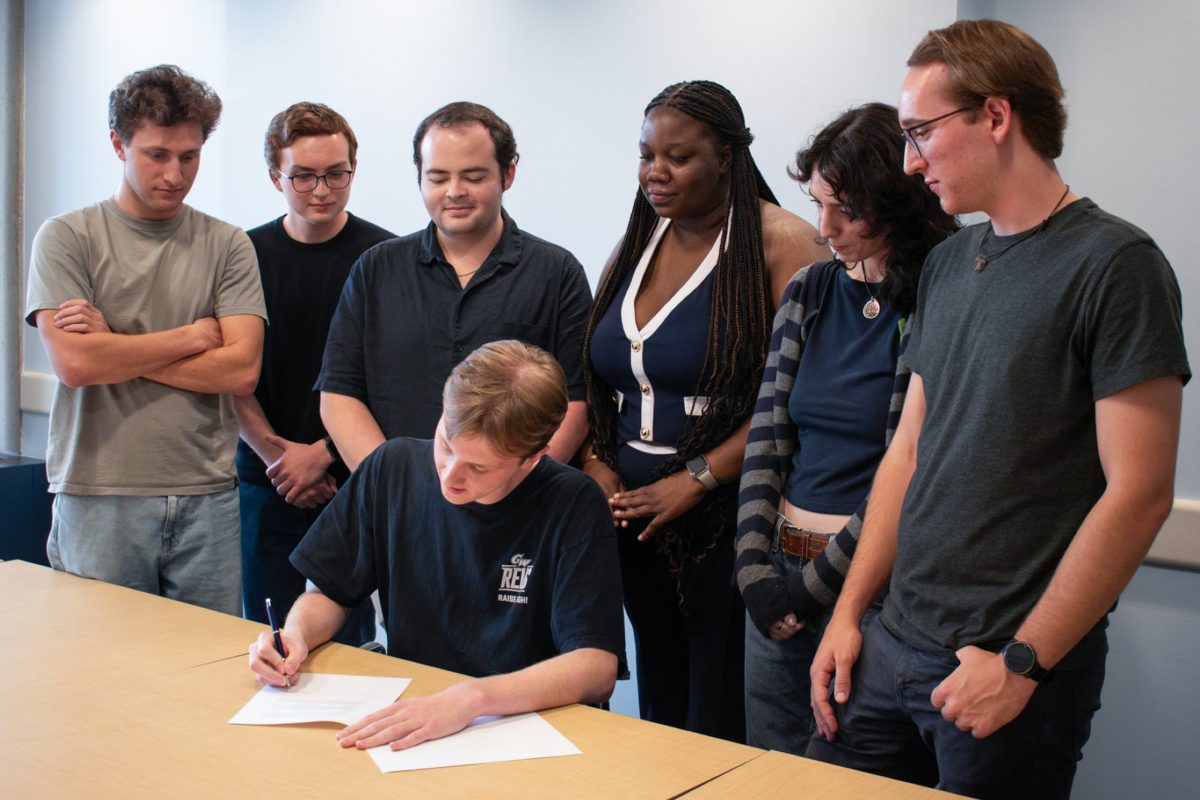
Student Government Association President Ethan Lynne signed an executive order Tuesday establishing an office to assist students and organizations undergoing the conduct process.
The Student Advocate’s Office will operate as an independent entity within the SGA and will establish a team of specially trained student advocates to assist students and organizations navigating the conduct process, Lynne said. At the signing ceremony, Lynne said the office is “the first step” in a broader effort to give students “a voice” in conduct proceedings.
University policy currently allows students or organizations going through conduct proceedings with the Office of Conflict Education and Student Accountability to select a “support person” — an individual who can advise the student or organization through the student conduct process — which can range from GW faculty and staff members to other GW students, parents or friends. The new office offers additional support but doesn’t replace the student’s ability to select their own support person, according to documents Lynne shared with The Hatchet.
“I’m so grateful to all the people who worked with us on this,” Lynne said in an email. “And it’s also crucial to remember that this signing is just the first step in what will be a lengthy and detailed process.”
Lynne said he created the office in response to the concerns that “numerous stakeholders” — including friends and student organizations — across campus have raised to him about the conduct process. He said the office and its advocates will also help any student organizations that seek its resources, in addition to individual student cases.
The office will not begin handling student conduct cases until at least spring 2026, according to documents provided by Lynne. During the fall 2025 semester, the office will focus on finalizing operational details and recruiting staff between August and October and then begin practicing casework and advertising the office starting in November, according to the documents.
A chief student advocate, a GW student who the SGA president appoints and the SGA Senate confirms, will oversee the office and three deputies — also students appointed by the chief advocate — who will manage each of the office’s three policy areas: academic affairs, conduct and safety and student grievances.
University spokesperson Kathleen Fackelmann said CESA participated in some preliminary discussions with the SGA about the creation of the office, where officials discussed being available to train the advocates, supporting the initiative and maintaining student privacy during conduct proceedings.
“CESA looks forward to the Student Government Association’s effort to establish an additional resource available to students in the Conflict Education & Student Accountability process,” Fackelmann said in an email. “‘Support People’ are an important part of CESA’s processes. While CESA works to help all participants in our processes, a chosen support person can focus on an individual student in a different and meaningful way.”
After signing the order, Lynne appointed Ben Wieser, the SGA executive branch’s special counsel, as the acting chief student advocate and nominated him for the permanent position. Wieser will face SGA Senate confirmation at the next SGA Senate meeting on Sept. 15 or at a future meeting decided by SGA Vice President Liz Stoddard.
Lynne said the office is still finalizing details regarding advocate recruitment and office structure. He said he and Wieser will look to appoint staff “passionate about making a difference” and “standing up for others” but will not require students to have past experience with CESA to join.
Lynne said caseworkers will sign confidentiality agreements and disclose conflicts of interest, like participation in student organizations or University-sponsored employment, with only the chief student advocate and deputies having access to all case files. He said individual advocates will only see the files for the cases they are assigned and other SGA members, including the president, vice president and senators will not have access to the office’s files.
“The SAO will retain as little identifiable student information as possible,” Lynne said. “For example, after the conclusion of a casework matter, the SAO will send the student client a copy of all the documents the SAO gained access to or generated during the case. Then the SAO will promptly delete those records.”
Beyond its main function of student casework, Lynne said the office will also provide policy guidance related to the conduct process to the SGA’s legislative branch and generalized data on student experiences and outcomes to inform policy recommendations.
“I think it will prove to be an incredibly helpful resource as SGA leaders work to develop future policies,” Lynne said. “To grow leaders with a deep knowledge in that niche field will have benefits whenever policy discussions arise in the future.”
From 1978 to 2001, the SGA — then known as the Student Association — ran the Student Advocacy Service through the executive branch, which informed students accused of conduct violations of their rights and responsibilities and guided them to resources for help navigating the discipline process.
In 2018, Student Association leaders began recruiting a group of student mentors for the Student Advocacy and Support Corps, a program that offered guidance to students who violated the Code of Student Conduct. Student advocates under that program took part in a roughly a three-month training with SA leaders where they learned about the academic code of conduct and GW’s disciplinary process.
The Student Advocacy and Support Corps closed in 2021 due to low casework numbers.
Lynne said SGA leaders will focus on keeping the new office active and give it duties, like advising policy decisions, to ensure it can remain open even with low casework numbers.
“I think the time is now for advocacy projects across the board, especially those that stand to help protect students rights,” Lynne said. “We will definitely center our focus on longevity and making sure it doesn’t disappear like in the two previous occasions.”
Wieser, the acting chief student advocate, said he developed and proposed the idea of creating the office to Lynne after talking to SGA members who were familiar with free speech and other University policy issues who explained the lack of resources for students in the CESA process.
“Talking with them, we realized that even in environments where policy change was difficult, there was still a lot of good to be done by making sure that students knew what their rights were and what was supposed to happen when they encountered those processes,” Wieser said in a message.
Wieser said although the executive order to create the office has already been signed, it does not mean the office’s structure is “set in stone.” He said the office will spend the fall semester gathering student input and talking to student organizations about common problems they face in the CESA process to build a model that “delivers results.”
Wieser said he will retain the role of special counsel within the SGA executive branch but that any policy work he did will now take place under the office.
Kalah Neal, president of the GW Black Student Union, said she collaborated with Wieser on the proposal to ensure the office could build trust with students. She said for the office to be effective, it has to be “consistent, transparent and accountable” to the student body.
“I see it as an opportunity for students to have a stronger voice in University decision-making, and I wanted to ensure that vision was built into how the office is structured,” Neal said in a message.
This post was updated to include comment from the University.