
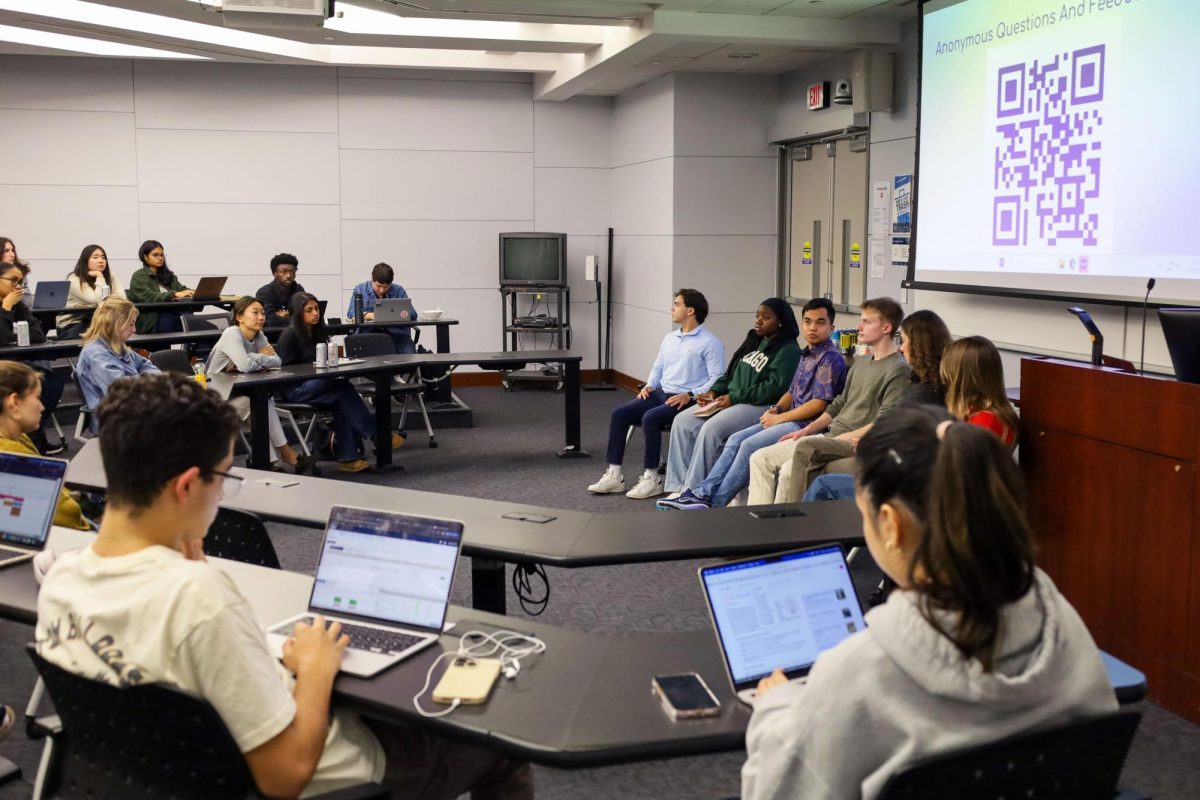
Members of the Student Government Association answered student questions about how the body plans to advocate for greater transparency from officials about National Guard presence on campus at an SGA town hall meeting Tuesday.
SGA Vice President Liz Stoddard led the SGA’s first town hall of the year, reading questions submitted by the audience to the panel of six SGA members representing several committees, including the Student Life Committee and the Community, Advocacy and Inclusion Committee. Attendees asked anonymous questions through a Google form about how the SGA works and plans to act as a voice for students when it comes to worries about heightened guard presence on campus, the University’s new strategic framework officials launched Tuesday and online harassment on social media apps, like Fizz.
The town hall, which Stoddard said she hopes to host more of this semester, comes as students have called on the SGA in recent years to be more transparent about what the body does on campus and how it advocates for students to University officials, with seven of 11 SGA candidates for vice president and president mentioning transparency or increased presence in their campaign platforms over the last two elections.
About seven students not affiliated with the SGA attended the town hall, with the rest of the almost 30-person audience consisting of SGA senators and SGA Senate staff.
“This is the first one we’re doing this semester, we hope to keep doing more of these,” Stoddard said.
Stoddard and the panel answered a question about what steps the SGA can take to push back against the guard’s presence on campus and prevent troops from accessing campus buildings.
Students have reported a rise in guard presence on campus over the past few weeks and said the continued deployment makes them feel unsafe. About 2,300 guard troops from eight states remain in the District two months after President Donald Trump sent troops to patrol the city as part of his crackdown on crime.
Officials said in a weekly federal updates email to community members Thursday they are aware of the increased visibility of the guard on campus. Officials said they are also aware of “limited” instances where guards entered University buildings and confirmed they did not request the guard’s presence on campus.
Officials also clarified that recent reports of guard troops on the Mount Vernon Express shuttle were actually members of GW’s Naval Reserve Officers Training Corps who were erroneously identified as members of the guard because they were dressed in NROTC camouflage uniforms.
SGA President Ethan Lynne said at last week’s Board of Trustees meeting that students are anxious about their physical safety on campus. He held up a photo of guard troops inside Duques Hall — a tap access-restricted building — at the meeting and called on officials to reaffirm their commitment to students’ safety and belonging because students want to feel secure and supported on campus.
Stoddard said troops are trespassing any time they enter a building that requires tap access, which Associate Vice President for Campus Safety Katie McDonald confirmed at an SGA Senate meeting last month and encouraged students to send the SGA pictures if they see the guard in University buildings, so they can share that information with officials. She said she has noticed over the past few weeks that the guard has “creeped” from the Foggy Bottom-GWU Metro station, where they mainly patrolled when they were first deployed, further into GW’s campus and continue to have a larger and more prominent presence.
Stoddard said administrators should make it clear to students that the guard is not allowed on campus and create a reporting mechanism for students to report troops in buildings so GWPD can remove them.
“They have no business on our campus to be quite frank and that admin’s lack of pushback is really disappointing,” Stoddard said.
SGA Sen. Aicha Sy (CCAS-U), chair of the Community, Advocacy and Inclusion Committee, said members of her committee are working to make sure that students feel safe on campus, even with the heightened presence of the guard and federal immigration agents in the District.
“We’ve been having conversations with groups on campus that specialize in talking about undocumented students and their status here at GW and making sure that they have all the resources they need,” Sy said.
Sy said the Community, Advocacy and Inclusion Committee will bring a resolution to the full senate soon, calling on the University to support students’ rights to safety, free speech and education and call on the University to reject “federal interference” that threatens these rights. The resolution, which will be presented to the SGA Senate at its Oct. 27 meeting, will urge the University to reject federal monitoring and provide immediate alerts to the GW community regarding federal enforcement actions on campus, if passed.
Attendees asked if SGA members had read through the strategic framework and if there were any key points they should pay attention to. Officials released the University’s strategic framework Tuesday, which outlines three institutional priorities for GW in the next five to seven years — generating scholarship with impact, preparing students to be strong and resilient leaders and strengthening the University’s operational foundation.
Stoddard said the framework was mostly a set of ideals that the University is reaching for and not a step-by-step plan for achieving them. She said the plan is “very positive” but also “very vague” about the University’s ambitions.
“I don’t think anyone’s gonna sit here and say, ‘I think GW should be worse,’” Stoddard said.
The strategic framework website states that adopting a framework instead of a plan was intentional because a framework allows for more flexibility in how the University ultimately reaches a defined vision, while a plan is usually a step-by-step approach to reaching institutional goals. Officials began drafting the University’s last strategic plan in 2019 under former University President Thomas LeBlanc, which was met with criticism from the GW community for lacking shared input and later deemed “obsolete” following the COVID-19 pandemic.
SGA Sen. Cheydon Naleimaile-Evangelista (CCAS-U) said the SGA helped develop the strategic framework by presenting ideas to administrators and asking questions about the plan as officials were drafting it.
Students asked Stoddard and the panelists what the SGA is doing to discourage cyberbullying, especially when it comes to the anonymous social media app Fizz. Two years after the app debuted on campus, students said the app harms campus discourse and is a breeding ground for rumors, personal attacks and overall negative discussion about campus issues.
Stoddard said it is not the SGA’s job to close off avenues of discourse on campus, even though she said Fizz can be the home of “really cruel stuff” about students with their names and other personal information listed.
“I think we as the SGA can advocate for there to be more programming around how we interact with other people and more programming around at least having these dialogs in person,” Stoddard said.