
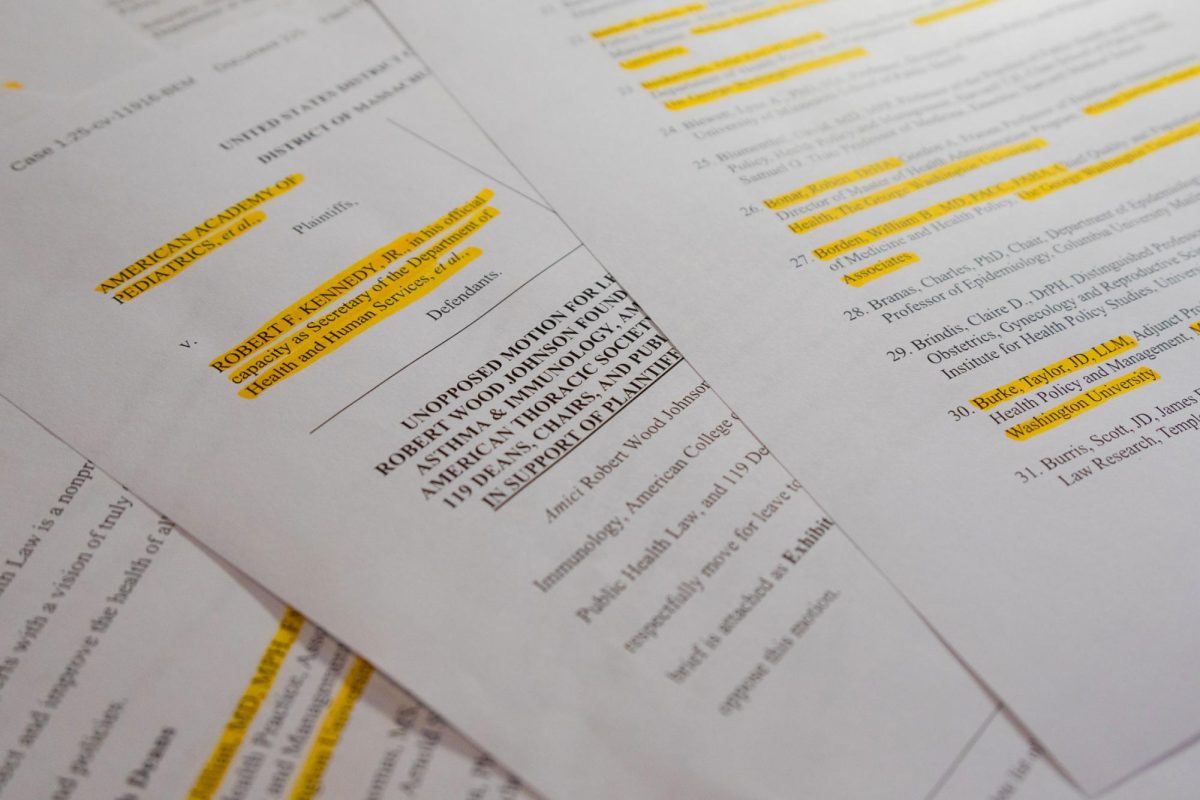
More than 40 faculty joined five public health organizations in filing an amicus brief earlier this month, warning that Health and Human Services Secretary Robert F. Kennedy Jr.’s May changes to the childhood vaccine schedule endanger public health.
The brief supports a lawsuit filed last July by public health organizations, including the American Academy of Pediatrics, and spearheaded by GW Law professor Richard Hughes IV, challenging Kennedy’s decision last May to roll back COVID-19 vaccine recommendations. The brief — signed by 43 GW faculty, including 39 from the Milken Institute School of Public Health — urged the judge to weigh the consequences of abandoning routine vaccine recommendations for serious childhood diseases, citing lower vaccination rates, added strain on pharmacies and weakened protections for immunocompromised individuals.
“Defendants’ actions will depress vaccination rates and cause increased vaccine-preventable outbreaks, preventable hospitalizations, and unnecessary deaths,” the filing states.
Kennedy, who has expressed skepticism of COVID-19 vaccines, in May announced that the CDC would stop recommending routine COVID-19 vaccines for healthy children and healthy pregnant women, citing a lack of “clinical data” to support giving the boosters to children. The lawsuit alleges Kennedy did not consult with the CDC’s Advisory Committee on Immunization Practices before ordering the change, violating the Administrative Procedure Act and requesting the judge pause the order.
The brief expands on the lawsuit’s argument by denouncing Kennedy’s subsequent changes to the pediatric vaccine schedule, like removing the vaccines for hepatitis A and B, influenza, rotavirus and meningococcal disease from the routine schedule. HHS now designates the vaccines as shared clinical decision-making vaccines as opposed to routine vaccinations as recommended by the ACIP. Vaccines on the ACIP’s routine schedule are recommended by a physician at pediatric check-ups for all children, but the CDC only recommends SCDM vaccines to some children based on risk or other factors.
Over 110 public health professors and leaders across the country signed the brief, along with five organizations — the American Academy of Allergy, Asthma & Immunology, Robert Wood Johnson Foundation, American College of Chest Physicians, American Thoracic Society and Network for Public Health Law.
An amicus curiae, or “friend of the court,” brief is an additional filing by an outside party to support one side of a case by providing relevant information before a ruling, sometimes sharing expert knowledge. Foley Hoag LLP is representing the amici.
The brief argues these changes go against scientific evidence of the vaccines’ safety, efficacy and public health benefits and that the changes will reduce pediatric vaccination rates and endanger public health, and the changes did not consider the effects on parents, providers and state and local governments.
Sara Rosenbaum, former professor emerita of health law and policy at Milken, led the development of the brief as part of the Public Health Deans and Scholars Amicus Briefs and Public Comments Project. The project, Rosenbaum says, aims to ensure that public health information is available to courts in significant national cases.
“This case raises such essential issues that an amicus brief was more than necessary,” Rosenbaum said.
Rosenbaum, who signed the brief herself, said the changes to the vaccine schedule pose a threat to vaccine access and will make it harder for children to get appropriately vaccinated while causing greater difficulty in the decision-making process for parents because the SCDM is time consuming for doctors and patients.
“They have injected mass confusion into millions of families,” Rosenbaum said. “Life is already confusing, now because of the reclassification of vaccines from routine to shared clinical decision making.”
A University spokesperson said the views expressed in the brief are those of the faculty members who signed it and do not necessarily reflect the views of the University.
“George Washington University supports the academic freedom of its faculty to engage in research, scholarship, and public discourse, including participation in legal filings such as amicus briefs in their individual capacities,” the spokesperson said.
The University is not directly involved in this filing, though GW has previously filed and joined amicus briefs opposing President Donald Trump’s administration policies in his first term. GW signed an open letter last June that called on Congress to block a proposed $18 billion budget cut to the National Institutes of Health. Last April, University President Ellen Granberg signed a letter that said “federal overreach” in higher education was “endangering” universities.
Faculty have also previously signed onto amicus briefs, including in 2025 when the Supreme Court considered whether states could remove Planned Parenthood from Medicaid programs.
Timothy Holtz, chair and director of GW’s Redstone Global Center for Prevention and Wellness, said he signed onto the brief because the “flood of changes” happening under Kennedy’s HHS, like the changes to the vaccine schedule, ignores “robust” scientific evidence about the effectiveness and safety of vaccines and that HHS has not provided scientific evidence that supports its changes.
“I’m extremely concerned and very worried that we’re going to see a return of a lot of vaccine-preventable diseases, not just in children, but also in young adults, for example, meningitis, as well as older adults,” Holtz said.
Hughes, the GW Law professor representing the plaintiffs in the case, said the judge has read the brief and said the filing shows the “very real damage” happening to public health because of how the vaccine schedule changes impact doctors and pharmacies and said the plaintiffs are “thrilled” to have the support of scholars in health, law and policy.
“I’m especially appreciative to my fellow GW faculty for their support in this important case,” Hughes said in an email.
Maureen Byrnes, a teaching instructor in the Department of Health Policy and Management, said she signed the brief to document the evidence and science of the historic effectiveness of childhood vaccines.
“I’m deeply concerned about the health of the children who will not be vaccinated, the health of other children who can’t be vaccinated for health reasons, and their potential exposure and the potential for diseases to spread on a larger basis that we know can be preventable,” Byrnes said.
Byrnes said she has signed onto amicus briefs in the past in support of public health and said the brief’s use of science, evidence and data will strengthen its argument.
“Based on my public health policy experience and knowledge, this is an opportunity to be able to use that experience and knowledge and scholarship to inform important policy decisions,” she said.