


GW’s total international student population fell by more than 10 percent this fall following visa changes and a travel ban under President Donald Trump, Vice President and Dean of Enrollment Management and Student Success Jay Goff told the Faculty Senate Friday.
Goff, in a presentation on 2025 enrollment data, disclosed that GW enrolled 392 fewer international students this fall than last year, the first significant drop in international enrollment since the COVID-19 pandemic in 2020 and 2021. He largely attributed the decline to federal visa policy changes and immigration rules since Trump returned to power in January, but said the University continues to seek students from a broad range of countries as the number of students from China — traditionally GW’s largest cohort of international students — drops nationwide.
GW enrolled 3,281 international students from 140 countries this fall, 392 students and two countries less than the 3,673 international students who enrolled in 2024, according to enrollment data. Despite this, Goff said officials enrolled a “very strong class” of undergraduate international students this fall, which he called a “surprise” as officials were “very concerned” enrollment would decline similarly to international graduate enrollment over the summer due to visa delays following Trump’s travel ban.
Total international undergraduate enrollment rose by 27 students in 2025, from 804 students to 831 students, according to GW’s enrollment dashboard. GW enrolled 293 fewer new international graduate students this year, from 1,003 in 2024 to 710 in 2025, according to Goff’s presentation.
“As I shared with the senate last spring, we were on track for a strong international intake and our diversification strategy has been very effective,” Goff said. “However, the visa delays clearly impacted both new and continuing international enrollments, particularly in graduate programs.”
Trump’s travel ban bars or limits entry to the United States for citizens of 19 countries and includes new vetting processes that Goff said in July would delay the return of dozens of international students to campus. He said at the time students weren’t able to schedule visa appointments until August, which would result in their late arrival to campus or request to defer their enrollment.
International student enrollment last dropped at GW by 20.5 percent in 2020 and 7.5 percent in 2021 due to worldwide travel restrictions during the COVID-19 pandemic. After 2021, international student enrollment increased each year before dropping in 2025, according to enrollment data.
International students from India and Saudi Arabia experienced the sharpest decline in enrollment this semester, according to Goff’s data. GW’s international student population from India, traditionally the second-largest demographic of international enrollment at GW, dropped almost 32 percent, from 813 students in fall 2024 to 553 students in fall 2025.
The University saw a nearly 19 percent decline in Chinese international enrollment this fall, from 833 students in fall 2024 to 676 in fall 2025, per the enrollment data. For students from Saudi Arabia, the University’s population declined by more than 23 percent, from 170 in fall 2024 to 130 in fall 2025.
At the same time, the number of international students from Zimbabwe rose 141 percent, from 63 students in fall 2024 to 152 in fall 2025 — the largest increase in students from any country.
Goff also highlighted officials’ progress with its undergraduate enrollment objectives put in place following the COVID-19 pandemic, which include restoring full-time enrollments, maintaining and improving GW’s academic profile, expanding national reach, diversifying international markets and increasing access and student success levels. Goff did not discuss the University’s sixth post-pandemic goal to increase student diversity, even though it was one of the objectives officials set to work on from 2021 through 2026.
In 2024, Goff said the University met all its enrollment targets for the 2024 admissions cycle despite delays in federal aid applications and the Supreme Court’s decision to ban race-conscious admissions policies, where admitted underrepresented minorities actually rose to make up 25.7 percent of the Class of 2028. Goff’s presentation on Friday did not include breakdowns of student populations by ethnicity for the Class of 2029.
A University spokesperson said GW collects and reports a broad range of enrollment data, like students’ geographic backgrounds, academic interests, preparation and socio-economic status, as part of its academic, compliance and institutional research responsibilities, adding that not all data is included in every Faculty Senate presentation. They also said GW’s objective to diversify enrollments, as mentioned in prior Faculty Senate presentations, was specific to GW’s post-pandemic enrollment strategy, though they did not specify whether they document race or ethnicity.
“In this context, a set of maps were highlighted to show how diversification helped to expand University outreach into new domestic and international markets and increased support for academically qualified low-income and first-generation students, including those eligible for Pell Grants,” the spokesperson said in an email.
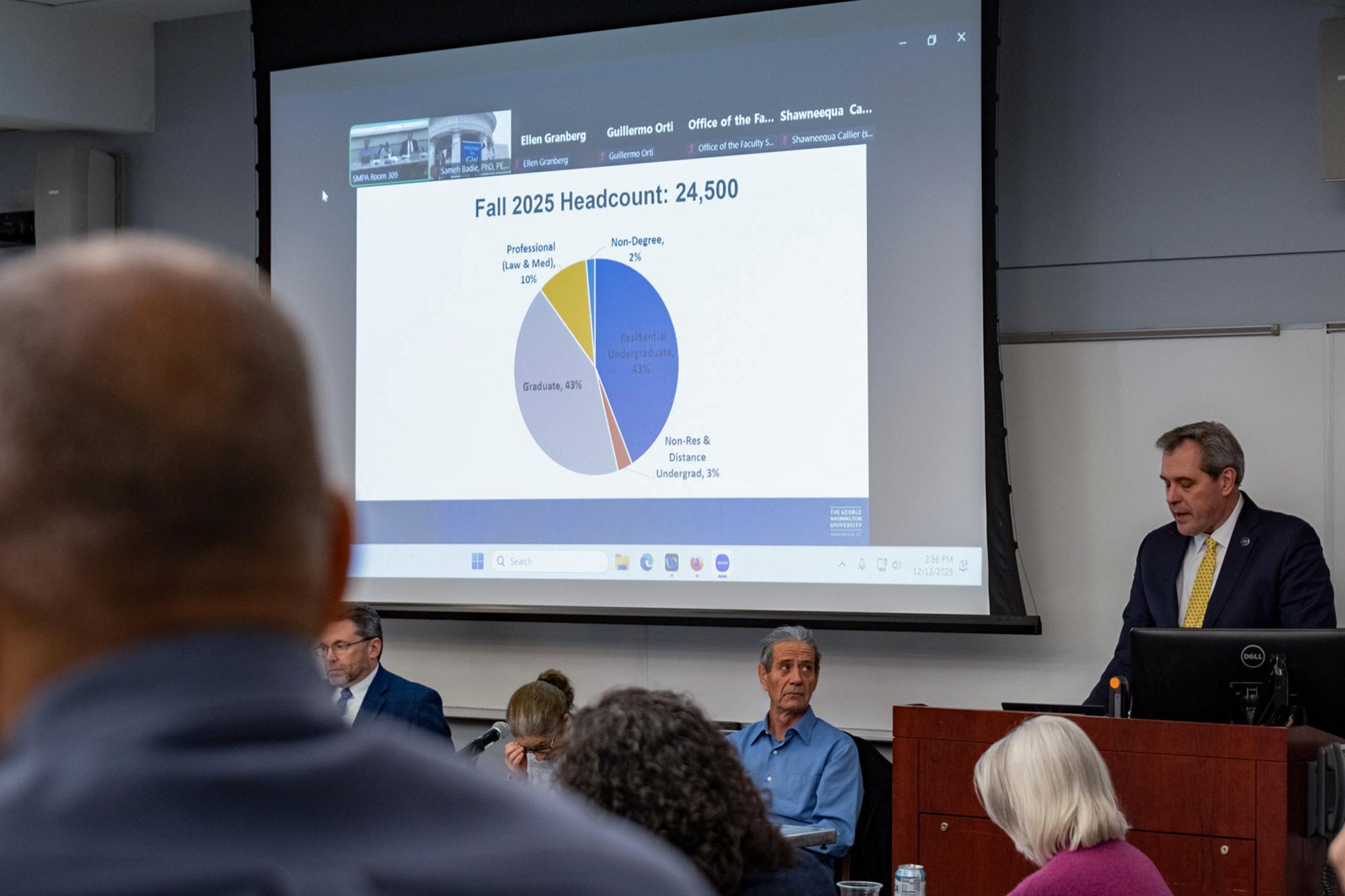
Goff said the University’s total enrollment stood at just over 24,500 students this fall, with residential undergraduates and graduates each accounting for 43 percent of the student body. In fall 2024, GW’s headcount stood at 25,374 total students, including 41 percent accounting for residential undergraduates and graduate students making up 44 percent.
Goff said GW’s domestic enrollment remains strong, with 21,219 students coming from all 50 states, Puerto Rico and other U.S. territories. He also said full-time domestic enrollment reached a new institutional record this fall at 15,726 students.
He said the University will launch a new private loan portal through the Office of Student Financial Assistance’s website by April to allow students to browse and apply to private loans vetted by GW — a move that comes after Trump enacted the One Big Beautiful Bill in July, which will implement borrowing caps and restricts federal loan borrowing for certain students.
The Grad PLUS program — which will phase out after July 1, 2026 — allows students to borrow up to the full cost of their graduate programs minus any financial aid. Goff said the change will require many graduate students to turn to private lenders for loans.
“What this does allow is that future students will be able to borrow up to their cost of attendance, but instead of it being funded completely by federal loans, it will be funded by a combination of federal loans and private loans,” Goff said.
Rhonda Schwindt, a faculty senator from the School of Nursing, asked Goff how officials are considering marketing strategies to appeal to graduate students, given many may choose to go elsewhere because it’s less expensive. She said marketing strategies could be helpful as part-time graduate student enrollment is already down and most nursing graduate students attend part-time, which also comes as the Department of Education removed nursing as a professional designation.
“I do think we’re going to have to come up with a really good strategy to communicate this particular message when it’s not consistent with the message that those of us in the profession are hearing on a nationwide scale,” Schwindt said.
Goff said faculty should ensure the graduate enrollment management teams at each school include updated information in their program communications, like about the University’s new private loan portal. He said the upcoming portal system will allow students to borrow from private lenders up to the full cost of attendance.
“What I would suggest is that you do is be as clear as possible that there’s no reason to panic,” Goff said.
University President Granberg — who attended the meeting virtually due to University travel to meet with alumni and donors — said she has no “definitive” update on interactions with the Justice Department after they found in August GW violated federal civil rights law by failing to combat antisemitism, seeking “immediate remediation” from the University. She said there was one additional outreach from the DOJ after the department thought University officials hadn’t initially replied, signaling the DOJ is “definitely showing signs of life.”
A University spokesperson in August confirmed officials were “in contact” with the DOJ after the deadline passed for GW to indicate interest in discussing a voluntary resolution agreement.
Granberg also said GW’s negotiations with Universal Health Services over ending the University’s financial support for the Medical Faculty Associates are continuing, and both sides have a “fair understanding” of each of their positions on critical issues. She said the parties are largely in agreement on the overall structure, but are still discussing details.
Faculty senators Phil Wirtz and Jamie Cohen-Cole raised concerns about the Joint Committee of Faculty and Students hearing a textbook affordability proposal from Follett ACCESS — a flat-fee textbook program that provides digital access to course materials, like textbooks, to students for $245 per semester — last month. Wirtz said the Faculty Senate’s Educational Policy & Technology Committee spent an “enormous” amount of time looking at the proposal starting in January, which included discussions with student leaders, where they ultimately decided the program had numerous flaws.
Granberg said students at the meeting last month weren’t all in agreement that Follett’s program was a good idea, though they wanted to discuss it, adding the committee has the ability to set their own agenda. Chief of Staff Scott Mory added that the Faculty Senate never passed a resolution against the adoption of Follett’s policy, allowing students to add the issue to their agenda.
“I think that’s exactly what the joint committee is there for, for issues to get raised,” Mory said. “I think, as the president indicated, the joint committee is not the final decider of anything.”
Lach announced officials will soon launch a formal search to fill the vice provost for faculty affairs position after officials appointed Emily Hammond to serve on an interim basis at the beginning of September. He said officials will soon create a search committee which will accept applications from internal candidates, who must be tenured faculty at the rank of full professors.
Zoomel Ghauri, Arunmoy Das, Hannah Marr and Fiona Riley contributed reporting.


