
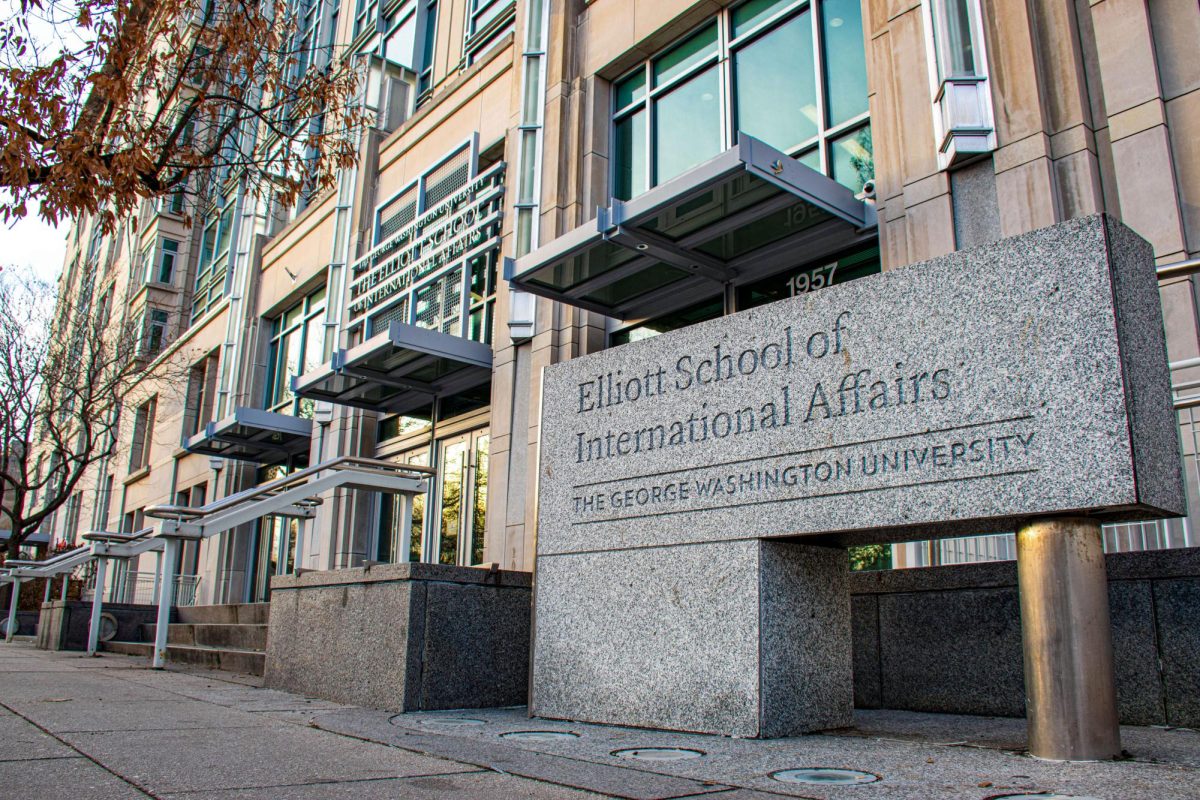
A professor in the Elliott School of International Affairs launched an initiative last week aiming to counter democratic backsliding from authoritarianism and poor human security through public events and student advocacy trainings.
The Athena Initiative will collaborate with various Elliott programs — beginning with the Institute for Middle East Studies — to hold events featuring foreign policy experts to discuss human rights and humanitarian issues stemming from ongoing conflicts. Shirley Graham, director of the initiative and a professor of international affairs, said her goal is to equip students with the information to confront what she sees as a rising global authoritarianism that impacts underrepresented groups, like women and girls.
Graham said the idea to create the initiative started from conversations with students and other faculty about the “authoritarian turn” happening globally, including in Iran and Afghanistan. Graham said GW’s Student Consortium on Women, Peace and Security, which she founded in 2021 to promote women in the study of national security, was a helpful resource for brainstorming ideas, including what to name the initiative.
“We wanted to create a space where we could convene conversations with different communities,” Graham said. “Particularly, places where we could bring in the perspectives and views of populations who are often underrepresented. And we wanted to really harness the energy of a sort of figure that could inspire us.”
Graham said while the Athena Initiative is not directly affiliated with other Elliott School programs, it is designed to work across the school’s academic programs since the events cover different countries and issues, like Middle East studies, women’s rights, conflict prevention and U.S. legislation about improving genocide and atrocity awareness.
“In all of these crises, the voice of the most marginalized people are the ones that are most silenced,” Graham said. “Here in the Athena Initiative, we will be centering those voices, particularly the voices of women and girls.”
Graham said students can get involved by attending the initiative’s events and incorporating what they learn into their class assignments to help raise awareness about human security, which refers to how people protect themselves when dealing with troubling events outside their control, like civil wars and food insecurity.
“It’s not all about women, peace and security, they’re just some of the events lined up in the near term,” Graham said. “But it’s a much wider topic, obviously.”
Graham said the initiative will also host Capitol Hill advocacy trainings where students learn how to brief congressional staff and support U.S. legislation that supports global peace and security. She said the training will walk students through the process of arranging meetings with staffers, presenting policy arguments and urging funding for measures like the Women, Peace and Security Act, the Global Fragility Act and the Elie Wiesel Genocide and Atrocities Prevention Act.
“A lot of students have said to me how frustrated they feel at the moment, and you know that they want to take action, and they’re not sure where they have power, what they can do and what specific action to take,” Graham said.
The initiative kicked off last Tuesday with a panel event about the September 2022 death of Iranian activist Mahsa Amini, which sparked massive protests in Iran in 2022 and 2023 when she died in police custody after they arrested her for not wearing her hijab correctly. Graham said at the event that there are multiple crises facing the world, including an escalation in “man-made” famines, genocide and an erosion of democratic institutions, reinforcing the importance of the initiative.
Just after the three-year anniversary of Amini’s death, Graham said it felt appropriate to honor her by kicking off the new program focused on human security and women’s rights with a panel focusing on Amini’s legacy and the Iranian women’s freedom movement.
“This was a good event to have as our inaugural event because it marked her death, which sparked the movement in Iran,” Graham said. “We wanted to honor her and bring in experts, who were Iranian, Iranian American or American, who had a lot of knowledge on this topic to really flesh it out for us because we often don’t hear enough about what’s actually happening to people on the ground in Iran.”
Sina Azodi, an assistant professor of Middle East politics, moderated the event, which featured panelists Barbara Slavin, a fellow at the Stimson Center, Shirin Saeidi, a professor at the University of Arkansas and Emily Blout, a professor at Georgetown University.
The speakers at the Tuesday event said that rising authoritarianism erodes basic freedoms, from women’s bodily autonomy to freedom of speech and described how Iranian women’s defiance and global solidarity movements challenge those crackdowns.
Slavin said Iranian women’s protests demonstrate a cultural shift that governments don’t have the power to reverse, noting that despite state attempts to monitor hijab-wearing, some Iranian women still protest the regime by opting not to.
“And sometimes your car gets impounded and sometimes a cafe gets shut down for allowing women to come in without hijab,” Slavin said. “But women are still going without hijab. They cannot force them back into it.”
Saeidi said freedom is a collective struggle that requires conversation between civil rights organizations and state officials and those in power, which she said is happening in Iran. She said more women are choosing not to wear the hijab and see it more as a lifestyle choice now rather than an act of protest.
“One of my co-authors in Iran told me yesterday, she said, ‘We feel like this is a new chapter. We feel like things are changing,'” Saeidi said.
Blout said the Iranian government’s response to protests over Amini’s death was “ruthless” and “relentless,” as Iranian officials’ security crackdown killed more than 500 people and saw over 22,000 detained. She said the protests first started in the Kurdish area of Iran where she was born, but they quickly spread to 81 cities in 31 provinces.
“They chanted, ‘Down with the dictator, down with the Islamic Republic,'” Blout said. “They set their headscarves on fire, and they cut their hair in protest.”
Blout said in an interview after the event that she was struck by how the initiative centers human security with a focus on women, like in Iran where the government imposed restrictive dress codes on women.
“I just want to applaud Dr. Graham and Dr. Azodi for thinking about this event and centering women and gender in this conversation because I think sometimes that’s lost in the mix,” Blout said.