
In the wake of conservative activist Charlie Kirk’s murder at Utah Valley University, security experts urge universities to conduct rigorous threat assessments for on-campus events and consider moving speaker engagements indoors to enhance safety.
Kirk’s assassination earlier this month marked the first time in recent memory that a speaker on a university campus was deliberately targeted and killed by an attendee, igniting a nationwide conversation around universities’ event safety protocols, especially for events with political speakers in outdoor campus spaces. Security experts say that in the face of this new threat, universities like GW that frequently host political speakers should enhance scrutiny in event planning by tailoring security measures to the likelihood of a threat when deciding to host outdoor campus events.
The national conversation around campus event safety comes amid reporting that Utah Valley University had less security than other campuses that hosted Kirk on his national tour — just six police officers for 3,000 attendees, according to Jeff Long, the campus police chief. The police force hasn’t said whether they swept nearby rooftops ahead of the event, including the university building from which the suspect shot and killed Kirk from hundreds of feet away.
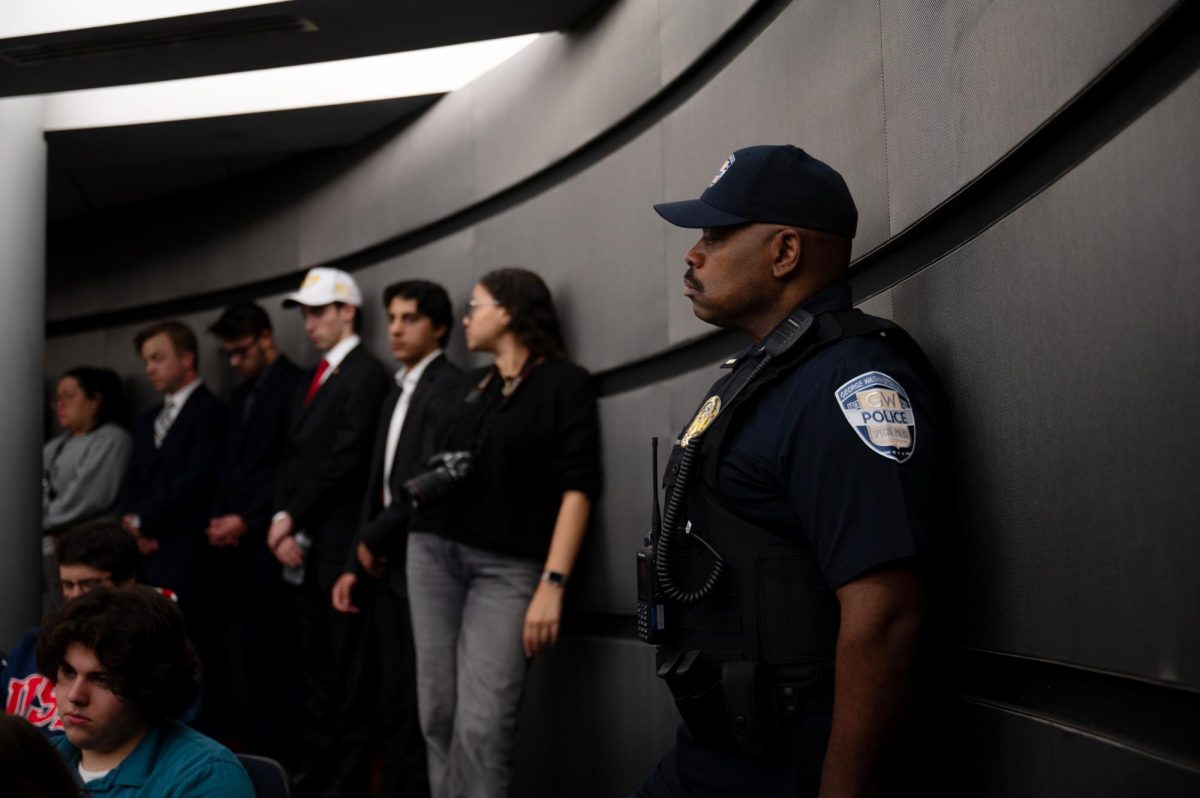
Last week, student organizers told The Hatchet that officials pledged to add metal detectors and bag searches at all speaker events hosted by GW College Democrats and GW College Republicans. University spokesperson Julia Garbitt said last week GW is working with “external partners” to evaluate and make any necessary changes to campus security measures.
Garbitt declined to comment on the University’s security protocol for high profile speaker events or if security protocols and safety measures will change in the wake of Kirk’s killing.
“We are evaluating each event in the current environment and working with external partners to determine and adjust security measures to take as appropriate,” Garbitt said. “We continue to work with individual event organizers to assess specific safety and security needs.”
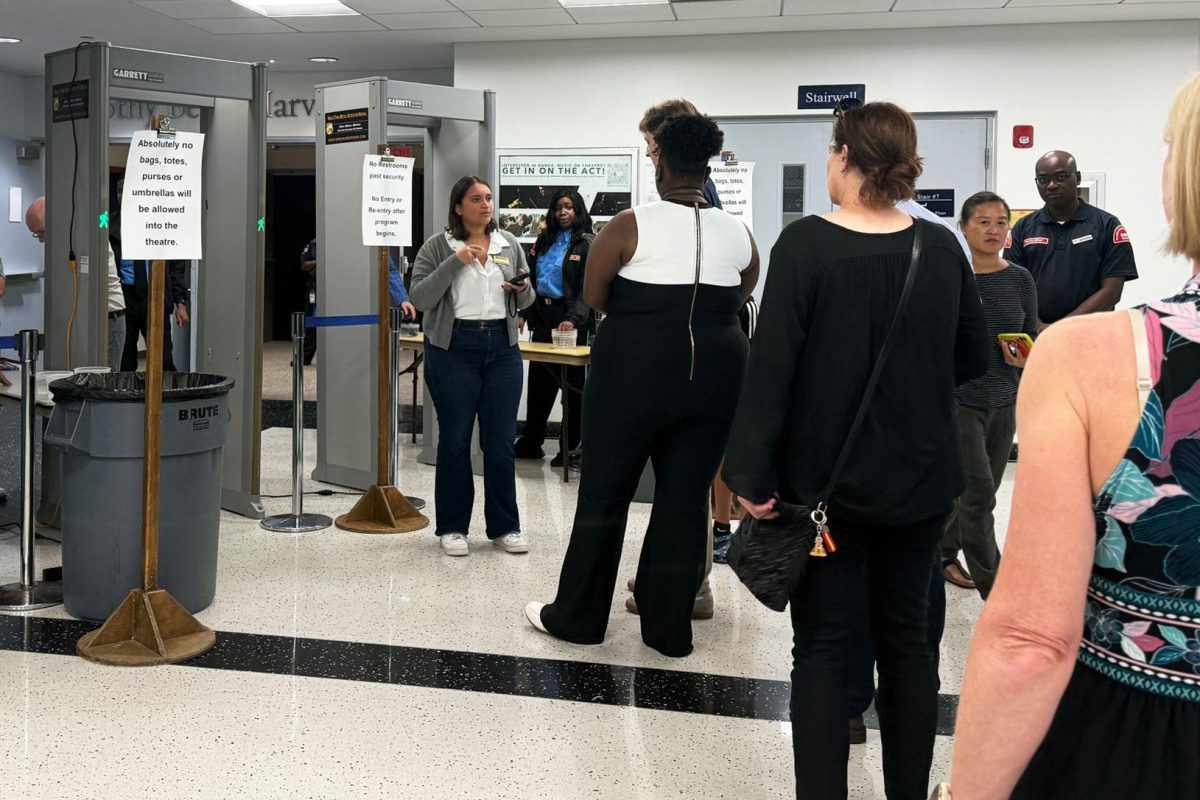
Supreme Court Justice Sonia Sotomayor and Judge David Tatel headlined an event hosted by Politics and Prose held Wednesday, which did not permit bags inside the Dorothy Marvin Betts Theatre in the University Student Center. Guests also passed through metal detectors when entering the venue.
During a vigil where about 100 people gathered in the basement of the School of Media & Public Affairs to remember Kirk’s life Wednesday night, a security guard was posted on the roof of Gelman Library.
Tin Nguyen — a principal investigator at the National Counterterrorism Innovation, Technology and Education Center and an assistant professor of psychology at the University of Nebraska at Omaha — said the concern around bolstering security measures at GW, a highly politically engaged campus located in the nation’s capital, will be greater than on other campuses. He said this difference stems from the University likely bringing in more political speakers compared to schools with a student body that’s less politically active.
In the past year, GW has hosted on campus political figures like the Croatian Prime Minister, Rep. Johnny Olszewski (D-MD), and Supreme Court Justice Sonia Sotomayor, as well as prominent speakers like Bill Gates and John Green.
Nguyen said enhanced security protocols, like GW’s pledge to add metal detectors and bag checks at political events, are likely to remain as long as the nation’s political climate remains polarized.
“If law enforcement and security folks are aware that speaker events are potentially more contentious or more politicized on this particular campus more than others, the concern around bolstering security measures is going to be a lot greater,” Nguyen said.
The Division of Safety and Operations oversees a special events task force, composed of “key representatives from across university operations” who review events expected to host more than 300 guests so GW can organize event safety and security, per the task force’s website.
DSO also administers a Threat Assessment Team to evaluate behavior that individuals perceive as warning signs for future violent or self-destructive actions, which can be “rapidly convened” to assess threats whenever they arise, the team’s website states. The team met last week in response to a staff post calling Kirk’s killing “fair,” officials said at a Staff Council meeting, and officials boosted security on the Mount Vernon Campus shortly after for at least two days.
But last October, half a dozen former GW Police Department officers said the force’s firearms training was lackluster and left them unprepared to respond to urgent emergencies, like an active shooter. Officers said they lacked in-person scenario-based training, which would involve the department practicing its response to an active shooter as a team in a more realistic setting.
Last Monday, GWPD Police Chief Victor Brito said at a Student Government Association meeting that only eight officers are currently armed, a fraction of the planned allotment.
Princeton University’s Bridging Divides Initiative, which offers policy solutions to mitigate “rising threats” against political officeholders, recorded a 74 percent rise in threats and harassment against local elected officials since 2022 in a May study.
Nguyen said politically active universities like GW should conduct “vulnerability assessments” to determine potential risks for attendees or speakers before hosting any further outdoor events to identify areas on campus that are more susceptible to high-elevation attacks, like the kind that enabled Kirk’s murder. He noted that resources and staffing on campuses, especially urban ones, where security might be pulled in different directions, is a challenge in conducting assessments.
While the bulk of speaker events are held indoors, GW hosts some events outdoors, like its annual Commencement ceremony on the National Mall.
“Many of the things that you typically hope security and law enforcement would do, they’re mostly just trying to be more meticulous about those things going forward,” Nguyen said. “In most cases, you’d still see similar practices in place, but the amount of attention and effort put into each of those different planning elements, I think, is going to be heightened for quite some time.”
Kenneth Gray, a retired FBI special agent and a professor of practice of criminal justice at the University of New Haven, said officials’ move to add bag checks and metal detectors at speaker events is “prudent” in light of Kirk’s murder. At Kirk’s event at Utah Valley University, event hosts did not check tickets at the door or screen attendees for weapons, which Gray said was a lapse in security, in addition to not clearing nearby rooftops.
He said any speaker likely to generate controversy or protest would likely require a higher level of security than just entry screenings, including stationed security personnel around the event’s perimeter.
Every outside speaker that a university brings in should undergo a threat assessment — a systematic process to evaluate potential threats aiming to reduce targeted violence — to determine those who may want to do the speaker harm, Gray said, which in addition to the extra security personnel, could get costly for the University.
In February, pro-Palestinian protestors demonstrated outside an event co-hosted by the Elliott School of International Affairs and the North Atlantic Treaty Organization.
“The assassinating of Charlie Kirk certainly brings this up as a concern,” Gray said. “But it doesn’t have to be somebody as controversial as Charlie Kirk to require this as a procedure. The security needs to be built into every event, no matter what the threat level is.”
Aaron Woodruff — the chief of police at Illinois State University, which hosted Kirk for an outdoor event in April — said Illinois State convened its event review committee to evaluate potential threats ahead of the event, a practice he’d recommend all universities implement when hosting large-scale speaker events.
Leaders of Illinois State’s chapter of Turning Point U.S.A. opted not to hold the event inside against Woodruff’s recommendation, he said. Rather than hosting the event inside, leaders shifted the event from the university’s quad, a wide-open space, to a more secure outdoor location with stronger camera coverage on nearby rooftops, he said. He added that the review also caused the force to bolster staff for crowd control and to safeguard Kirk from potential counterprotests.
“If we do a better job on the front end of identifying individuals who see violence as a solution to whatever problems or grievances that they have, then we’ll be going to be much more effective than trying to respond to these things after the fact,” Woodruff said.
Laura Beltz, the director of policy reform at the Foundation for Individual Rights and Expression, said GW would need to ensure safety through enhanced protocols without discouraging student groups from inviting speakers that may prompt pushback. She said the University shouldn’t push the higher security costs onto student groups because they may stop hosting events meant to spur dialogue.
She said she questioned whether GW’s pledged blanket policy of adding bag checks and metal detectors to all GW Republicans’ and GW Democrats’ speaker events is warranted, instead arguing that officials should review security risks on a case-by-case basis. She added that officials should engage with student groups who want advice on hosting controversial speakers that could prompt protests or hecklers.
“We want to handle that carefully to make sure that that sort of burden isn’t passed on to students and that the administration is handling that without bringing the content or the viewpoint of the speaker into account,” Beltz said.