
The Corcoran School of the Arts & Design will offer a new micro-minor in textile and dress studies starting next academic year.
Program Co-Directors Katrina Orsini and Bibiana Obler said they began developing the micro-minor, a collaboration between Corcoran’s art history program and The George Washington University Museum and The Textile Museum, nearly 2 years ago after students expressed heightened interest in fashion and textile courses. Starting fall 2026, GW undergraduate students can declare the nine-credit micro-minor made up of six existing art history and sustainability courses, including fashion histories, global textiles and responsible fashion.
The textile and dress studies program will be the fourth ever micro-minor available to students in the Columbian College of Arts & Sciences, adding to its existing disability studies, health equity and immigration and migration studies micro-minors. The school introduced micro-minors — a nine-credit credential comparable to a concentration — in fall 2021 to bridge a gap between the humanities and other academic disciplines by expanding interdisciplinary opportunities across departments.
Obler, an art history professor, said she and Orsini worked with officials like Corcoran Deputy Director Laura Schiavo, CCAS Vice Dean of Programs and Operations Kimberly Gross and Associate Dean of Undergraduate Studies Rachel Riedner to organize the curriculum after generating the concept for the program around 2 years ago based on existing coursework and student interest. Obler said officials gave them the go-ahead to launch the program in December after approval from art history faculty, the Corcoran Academic Committee and the CCAS Undergraduate Studies Committee.
“Students are coming to GW because of the textile museum, because of opportunities they’re having at the textile museum, except they’re interested in textile dress studies,” Obler said. “It seems like there’s this demand for it from the students.”
Obler said the program allows students to develop foundational knowledge of fashion and textiles because the courses offered survey multiple disciplines, including art history, anthropology and business, giving students the opportunity to learn about textiles through varying lenses.
“Many art historians work on textiles and dress studies to serve part of what we do as art historians,” Obler said. “We’re historians of visual culture and material culture.”
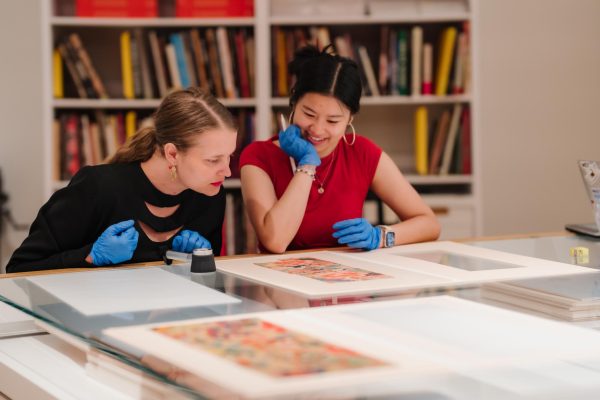
Orsini, a program associate for academic engagement at the textile museum, said students who add the micro-minor will study the fibers of varying textiles and their historical and cultural significance through an interdisciplinary lens by analyzing how textiles are impacted by their countries of origin, production process and distribution.
“We already have a number of offerings that students have become very interested in,” Orsini said. “It only made sense to kind of give it a name and make sure that students got credit for what they were learning about and taking classes in.”
After taking the required foundational course, Textiles 101: Fiber to Fabric, Orsini said students in the micro-minor will take elective courses from two groups — cultures and collecting, and production and impact — in which students will analyze fabrics and materials that carry cultural significance across different countries and the production of textiles over time.
Orsini said she plans to advertise the program during the various existing workshops the museum offers for students like weaving, activism through art and knitting, which she said draws thousands of GW students every year.
“So I can just advertise that every single time, ‘If you enjoy what you did here today, working with these textiles, and your history class, whatever it is, we actually have an entire micro-minor around this, and you can take classes dedicated exactly to this,’” Orsini said.
John Wetenhall, the director of the textile museum and associate professor of museum studies, said the new micro-minor aligns with the University’s commitment to “hands-on” experiential learning — as outlined in the new strategic framework — that a traditional classroom could not replicate.
“A micro-minor, however it’s packaged, creates access,” Wetenhall said. “It’s accessible to bring people in so that they are not intimidated in the world of textiles and have the basic understandings that they can build further more in depth knowledge.”
Thea Tejansie, a 2025 graduate who studied American studies and minored in sociology, said they are excited officials established the micro-minor because taking fashion and textile courses was the “best part” of their academic experience at GW, thanks to their relationships with faculty and engaging coursework. They said beyond academic engagement in responsible fashion and culture, they think the micro-minor will allow students to expand their professional scope by gaining an additional credential on their transcript.
“A lot of things gel well with the micro-minor as well, like American studies and sociology, in my case, pair perfectly with that minor, because textiles are cultural texts that you can analyze and talk about historically and what they mean in society in so many different avenues,” Tejansie said.
Audrey Emanuel, a senior studying art history, said students who enroll in micro-minor coursework will be able to take advantage of primary source research within the textile museum’s Cotsen Collection, a rare fabric collection that houses one of the biggest textile collections in the world at nearly 4,000 historical and cultural textiles. She said she thinks the micro-minor will provide students interested in textiles and fashion with more resources for their academic interests.
“We have amazing staff and an amazing faculty that can teach,” Emanuel said. “It naturally makes sense for GW to have an official course offering, or a degree offering.”