

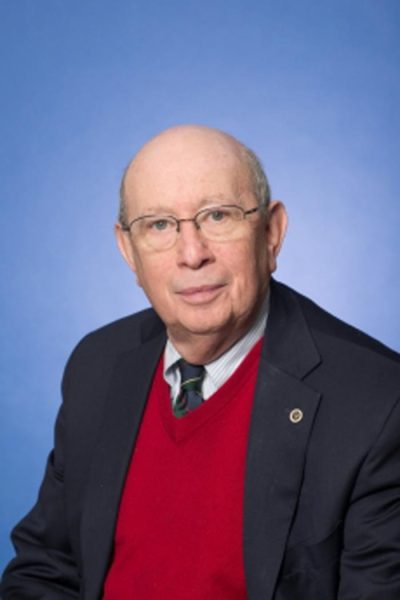
Ronald Spector, an esteemed emeritus history professor, war veteran and author, died on March 26. He was 83.
Spector — who taught history at GW from 1990 until he retired in 2020, serving as a department chair at one point — fought in the Vietnam War for over 13 months before becoming one of the first historians to study the war and its effects on the Americans and the Vietnamese who fought in it. His colleagues remember him as an engaging teacher and a humble presence in the department who never let his “distinguished” legacy as an author of critically acclaimed military history overshadow his interactions with peers and students at lunches and gatherings.
“He was a demanding perfectionist, which makes his books so amazing,” Thomas Long, a professor emeritus of history, said in an email. “At the same time, he was generous and friendly to all his students. He was a great role model and a wonderful friend.”
Born in Pittsburgh, Pennsylvania, in January 1943, Spector received his bachelor’s degree in history from Johns Hopkins University in 1964 and completed his doctorate in history from Yale University in 1967. The same year he graduated from Yale, he was drafted to the Vietnam War, where he served as a combat historian in the U.S. Marine Corps until 1969 and reached the rank of Major. He later joined the Marine Corps Reserve, retiring as Lieutenant Colonel, according to his obituary.
Spector authored several books on U.S. military history, including “Eagle Against the Sun: The American War with Japan” in 1985, which won the Theodore and Franklin Roosevelt Prize in Naval History. The New York Times called the book the “most concise and comprehensive” account of the Pacific Theater during World War II in a book review.
Spector also wrote two books drawing on his time as a combat historian in the Vietnam War, which unlike other scholars in the field who focused largely on the American perspective, put equal time into researching and writing about the Vietnamese — “Advice and Support: The Early Years of the U.S. Army in Vietnam, 1941-1960” and “After Tet: The Bloodiest Year in Vietnam,” according to his New York Times obituary.
Long said he met with then-chair Spector in 1999, who encouraged him to apply to GW as he was retiring from law and pursuing a doctorate in history, adding that reading “Eagle Against the Sun” influenced him to apply to the University. He said he took several classes Spector taught, with him also serving as one of his dissertation directors.
“He was an extraordinary researcher and an even better writer,” Long said in an email.
History Professor David Silverman said when he arrived at GW, Spector already had a reputation as one of the department’s premier scholars of military history. He said despite Spector’s stature as a premier historian, he always made time out of his busy schedule to meet and engage with new faculty, adding that Spector would schedule lunches with every single member of the department each year, which made a “real difference” in acclimating Silverman to the school.
“What I remember most fondly about Ron Spector were his wry, sardonic comments about the University administration and the department,” Silverman said. “He was a real crack-up that way.”
Silverman said Spector studied history the “right” way by using empirical evidence instead of allowing himself to be swayed by cultural or social expectations, while making his work understandable to a general audience.
“He believed that that’s part of what’s special about the practice of history, that we don’t have specialized language, that we produce scholarship that is accessible to everybody,” Silverman said.
He said veterans like Spector are becoming increasingly rare in the field of history, and he believes losing the perspective of people who fought for their country has made the field “worse off.”
“A sense of what the nation stands for and what’s required to keep it standing,” Silverman said. “I think there’s an appropriately deep skepticism about uncritical patriotism in the academy, and yet, at the same time, this is a place that allows us to do what we’re doing.”
Dane Kennedy, a professor emeritus of history and a friend of Spector, said Spector had a “wry disdain” for University administrators and preferred teaching to his role as chair. He said some students might have seen him as “curmudgeonly” at first, but they would always quickly warm up to his curious and engaged presence.
“It didn’t take long for smart students to realize how warm and wise and supportive he really was,” Kane said in his eulogy at Spector’s funeral, which he shared with The Hatchet. “Over the years, I’ve been struck by how many deep and lasting relationships he established with his students.”
Kennedy said he and his wife bonded with Spector and his wife over their shared political commitments and love for ethnic foods, like Chinese, Indian and Uyghur restaurants. He said family was their greatest “shared delight,” and they’d often share stories about their children’s careers and grandchildren.
“Family meant everything to Ron, and I’m sure he was comforted in his final days with the knowledge that he had left such a lasting, loving legacy,” Kennedy said in his eulogy.
Denver Brunsman, an associate professor and the chair of the history department, described Spector as one of the “pillars” of the department, adding that when he first came to GW, Spector immediately reached out asking to get lunch, a tradition the two continued until Spector’s retirement.
“He was the most famous member of the department, based on his bestseller ‘Eagle Against the Sun: The American War with Japan,’ but you wouldn’t have known it by his down-to-earth nature and kindness,” Brunsman said.
Before coming to the University in 1990, Spector taught at Louisiana State University from 1969 to 1971 and the University of Alabama. He also worked at the U.S. Army Center of Military History from 1986 to 1989, where he was the first civilian to serve as Director of Naval History and taught at the National War College and the Army War College from 2005 to 2006.
Hope Harrison, a professor of history and international affairs, said unlike most academics, Spector was very social, constantly getting lunch with colleagues and hosting parties with his wife at their house for faculty.
“Going through a heart transplant and then cancer, he never complained and was incredibly brave,” Harrison said in an email. “He was a model human being.”
Gregory Daddis, a professor of American history at Texas A&M University, said Spector was a “phenomenal” historian, and his work regarding the Vietnam War continues to be “indispensable” for historians working in the field.
He said Spector’s book “After Tet: The Bloodiest Year in Vietnam” was instrumental in pushing for a new way of studying military history, where the broader effects of war on a society, beyond what happens on the battlefield, are studied.
“Ron’s perceptive, compassionate approach to history will last as a standard in the field and endure as essential reading for understanding how war and human history are inexorably linked,” Daddis said in an email.
Spector is survived by his wife Dianne, his sister Carol, his brother Richard, his sons Daniel and Jonathan and his four grandchildren and was buried at Arlington National Cemetery last month.


