
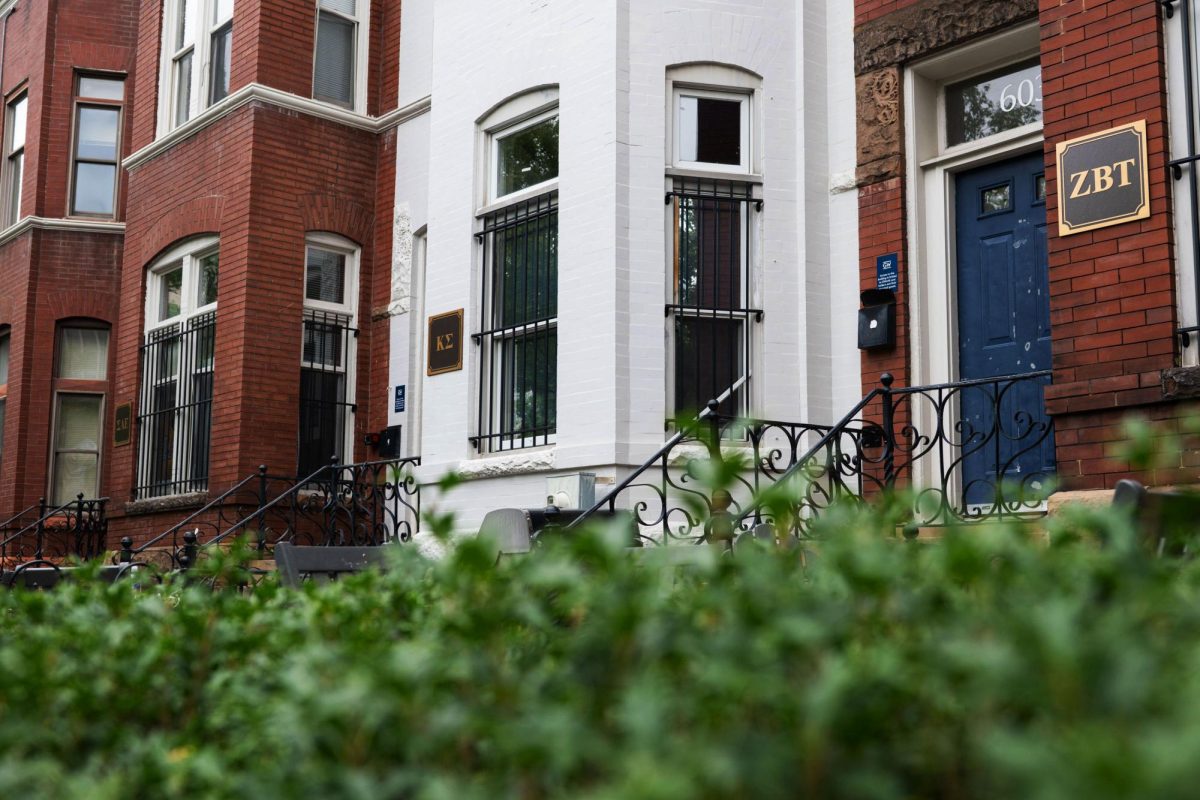
GW’s fraternities will recruit first-years during the fall semester for the first time since 2017.
The Interfraternity Council, the body that oversees social fraternities at GW, announced the change for eight of the nine chapters in an Instagram post earlier this month. IFC President Trex Jones said the council and each of its nine member chapter presidents made the decision to expand eligibility in order to provide more rush opportunities for first-year students who want to join Greek life, with the options to rush in the spring and in the fall now available to first-years.
The IFC said in the post that first-years can only rush for eight of its nine member fraternities, except Sigma Alpha Epsilon. The IFC declined to comment on why the eligibility shift does not apply to SAE.
In 2017, a task force — including Greek and non-Greek affiliated students, parents, faculty and staff — recommended the University add a requirement that students must complete 12 credits before joining any Greek life on campus, which the Division for Student Affairs then implemented. Then-Director of Student Life and Greek Life Christina Witkowicki said the shift was made to allow time for first-year students to acclimate to campus before joining Greek life.
The only exception to the policy came in the wake of the COVID-19 pandemic in fall 2021, when officials temporarily lifted restrictions during the 2021-22 academic year to help first-year students better acquaint themselves with GW’s campus following a year of social isolation. The shift applied to all Greek life chapters that hosted formal recruitment, mostly social fraternities and sororities in the IFC and Panhellenic Association. Officials reinstated the 12-credit policy for the 2022-2023 academic year.
University spokesperson Skyler Sales said officials support the IFC’s decision to permit fall rush for first-years. She said Greek life councils and individual fraternities and sororities have their own specific eligibility requirements, like GPA minimums, but all potential new members must also complete requirements set by the Division for Student Affairs, including an online module on fraternity and sorority life and a registration process, a policy that has been in place in years past.
In the eight years since officials implemented the 12-credit requirement, different fraternity and sorority councils have slowly rolled back the rule. The Multicultural Greek Council and National Pan-Hellenic Council do not currently have any credit requirements, hosting an “individual membership intake process” throughout the year, according to then-Director of Fraternity and Sorority Life Brian Joyce in 2021.
The Panhellenic Association is now the only Greek life council on campus that requires a 12-credit minimum for students to rush, maintaining the policy that was instated in 2017. University officials removed the 12-credit requirement for the Panhellenic Association for the 2020-21 academic year as sororities in the association turned to informal recruitment, after the formal recruitment process saw a continuing decline.
Sales said the DSA works with each council and chapter on campus to ensure Greek life meets the needs of first-year students.
“Allowing first semester students to participate in recruitment or intake can have a positive impact on their student experience, provided that councils and chapters have a well-developed and intentional recruitment process,” Sales said in an email.
Jones said the IFC and chapter presidents made the decision to expand eligibility to give first-year students the opportunity to rush for a fraternity during a semester that best fits their schedule. He also said he believes expanded rush options will increase interest in Greek life on campus.
Jones said the decision to shift eligibility was approved by a vote of the presidents of the nine fraternities in the IFC, but did not comment on which fraternities voted for or against the shift.
“We stand by the fraternity presidents’ decision on this change,” Jones said in a text message.
Jones said the IFC did not campaign to shift eligibility. He said there has been no change in the planning process for fall rush, only that first-year students can now participate in fall recruitment instead of just spring recruitment.
Jacob Weiss, a first-year student, said he’s excited to start the rush process in the fall as opposed to the spring because he’ll be able to go through the process with his friends attending other universities at the same time. He said fall rush will help him bond with his home friends when they return for breaks later on in the academic year, especially the fall semester, because they’ll be in step throughout the recruitment process and joining Greek life.
Weiss said first-year students are still looking for their social circles on campus, so the opportunity to join a fraternity in the fall would open up paths for social connections on campus with the network of brothers.
“I think coming in with the idea that everyone’s here to make new friends will help everyone get to know each other better in the fall,” Weiss said.
When officials reinstated the 12-credit policy after the brief 2021 pause, IFC recruitment plummeted from 121 in fall 2021 to 22 accepted bids in fall 2022. However, spring recruitment later that academic year neared pre-pandemic levels, with 156 students participating in the bidding process, and 116 students accepted bids.
IFC recruitment then doubled in fall 2023, with over 90 students participating in the process and 53 students accepting a bid. For fall 2024, however, recruitment numbers fell again, with 51 students participating in recruitment and 26 accepting membership.
Weiss said since he’s from the Midwest, he grew up surrounded by Greek life at universities near him. He said he has friends and family who have rushed for fraternities in the fall at their respective universities, so it’s been present in his social life as well.
Brian Murphy, a sophomore and member of Sigma Chi, said the expanded eligibility will be an opportunity to expand Greek life’s footprint on campus, adding first-years rushing in the fall will spread the word about Greek life on campus and then increase recruitment in the spring.
Murphy rushed in spring 2025, when the IFC saw 8.3 percent growth in recruitment. 91 students accepted bids from eighth fraternities out of 93 students who received an offer.
“If people like what they enjoy, then I think it will promote more people to rush in the spring,” Murphy said.
The most recent recruitment process in spring 2025 exceeded spring 2024’s 84 accepted bids, with 91 students accepting membership in eight IFC fraternities, but has not matched the post-pandemic record set during the fall 2021 recruitment process.
Over 1,300 undergraduate students participate in Greek life at GW, comprising about 12 percent of the undergraduate population.
Stephen Garvey, a senior in Phi Gamma Delta, said the switch to fall rush is “the right choice,” adding it will help develop a community for first-year students early on in their college experience.
“It’s very important when you join college to find a community of friends and brothers,” Garvey said.
Garvey said very little about how the fall rush process has shifted for his fraternity, except offering more resources to first-year students who are just arriving at the University and exploring campus, like being an additional aid to first-year students as they transition to college life.
“We want to help the transition be as easy as possible, whether they join Greek life or not, join our fraternity or not,” Garvey said.