
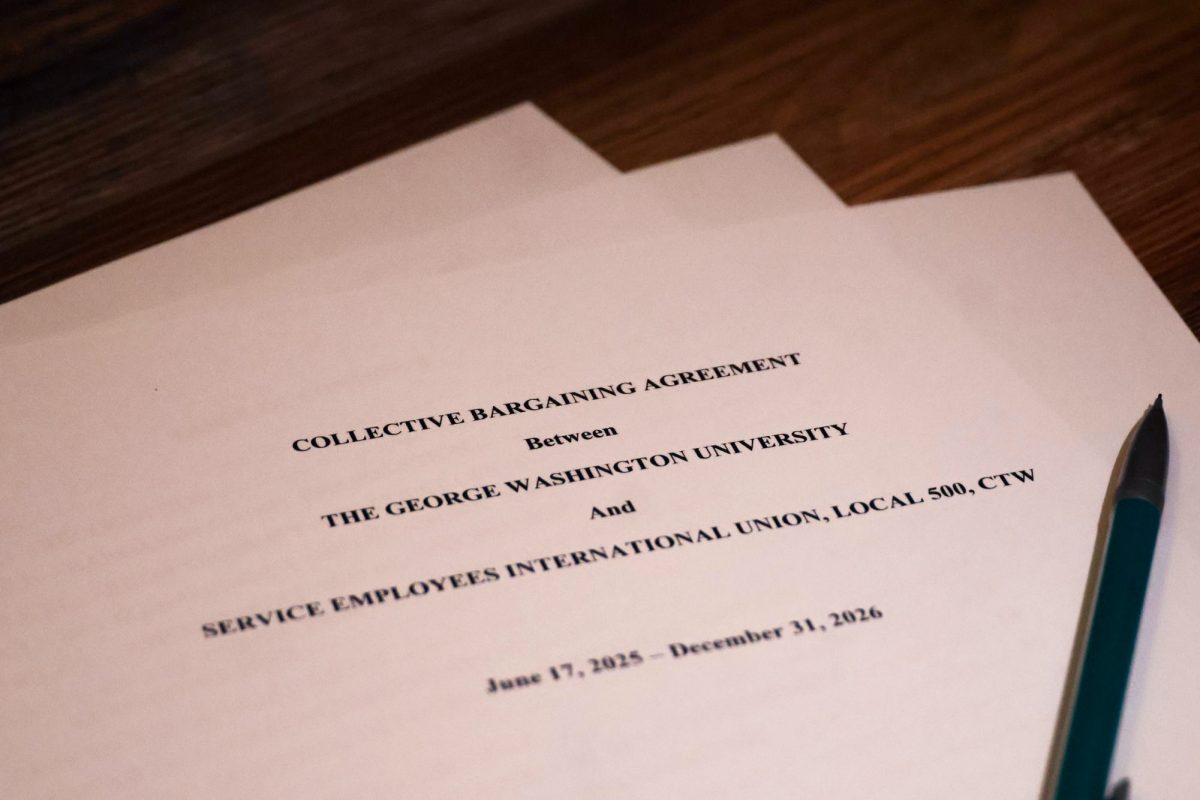
The new collective bargaining agreement for part-time faculty, in effect from June 17 through the end of 2026, increased the minimum pay by 4.5 percent for all part-time faculty, ending months of negotiations with the University.
The minimum pay increase applies to all part-time faculty, which includes adjunct professors, professorial lecturers and lecturers. But part-time faculty members said adjunct compensation often fails to reflect their class sizes and the significant work they do outside the classroom, and may not benefit those already earning above the new base rate.
The union, which formed in 2004 and affiliates with Service Employees International Union Local 500, had been bargaining with officials since October after the previous agreement expired in December. University Spokesperson Shannon McClendon declined to comment on when GW reached an agreement with the union.
Adjunct professors will make a minimum of $30,906 per year — up from $29,575 — and adjunct instructors will make $27,327 a year, up from $26,150. For teaching standard three or four credit courses, professorial lecturers will make a minimum of $5,225, and lecturers will make a minimum of $4,509 — an increase from $5,000 and $4,315, respectively, per the new agreement.
Per the agreement, GW defines adjuncts as regular part-time faculty members, with adjunct professors being professors with a terminal degree, which is generally defined as the highest academic degree someone can earn in a field, in their relevant field, while adjunct instructors do not have one. Both lecturers and professorial lecturers are paid per course, though the University defines professorial lecturers as those with a terminal degree, while lecturers don’t have a terminal degree in their field.
McClendon said the negotiations were “professional, collegial and collaborative.” She said the union and GW had “several factors” influencing their positions on contract terms like length and compensation, and GW remains “dedicated” to providing opportunities for part-time faculty and renewing contracts based on academic needs and financial conditions.
“Throughout negotiations, the University remained committed to fostering a good working relationship with the unionized employees while being responsive to their concerns and consistent with the University’s values,” McClendon said.
Union leadership members did not return requests for comment.
The salaries listed in the contracts are minimum rates, as the agreement states that the University is allowed to pay part-time faculty more money based on factors like experience and credentials.
The base pay numbers for GW lag compared to other D.C. universities, like Georgetown University, where adjuncts who teach 3 credit standard courses make at least $7,000, and are just short of American University, where professorial lecturers made a minimum of $5,400 last year for teaching a 3 or 4 credit course.
Part-time faculty will receive a $522.50 bonus — an increase from $500 — during the semester in which their tenth anniversary of teaching at GW falls, according to the agreement. The bonus will also be paid out for every subsequent ten-year anniversary.
The agreement allows faculty to be reimbursed up to $100 for membership costs to a professional organization or association relevant to the faculty member’s studies. Kip Lornell, a professor emeritus of music, history and culture and a member of the union’s bargaining committee, said in March that the union was pushing for reimbursement for member dues.
Colin Cleary, a professorial lecturer who teaches foreign policy in the political science department, said in an email that the pay for lecturers is “modest” compared to the time commitment and the number of students in a class.
“Lecturers do it because they want to engage with and help shape the next generation,” he said. “They — like full-time professors — are the tip of the spear. University administrators – some of whom make into seven figures – should reflect on the fairness of the pay scale for professional lecturers.”
Cleary said most lecturers teach out of a desire to offer students exposure to “real-world applications” of otherwise academic material.
He added that he feels like the amount lecturers make is inadequate, considering he usually has 37 students in a class and estimated the tuition students pay for just his class is much higher than the amount he makes.
Ellen Zavian, a professorial lecturer in law who previously worked on part-time faculty bargaining agreements at GW, said because some professors already make above the base level for adjuncts, the minimum base pay increases do not help them.
Zavian said the University shared certain salary data with the union but declined to say how many adjunct professors make above the minimum, but she said that there are “outliers” making as much as $175,000. She added that she felt like part-time faculty’s concerns, including growing class sizes and pay raises that didn’t account for inflation, weren’t properly addressed during past negotiations, which she said is why she no longer works on negotiations
“They’re running in a circle,” Zavian said. “Unless the faculty is willing to stand up to GW, then they’re letting us on the run.”
Zavian said GW “adds additional people” into part-time faculty’s classes and only gives extra help if a faculty member reaches a certain number of students.
“GW does not adequately comprehend the amount of work done outside the classroom,” she said.
The new agreement requires GW to keep part-time faculty email accounts active for one year following the end of the semester in which the departing faculty member taught. Under the old agreement, GW only did this for faculty who had a “reasonable” expectation of reappointment and did not specify for how long.
In a new change, the agreement states that part-time faculty with emeritus status get library access.
The amount of money in the professional development fund that faculty can use to be reimbursed for activities like attending industry conferences stayed at $50,000. GW will provide the union with a breakdown of how the funds are spent within 30 days of the end of each fiscal year, which will include a breakdown of the applicants, the requested amount and whether each applicant’s request was approved or denied, according to the agreement.
The agreement will remain in effect until Dec. 31, 2026, but will expire only 18 months after its enactment. The previous two agreements lasted from November 2022 to December 2024 and from November 2018 to June 2021, respectively.
Lornell said in March that agreements usually last three years but that officials and the union were discussing a shorter agreement with the option to reopen the agreement for finances.