

Readers’ pick: Nicole Bartels
Nicole Bartels has to relearn the American presidency every year.
Bartels, an assistant professor of political science, has taught classes on the executive branch at GW for the past seven years but said that teaching the course during Donald Trump’s presidencies has uprooted everything she thought she knew about executive power. She said Trump’s early-term actions and the reverberating impact of his return to power have dominated recent conversations in her course The American Presidency.
“I had a student ask me once, ‘What did you talk about in this class before Trump was president?’” Bartels said. “And I was like, ‘Not that much.’ It was not that exciting, but now it really is.”
She said that before teaching at GW she worked on a presidential campaign, in the office of Sen. Ed Markey (D-MA) and at the Alzheimer’s Foundation of America doing government relations. She said she pivoted to the classroom after helping teachers with curriculum development and found that her background “resonates” with politically engaged students.
“I think that that gives me kudos with them, and then luckily, people pay attention to that,” Bartels said.
Bartels said she does not have a doctorate like most political science professors, but her real-world experience helps her seize her students’ attention. She said her previous teaching experience at the U.S. Naval Academy from 2015 to 2020 was more “conservative” than GW, and the academy’s rules forbade criticism of Trump.
“At that point in time Donald Trump was in the office 1.0, you could not talk about the commander in chief in a negative way,” Bartels said.
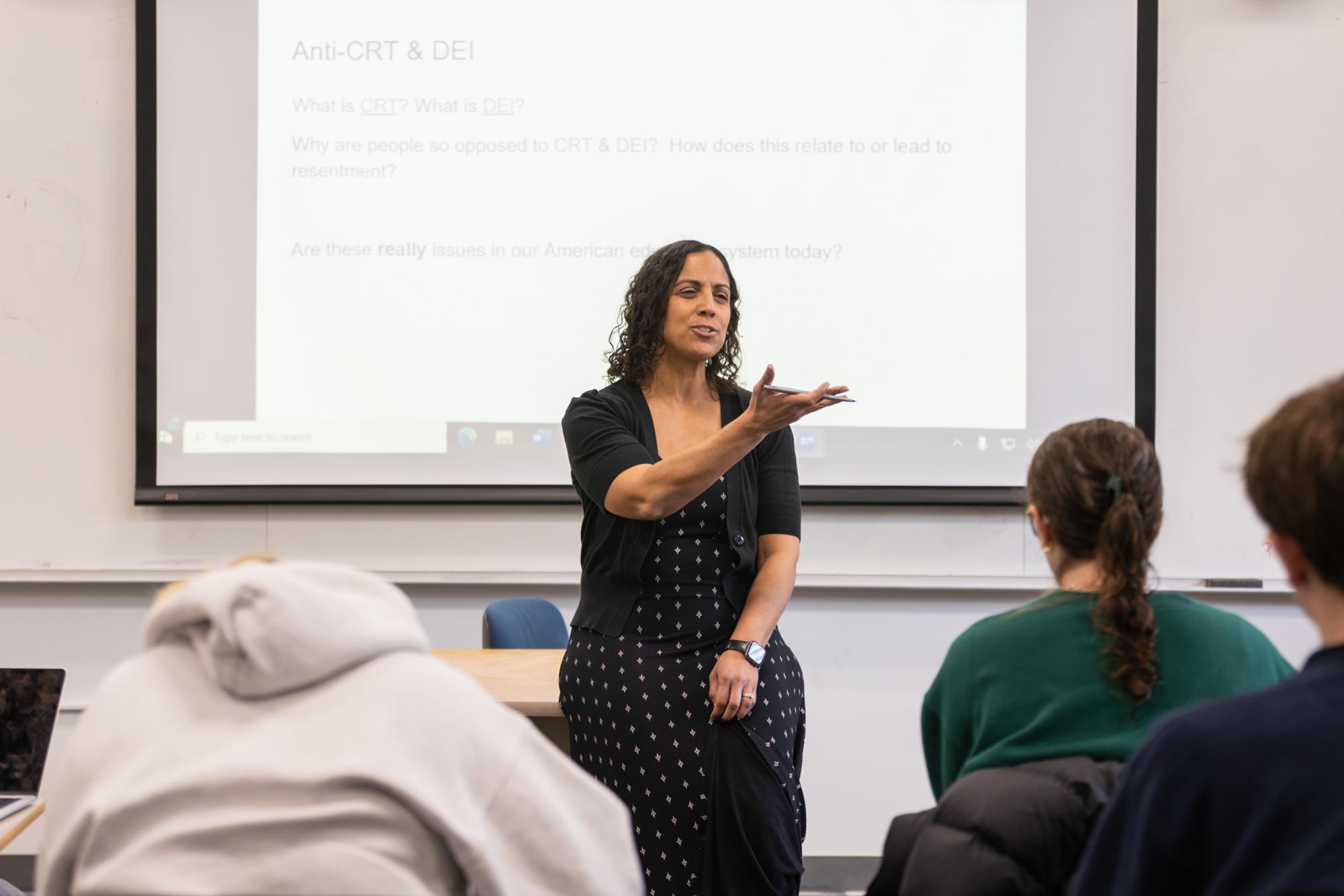
Bartels said she previously taught Introduction to American Politics and Government, an introductory lecture for undergraduate political science majors that usually fills almost 300 seats. But Bartels, whose classes are full of questions from eager political buffs on topics spanning from elections to legislative vetoes, said she decided the broad lecture covered too many topics with not enough time.
She said the more narrowly focused classes she teaches now, like those on the presidency and women in politics, make her life “easier” because they are tied to the current news cycle and spark student curiosity.
GW is a school positioned to monitor changing political trends, and Bartels’ understanding of that makes her a beloved instructor among students. She said her favorite course to teach is The American Presidency, where she and students examine the executive branch’s authority and how executive policy making and personality make its mark on the office. Bartels said students question the scope of executive powers and the president’s relationship with the other branches, as seen in Trump’s constant expansions to executive power, and the role is “constantly in flux.”
Bartels stands out among her peers because her teaching style is almost the exact opposite of the top-down executive decision making she teaches about. Bartels said even with the small lecture classes of about 40 students, her courses are “open” and “discussion-based” and utilize socratic seminars, simulations and breakout groups.
“I’m teaching them, like the things that come into play when you think about a presidential nomination, but they’re doing it in a way that’s much more engaging, interactive, and they’re talking to each other and then they’re like, ‘Oh, actually, if you think about, the Senate, might do this,’” Bartels said. “So it just is much more student-led.”
Unlike some professors who check out as soon as class ends, Bartels is always reachable outside of the classroom. Bartels said she has an “open door policy” for her Monroe Hall office, encouraging students to talk with her about class and topics outside of the classroom. She said she wants students to be honest with her when they’re confused and always pauses class for even the smallest questions. She said she is inspired by her students’ knowledge and continues to leave every day feeling fulfilled.
“You have to put in the work, but I try to make it so I can create a vibe and an environment where you can feel comfortable and be successful,” Bartels said.